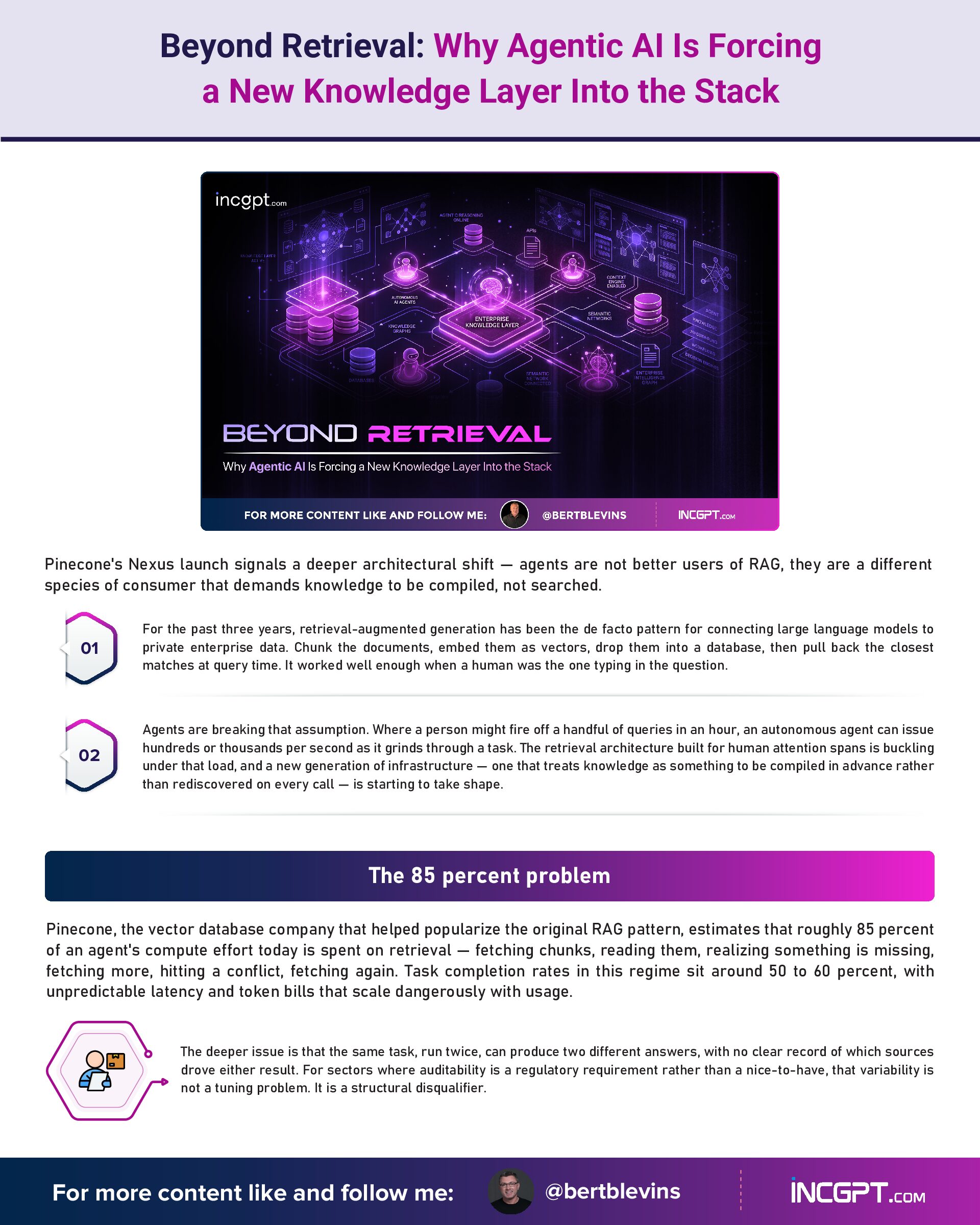
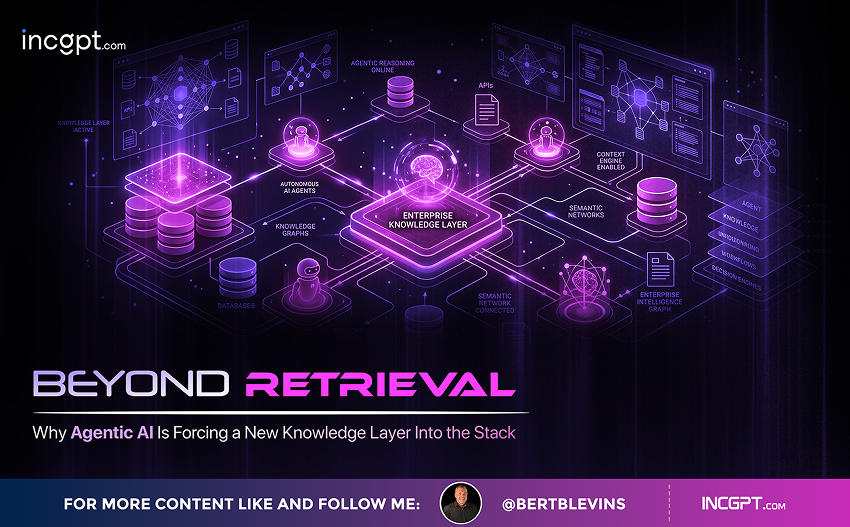
Beyond Retrieval: Why Agentic AI Is Forcing a New Knowledge Layer Into the Stack
Pinecone’s Nexus launch signals a deeper architectural shift — agents are not better users of RAG, they are a different species of consumer that demands knowledge to be compiled, not searched.
For the past three years, retrieval-augmented generation has been the de facto pattern for connecting large language models to private enterprise data. Chunk the documents, embed them as vectors, drop them into a database, then pull back the closest matches at query time. It worked well enough when a human was the one typing in the question.
Agents are breaking that assumption. Where a person might fire off a handful of queries in an hour, an autonomous agent can issue hundreds or thousands per second as it grinds through a task. The retrieval architecture built for human attention spans is buckling under that load, and a new generation of infrastructure — one that treats knowledge as something to be compiled in advance rather than rediscovered on every call — is starting to take shape.
The 85 percent problem
Pinecone, the vector database company that helped popularize the original RAG pattern, estimates that roughly 85 percent of an agent’s compute effort today is spent on retrieval — fetching chunks, reading them, realizing something is missing, fetching more, hitting a conflict, fetching again. Task completion rates in this regime sit around 50 to 60 percent, with unpredictable latency and token bills that scale dangerously with usage.
The deeper issue is that the same task, run twice, can produce two different answers, with no clear record of which sources drove either result. For sectors where auditability is a regulatory requirement rather than a nice-to-have, that variability is not a tuning problem. It is a structural disqualifier.
Compiling knowledge instead of searching for it
Pinecone’s response is a new product called Nexus, which the company is positioning as a knowledge engine rather than a retrieval engine. The framing matters. A retrieval system finds documents and hands the raw text to a frontier model at inference time, leaving the heavy reasoning work to be done in the moment, every single time. Nexus pushes that reasoning work upstream into a dedicated compilation stage that runs before any agent ever asks a question.
During compilation, raw source data and a task specification are fed into what Pinecone calls a context compiler. The compiler iterates on different representations of the data, evaluates them against the task at hand, and converges on a curated artifact — a structured, task-optimized object that an agent can consume directly. The same underlying corpus can produce different artifacts for different roles. A sales agent might receive deal context stitched from CRM records and call transcripts, while a finance agent working off the same data lake gets revenue context that ties contracts to billing schedules.
Crucially, those artifacts persist. They are reused across sessions, users, and workflows rather than regenerated from scratch on every call.
The three pieces of the architecture
Nexus ships as three components that work together. The context compiler handles the heavy upstream work, turning raw documents into reusable knowledge objects. A composable retriever then serves those artifacts at query time with typed fields, per-field citations carrying confidence levels, and deterministic conflict resolution — meaning a given query against a given artifact will return the same answer every time.
The third piece is KnowQL, a declarative query language built specifically for agents rather than humans. It exposes six primitives — intent, filter, provenance, output shape, confidence, and budget — that let an agent describe in a single call exactly what kind of answer it needs, what sources it will accept, how confident the result must be, and how much latency or token spend is acceptable. Pinecone’s CEO Ash Ashutosh has compared the gap KnowQL fills to the role SQL once played for relational databases: before a shared interface existed, every application was forced to write its own data access plumbing from the ground up.
The numbers Pinecone is putting on the table
In one of Pinecone’s own internal benchmarks, a financial analysis task that previously consumed 2.8 million tokens through a conventional agentic RAG loop was completed by Nexus using just 4,000 tokens — a roughly 98 percent reduction. The company’s broader claims are more conservative but still aggressive: up to 90 percent fewer tokens per task, task completion rates above 90 percent, and time-to-completion that is up to 30 times faster.
These numbers come from internal testing rather than independent customer production deployments, which means they should be read as a directional signal rather than a guaranteed outcome. But analysts watching the space see the architectural argument as the more important takeaway. Stephanie Walter, who leads AI stack research at HyperFRAME Research, told VentureBeat that the real innovation is not the idea of moving reasoning upstream — semantic layers, ontologies, and data catalogs have chased that goal for years — but the productization of knowledge compilation as a first-class infrastructure layer that can be operated at scale without standing up a dedicated engineering team for every domain.
Gartner distinguished VP analyst Arun Chandrasekaran framed the technical shift in similar terms, describing it as a leap from simple retrieval toward enhanced reasoning. By embedding structural logic into the metadata layer, agents can navigate enterprise schemas more effectively and carry richer context into their decisions.
Why agents broke the old assumptions
Understanding why this architectural shift matters requires looking at how different agents are from human users. A person types a query, scans the response, and either acts on it or refines the search. Agents do something fundamentally different. They issue queries in tight loops, chain calls together, route between tools, and need their results in machine-consumable formats with reliable provenance attached. They cannot tolerate the kind of ambiguous, unranked text dump that a human reader can usually parse intuitively.
Long-context models were briefly seen as a way to skip the retrieval problem entirely — just stuff everything into the prompt and let the model figure it out. That position has not held up. Recent enterprise data shows interest in long-context-as-dominant-architecture collapsing as soon as buyers actually try to deploy it. The economics of pumping millions of tokens into every call do not work, and the precision still degrades. Agentic memory systems, often pitched as the next post-RAG paradigm, also turn out to depend on retrieval underneath. The infrastructure does not disappear; it just gets relabeled.
Vector search, in other words, is not going away. Pinecone is explicit that Nexus sits on top of its existing vector database rather than replacing it. Compiled artifacts are themselves indexed and stored as vectors. The compilation layer shapes and serves knowledge; the vector layer continues to handle scale, storage, and retrieval speed.
From governance theater to governed pipelines
For enterprise buyers, the real selling point of a compilation-stage knowledge layer is governance. When reasoning happens at retrieval time, every query becomes a small unsupervised act of inference with no clean audit trail. When reasoning happens once, upstream, the resulting artifact can be reviewed, versioned, permission-checked, and signed off before any agent ever touches it.
That distinction maps directly onto the kinds of capabilities that finance and risk teams care about — provenance, deterministic conflict resolution, field-level citations, and access control enforced at the artifact rather than the document level. Walter’s framing is that the value proposition is not faster retrieval, it is governed knowledge pipelines, and those are the capabilities that move agentic AI from experiment to approved enterprise deployment.
A broader infrastructure realignment
Pinecone is not the only company reshaping its stack around the agent era. The wider vector database market is in transition: hybrid retrieval, which combines dense embeddings with sparse keyword search and reranking layers, has become the consensus enterprise approach. Independent open-source projects like Hindsight are pushing structured agentic memory architectures that organize knowledge into separate networks for facts, experiences, opinions, and observations. Researchers including Andrej Karpathy have publicly experimented with markdown-based knowledge bases that an LLM curates and maintains itself, bypassing vector retrieval entirely for small to mid-sized corpora.
Different bets, same underlying observation. The original RAG pipeline assumed that a model needed help finding the right paragraph. Agents need something closer to a knowledge product — pre-built, governed, structured, and ready to consume — and the layer that delivers that product is becoming a distinct piece of infrastructure rather than a feature inside the database.
What this means for data teams
For engineering and data leaders, the practical question is not whether RAG is dead. It clearly is not; static knowledge retrieval over well-bounded corpora still works. The real question is whether the existing stack is structurally capable of pre-compiling knowledge for specific agent tasks, or whether it was designed exclusively for a human user who never needed that capability.
Teams that are running real agentic workloads on conventional RAG pipelines are most likely already feeling the tradeoffs in their token bills, their latency graphs, and their incident reviews. Tuning embeddings or adding another reranker will not close that gap. The shift Pinecone is articulating with Nexus, and the parallel moves from competitors, suggest that the next layer of the stack is one that did not exist a year ago: a knowledge compilation tier sitting between raw enterprise data and the agents that need to act on it.
The companies that recognize that layer as a first-class part of their architecture, rather than a clever add-on, will be the ones whose agentic deployments survive the move from pilot to production.