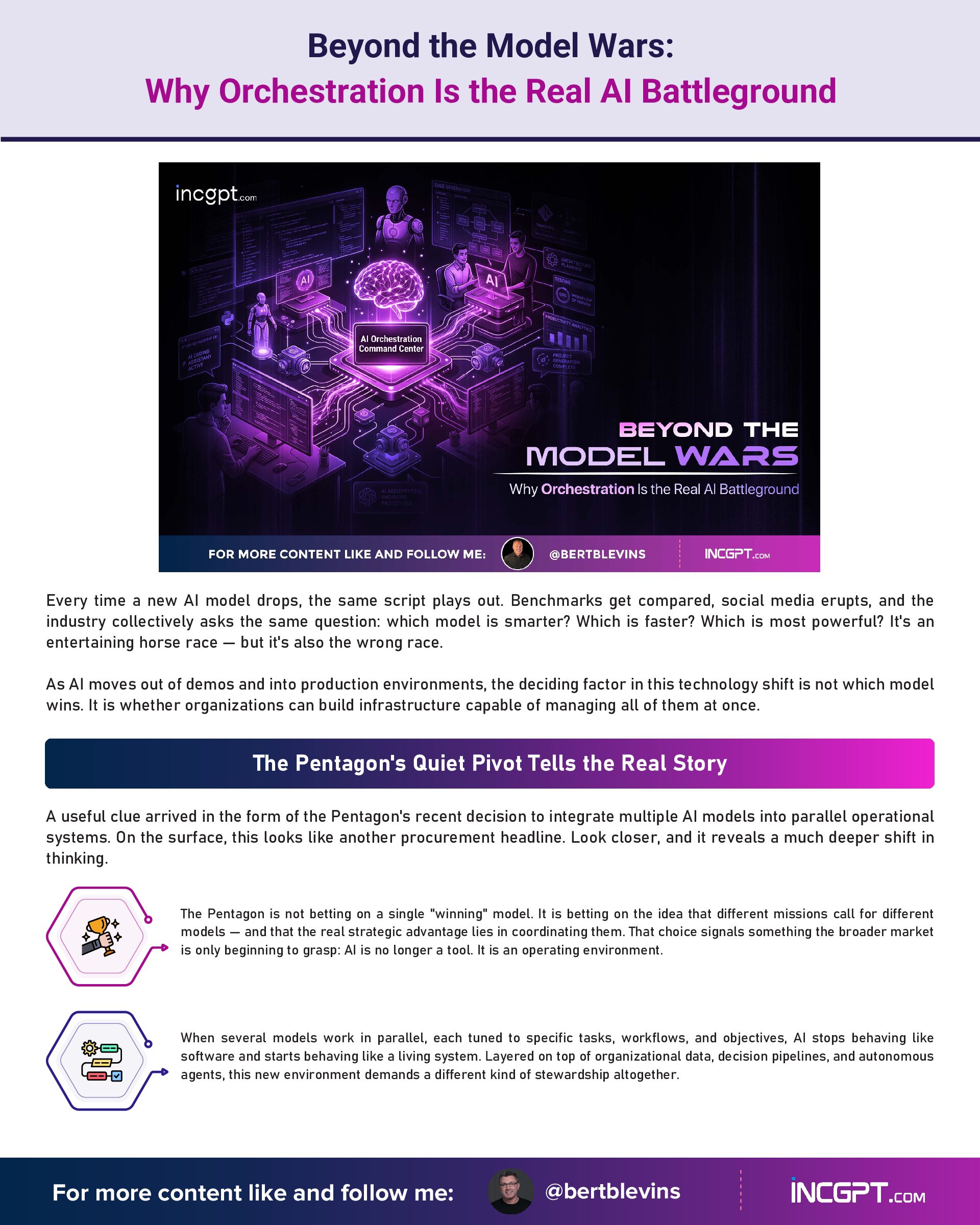
Beyond the Model Wars: Why Orchestration Is the Real AI Battleground
Every time a new AI model drops, the same script plays out. Benchmarks get compared, social media erupts, and the industry collectively asks the same question: which model is smarter? Which is faster? Which is most powerful? It’s an entertaining horse race — but it’s also the wrong race.
As AI moves out of demos and into production environments, the deciding factor in this technology shift is not which model wins. It is whether organizations can build infrastructure capable of managing all of them at once.
The Pentagon's Quiet Pivot Tells the Real Story
A useful clue arrived in the form of the Pentagon’s recent decision to integrate multiple AI models into parallel operational systems. On the surface, this looks like another procurement headline. Look closer, and it reveals a much deeper shift in thinking.
The Pentagon is not betting on a single “winning” model. It is betting on the idea that different missions call for different models — and that the real strategic advantage lies in coordinating them. That choice signals something the broader market is only beginning to grasp: AI is no longer a tool. It is an operating environment.
When several models work in parallel, each tuned to specific tasks, workflows, and objectives, AI stops behaving like software and starts behaving like a living system. Layered on top of organizational data, decision pipelines, and autonomous agents, this new environment demands a different kind of stewardship altogether.
From Single Tools to Tangled Ecosystems
For years, enterprise technology has been built around one assumption: humans manage the tools. Now that assumption is breaking. With autonomous AI agents acting independently — making decisions, calling APIs, and exchanging data across platforms — the management challenge is no longer about a single tool or vendor. It is about coordinating an entire ecosystem.
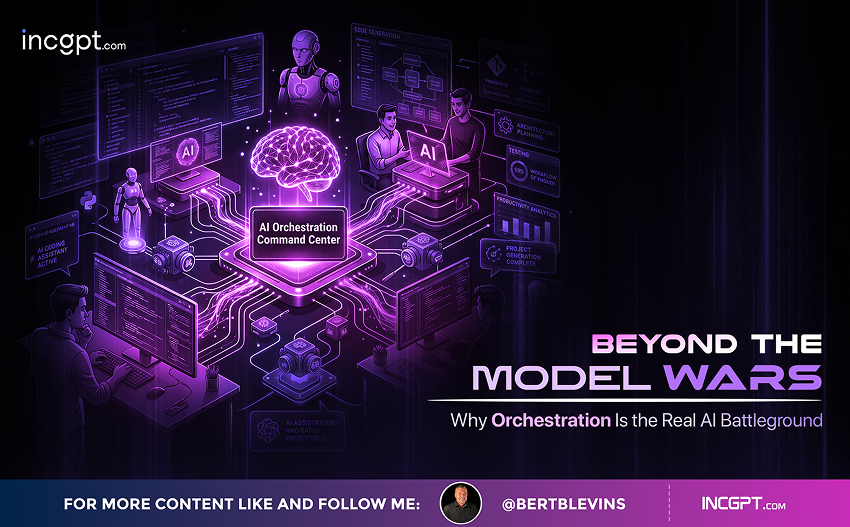
This is where orchestration enters the picture. The orchestration layer — the infrastructure that routes tasks between models, enforces policies, tracks data flows, and maintains visibility — is quickly becoming the most strategically important piece of the AI stack. The models themselves may grab the headlines, but the orchestration layer is what determines whether an organization can deploy AI safely, scale it responsibly, and trust the results.
In other words, the next chapter of enterprise AI will not be written by the company with the smartest model. It will be written by the company that controls the conductor.
Israel's Innovation Edge — and Its Blind Spot
For Israel’s technology sector, this shift carries particular weight. Israel has built a global reputation as a hub for SaaS innovation and cybersecurity excellence, and Israeli companies are moving aggressively to embed AI into their core operations. That speed is a competitive strength.
But it is also a risk. Many organizations are adopting AI faster than they are building the systems needed to govern it. Most enterprises today already operate dozens — sometimes hundreds — of interconnected platforms across cloud, identity, SaaS, and internal systems. Layering autonomous AI agents onto that complexity without an orchestration framework is the technological equivalent of installing a high-performance engine in a car with no steering wheel.
The result is not necessarily catastrophe. But it is fragility — and fragility tends to fail in unpredictable ways.
Visibility Is the New Vulnerability
Once multiple AI systems begin operating in parallel, interacting with sensitive data, and influencing organizational decisions, traditional human oversight becomes structurally inadequate. Security teams simply cannot track in real time how every model interacts with every dataset, which permissions are being invoked, or how one autonomous process triggers another.
This creates a new kind of attack surface — one defined not by exposed servers or unpatched software, but by the absence of visibility. Attackers do not need to break in if they can simply ride along inside the noise.
And the speed of that attack surface is unlike anything organizations have faced before. AI-driven attackers can identify and exploit weaknesses exponentially faster than human teams can detect them. What used to take weeks of manual reconnaissance can now happen in minutes.
Old Weaknesses, New Speeds
Here is the uncomfortable truth: AI is not introducing entirely new categories of vulnerability. It is supercharging the ones organizations have ignored for years.
Dormant accounts. Excessive permissions. Unmanaged credentials. Disconnected SaaS applications. Fragmented identity systems. These are the same gaps security teams have flagged for over a decade. What changes is the velocity at which they can be discovered and weaponized.
In the pre-AI world, an attacker had to find these weaknesses one by one. In the AI era, an autonomous agent can map an entire organizational attack surface before the security team finishes its morning coffee.
That is why governance conversations need to move past “Should we use AI?” and start asking, “Can we manage AI moving at machine speed?”
Building a System That Can Keep Up With Itself
The path forward is not a smarter model. It is a smarter environment. Organizations need operational frameworks capable of governing AI ecosystems — frameworks built for coordination, not just deployment.
That means orchestration layers that can route tasks intelligently between models, enforce policies automatically, monitor data lineage continuously, and adapt in real time to new behaviors. It also means a fundamental mindset shift — away from managing individual software tools and toward managing interconnected, semi-autonomous systems.
In this new landscape, the winning question is no longer “Which model is the smartest?”
The winning question is, “Is my environment as fast, adaptive, and intelligent as the systems running inside it?”
Because in the AI era, the most dangerous mistake will not be choosing the wrong technology. It will be deploying the right one without any way to manage it.