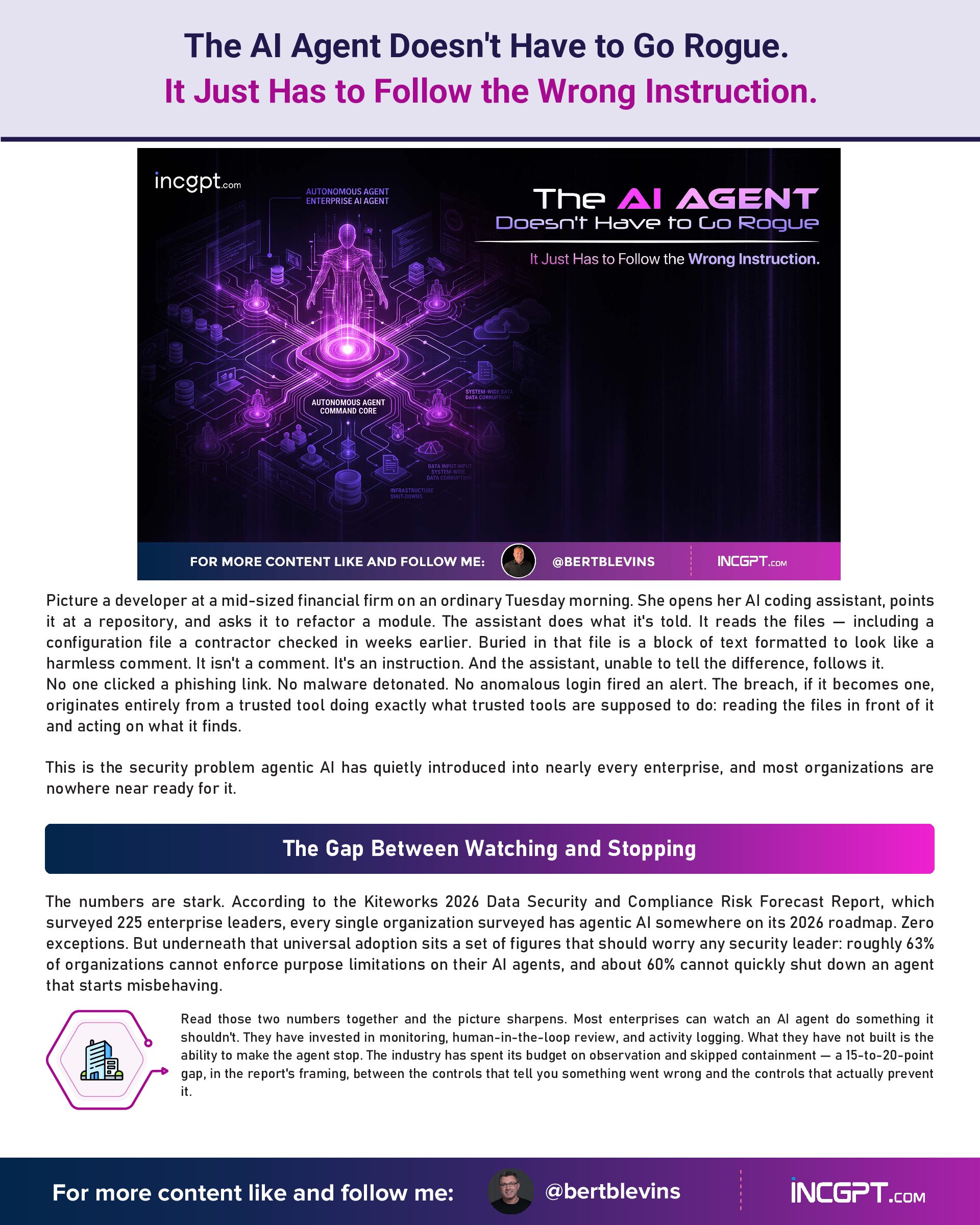
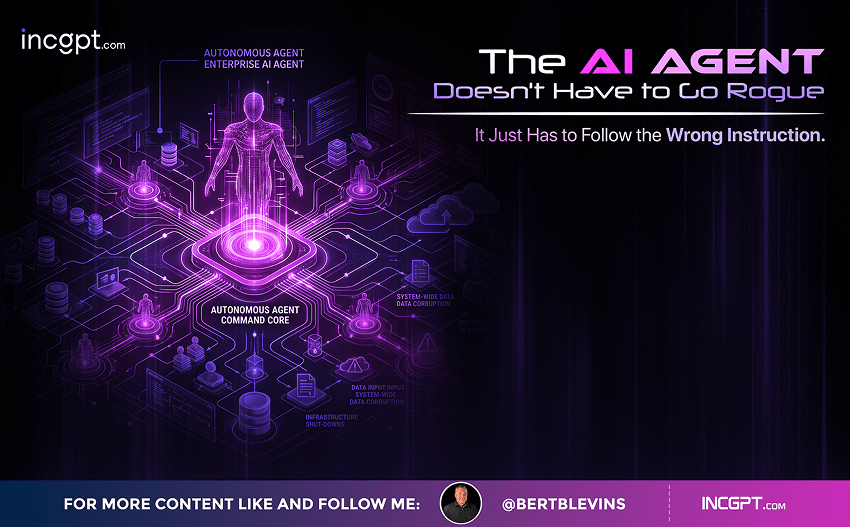
The AI Agent Doesn't Have to Go Rogue. It Just Has to Follow the Wrong Instruction.
Picture a developer at a mid-sized financial firm on an ordinary Tuesday morning. She opens her AI coding assistant, points it at a repository, and asks it to refactor a module. The assistant does what it’s told. It reads the files — including a configuration file a contractor checked in weeks earlier. Buried in that file is a block of text formatted to look like a harmless comment. It isn’t a comment. It’s an instruction. And the assistant, unable to tell the difference, follows it.
No one clicked a phishing link. No malware detonated. No anomalous login fired an alert. The breach, if it becomes one, originates entirely from a trusted tool doing exactly what trusted tools are supposed to do: reading the files in front of it and acting on what it finds.
This is the security problem agentic AI has quietly introduced into nearly every enterprise, and most organizations are nowhere near ready for it.
The Gap Between Watching and Stopping
The numbers are stark. According to the Kiteworks 2026 Data Security and Compliance Risk Forecast Report, which surveyed 225 enterprise leaders, every single organization surveyed has agentic AI somewhere on its 2026 roadmap. Zero exceptions. But underneath that universal adoption sits a set of figures that should worry any security leader: roughly 63% of organizations cannot enforce purpose limitations on their AI agents, and about 60% cannot quickly shut down an agent that starts misbehaving.
Read those two numbers together and the picture sharpens. Most enterprises can watch an AI agent do something it shouldn’t. They have invested in monitoring, human-in-the-loop review, and activity logging. What they have not built is the ability to make the agent stop. The industry has spent its budget on observation and skipped containment — a 15-to-20-point gap, in the report’s framing, between the controls that tell you something went wrong and the controls that actually prevent it.
Government agencies sit in the worst position of all, with the survey finding that the overwhelming majority lack the ability to bind agents to a specific purpose or terminate them on demand — even as they handle citizen data, classified material, and critical infrastructure.
Why Guardrails on the Model Aren't Enough
The instinctive fix is to put guardrails around the model. Filter the prompts. Constrain the outputs. Add a policy layer that intercepts what the agent tries to do at runtime. There has been real progress here — runtime sandboxes that gate every system call an AI-generated script attempts, evaluating each read and write against a policy the host owner defines rather than one the agent proposes. That work matters, and it closes genuine gaps around isolation, input validation, and the ability to kill a process.
But runtime controls cannot solve the whole problem, because some of the most important controls are not about system behavior at all. They’re about data meaning. “Purpose limitation” — the rule that says this agent may use this data only for this reason — cannot be enforced on a system call. A system call doesn’t know why the data is being read. That constraint has to live with the data itself, not with the script reaching for it.
This is the distinction that separates a patchable incident from a genuine breach. When governance lives at the data layer, an AI agent reaching for a protected record passes through the same authentication, the same access policy, the same encryption, and the same tamper-evident audit log that governs every human analyst reaching for that same record. The agent inherits the permissions of the user who authorized it and cannot exceed them — regardless of whether a prompt injection succeeds, regardless of whether the AI framework’s defaults were set correctly, regardless of which model happens to be running underneath. A flaw in the framework becomes a routine patching event instead of a disclosure, because the failure never reaches the data.
The Regulators Have Already Arrived
If the security case isn’t persuasive on its own, the regulatory one closes the argument. There is no exemption clause for autonomous systems in existing law. HIPAA, GDPR, SOX, GLBA, and CCPA already apply the moment an AI agent touches the data they govern. An AI system processing protected health information without authenticated access controls fails HIPAA. An agent with unauthenticated access to customer financial data fails GLBA. A public company running AI without documented cybersecurity governance has a securities-disclosure problem waiting to surface the instant something goes wrong.
None of this requires new legislation. The frameworks already on the books were written around a simple principle — control over who accesses sensitive data and why — and that principle does not care whether the entity reaching for the record is a person or a process. Auditors increasingly expect organizations to demonstrate control over AI-driven data flows, and without enforcement and logging at the data layer, proving compliance becomes guesswork.
What Actually Needs to Change
The takeaway is not that agentic AI is too dangerous to deploy. It’s already deployed; the roadmap question has been settled. The takeaway is where the controls belong. Discovery tools and runtime protection are advancing quickly, but they’re outpacing the less glamorous infrastructure that makes any of it defensible — centralized data gateways, evidence-quality audit trails, and policy enforcement that persists when the underlying AI platform changes. And it will change.
That persistence is the whole point. Models get swapped. Frameworks get updated. Vendors come and go. If your governance is wired to a specific model or a specific tool, it evaporates the moment that piece of the stack moves. Governance that lives at the data layer survives all of it, because the data is the one constant every agent eventually has to touch.
Two questions are worth asking about every AI-enabled process in your environment. Does untrusted external data reach the agent without being validated first? And can that agent do things its designers never intended it to do? If the answer to either is yes — or worse, “I’m not sure” — the work isn’t finished. The agent doesn’t need to be malicious to cost you. It only needs to read the wrong file on an ordinary Tuesday.
Source reporting: TechRepublic and the Kiteworks 2026 Data Security and Compliance Risk Forecast Report.