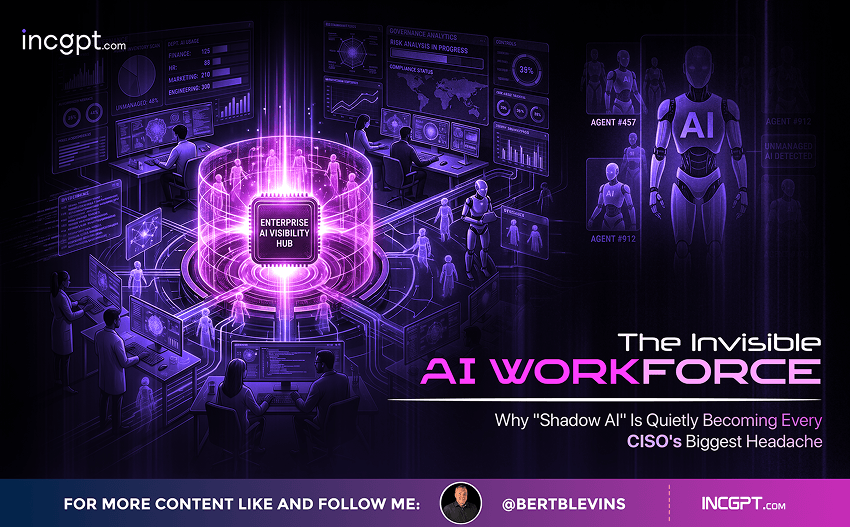
The Invisible AI Workforce: Why 'Shadow AI' Is Quietly Becoming Every CISO's Biggest Headache
Workers are pasting confidential data into ChatGPT, Gemini, and Claude without telling anyone. The productivity wins are real. So are the security holes.
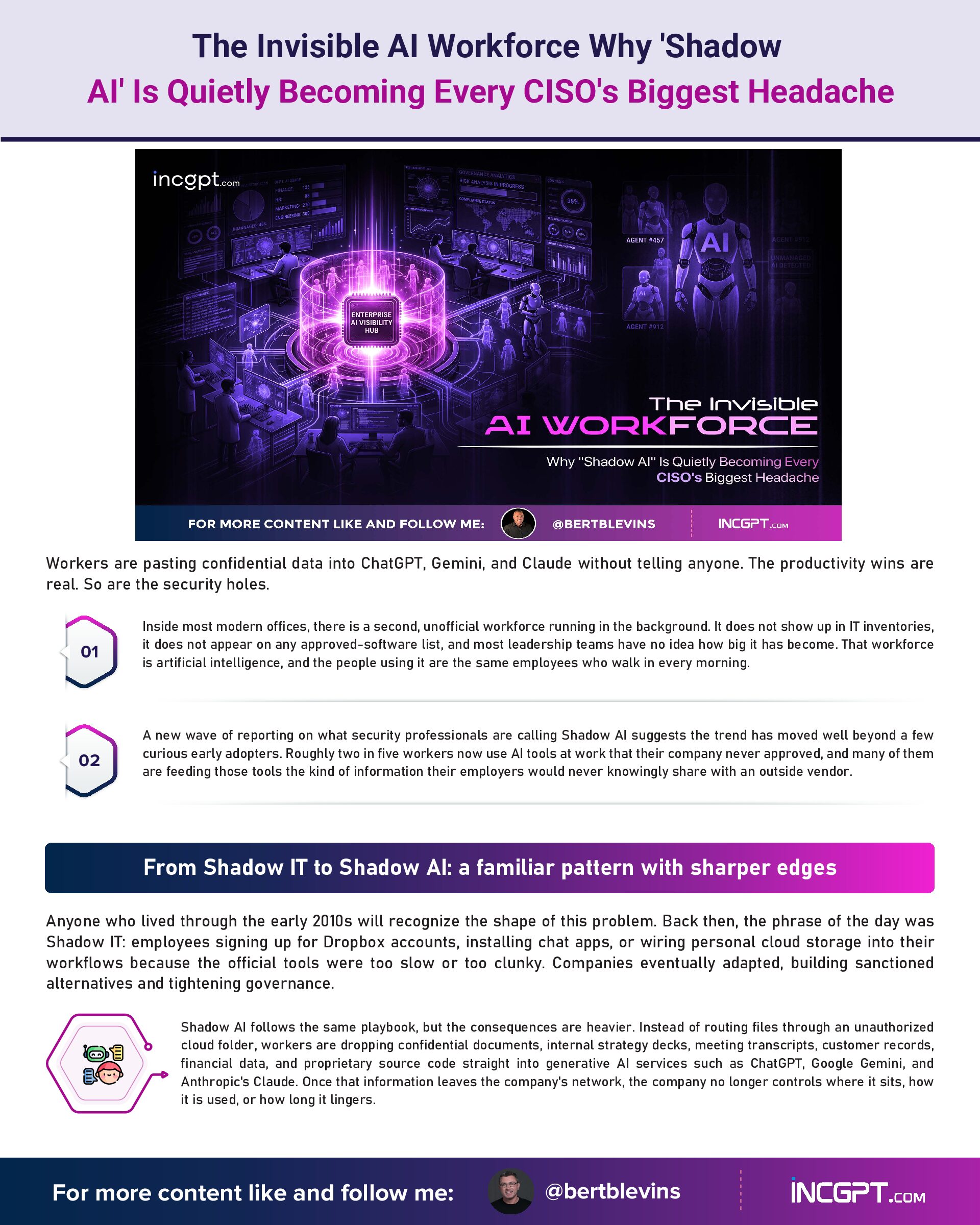
Inside most modern offices, there is a second, unofficial workforce running in the background. It does not show up in IT inventories, it does not appear on any approved-software list, and most leadership teams have no idea how big it has become. That workforce is artificial intelligence, and the people using it are the same employees who walk in every morning.
A new wave of reporting on what security professionals are calling Shadow AI suggests the trend has moved well beyond a few curious early adopters. Roughly two in five workers now use AI tools at work that their company never approved, and many of them are feeding those tools the kind of information their employers would never knowingly share with an outside vendor.
From Shadow IT to Shadow AI: a familiar pattern with sharper edges
Anyone who lived through the early 2010s will recognize the shape of this problem. Back then, the phrase of the day was Shadow IT: employees signing up for Dropbox accounts, installing chat apps, or wiring personal cloud storage into their workflows because the official tools were too slow or too clunky. Companies eventually adapted, building sanctioned alternatives and tightening governance.
Shadow AI follows the same playbook, but the consequences are heavier. Instead of routing files through an unauthorized cloud folder, workers are dropping confidential documents, internal strategy decks, meeting transcripts, customer records, financial data, and proprietary source code straight into generative AI services such as ChatGPT, Google Gemini, and Anthropic’s Claude. Once that information leaves the company’s network, the company no longer controls where it sits, how it is used, or how long it lingers.
The numbers leadership keeps underestimating
A survey conducted by CybSafe in partnership with the National Cybersecurity Alliance found that more than 38 percent of employees admitted to sharing sensitive information with AI tools without permission from their employer. That is one out of every two and a half people on the average payroll, quietly handing over data that may include client identifiers, internal pricing, code repositories, or HR records.
The scale is harder to detect than older shadow-tech problems because AI traffic looks almost identical to normal browsing activity. A browser tab, a personal account, or an installed extension can carry a steady stream of corporate data out the door without triggering a single alert. In many organizations, this means hundreds of employees are already using AI tools that the security team has never inventoried.
Why employees keep choosing the unsanctioned option
The simplest explanation is also the most uncomfortable for IT leaders: consumer AI tools tend to be better than the ones companies officially provide. Workers facing overstuffed inboxes, compressed deadlines, and constant pressure to deliver more with fewer resources have discovered that a quick prompt to a general-purpose chatbot can collapse hours of work into minutes.
AI is now genuinely useful for summarizing long meetings, rewriting emails, drafting reports, organizing scattered ideas, analyzing spreadsheets, sketching presentations, and accelerating coding. Once an employee experiences that lift in productivity, they rarely go back to a slower workflow just because the faster one is unofficial. If the corporate chatbot feels weaker than ChatGPT or Gemini, the corporate chatbot loses.
The real risk isn't the AI — it's what we feed it
Most coverage of AI risk focuses on the models themselves: hallucinations, bias, jailbreaks. Security researchers are increasingly pointing somewhere else: at the data employees voluntarily hand over. When confidential material is pasted into a public AI tool, several things can happen at once. The data may leave the corporate environment entirely, get stored on external infrastructure, trigger compliance violations under regulations such as GDPR or HIPAA, expose intellectual property to unintended parties, or breach contractual privacy commitments to clients.
None of that requires malicious intent. A well-meaning employee trying to save an hour on a quarterly report can effectively leak the same information a hostile insider would. The model does not need to do anything wrong; the moment the data crosses the boundary, the risk is already realized.
Convenience versus privacy: the tension shaping the next phase of AI
Shadow AI is one symptom of a wider standoff playing out across the technology landscape. On one side sit cloud AI services that are fast, powerful, and tightly woven into everyday workflows. On the other side sits a growing unease about where personal and corporate data end up, who can see it, and how long it persists.
That unease is fueling interest in alternatives such as on-device AI, local language models, zero-knowledge systems, and private inference workflows. Employees still want the productivity gains AI delivers. They are increasingly less comfortable with sending every keystroke, document, and idea into someone else’s data center to get them.
Banning AI won't work — building a better path will
Companies that respond to Shadow AI by issuing a blanket ban are unlikely to fix the problem. They are more likely to push the behavior further underground, where it becomes even harder to monitor. The organizations most likely to come out ahead are the ones that treat AI usage as a workforce reality to be channelled rather than a deviance to be punished.
That means writing clear AI policies that workers actually read, providing approved tools that are at least competitive with consumer options, training employees on what data is safe to share and what is not, and offering safer alternatives such as enterprise-grade or self-hosted models for sensitive workloads. It also means taking the time to understand why the workforce keeps reaching for unauthorized tools in the first place. If the official option does not save people time, no policy will keep them away from the one that does.
The bigger story: AI as an external brain
Underneath the corporate IT angle, Shadow AI is a story about how people work in 2026. Employees are not turning to unauthorized AI because they are reckless. They are turning to it because, for the first time, software can absorb and process the cognitive load that used to crush them. AI has stopped being just another productivity app. For millions of workers, it has become something closer to an external brain.
The companies that recognize that shift, and build a path for employees to use AI safely instead of secretly, will define how this next chapter unfolds. The ones that do not will keep discovering, one breach at a time, just how much of their business has already been pasted into a chatbox.