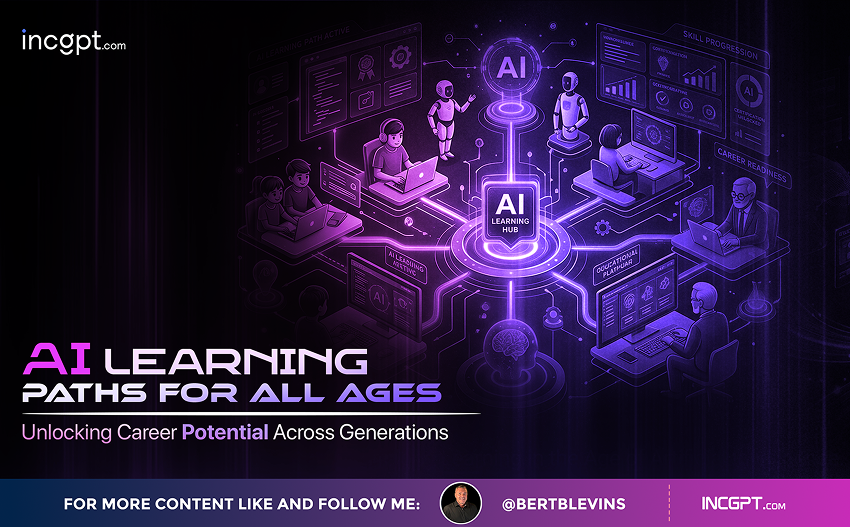
AI Learning Paths for All Ages: Unlocking Career Potential Across Generations
The Paradox of AI Creativity
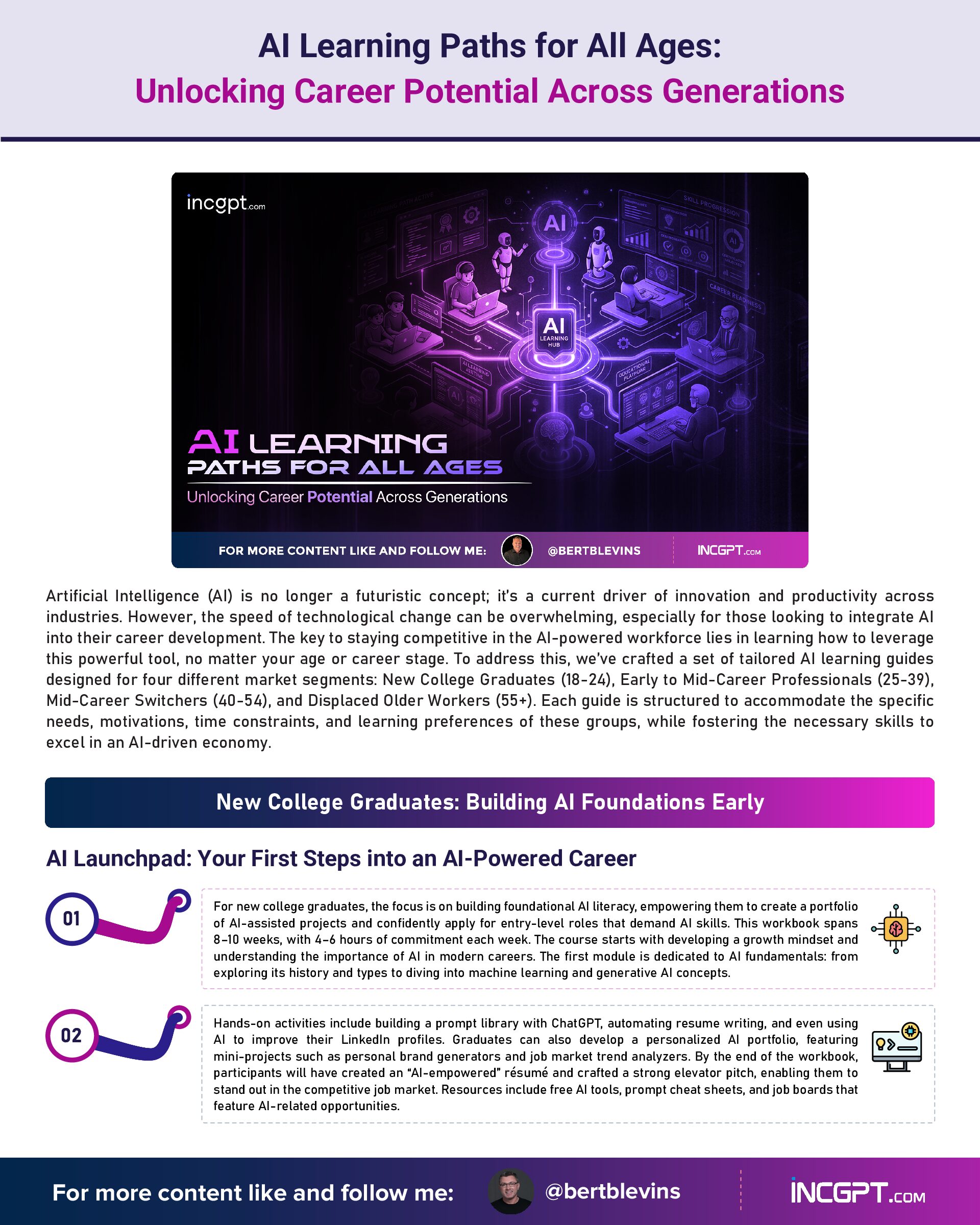
Artificial Intelligence (AI) is no longer a futuristic concept; it’s a current driver of innovation and productivity across industries. However, the speed of technological change can be overwhelming, especially for those looking to integrate AI into their career development. The key to staying competitive in the AI-powered workforce lies in learning how to leverage this powerful tool, no matter your age or career stage. To address this, we’ve crafted a set of tailored AI learning guides designed for four different market segments: New College Graduates (18-24), Early to Mid-Career Professionals (25-39), Mid-Career Switchers (40-54), and Displaced Older Workers (55+). Each guide is structured to accommodate the specific needs, motivations, time constraints, and learning preferences of these groups, while fostering the necessary skills to excel in an AI-driven economy.
1. New College Graduates: Building AI Foundations Early
AI Launchpad: Your First Steps into an AI-Powered Career
For new college graduates, the focus is on building foundational AI literacy, empowering them to create a portfolio of AI-assisted projects and confidently apply for entry-level roles that demand AI skills. This workbook spans 8–10 weeks, with 4–6 hours of commitment each week. The course starts with developing a growth mindset and understanding the importance of AI in modern careers. The first module is dedicated to AI fundamentals: from exploring its history and types to diving into machine learning and generative AI concepts.
Hands-on activities include building a prompt library with ChatGPT, automating resume writing, and even using AI to improve their LinkedIn profiles. Graduates can also develop a personalized AI portfolio, featuring mini-projects such as personal brand generators and job market trend analyzers. By the end of the workbook, participants will have created an “AI-empowered” résumé and crafted a strong elevator pitch, enabling them to stand out in the competitive job market. Resources include free AI tools, prompt cheat sheets, and job boards that feature AI-related opportunities.
Key Outcome:
New graduates will not only understand AI basics but also gain practical, hands-on experience to market themselves as AI-literate candidates for entry-level roles.
2. Early to Mid-Career Professionals: Elevating Skills to Stay Ahead
AI Accelerator: Level Up Your Current Role & Future-Proof Your Career
Professionals aged 25-39 often seek ways to remain relevant and advance in their careers, especially as industries rapidly evolve. This 10–12-week workbook (3-5 hours/week) helps individuals incorporate AI into their current workflow, aiming to increase productivity by 30–50%. The goal is to identify high-impact AI skills and integrate them into daily operations, enhancing performance and positioning individuals for promotion or lateral moves.
This trade-off between randomness and logic shows that while AI can simulate creativity, it cannot reliably generate diverse and meaningful ideas in the same way a human mind can. Increasing the temperature setting results in outputs that are too far removed from logical thought, leading to incoherent and impractical suggestions. This starkly contrasts with human creativity, where new ideas are often rooted in experience, logic, and a personal understanding of the world.
Key Outcome:
Mid-career professionals will master AI tools that align with their industry and job function, empowering them to perform tasks more efficiently and stay competitive in their field.
3. Mid-Career Switchers: Leveraging Experience in the AI Economy
AI Pivot: Leverage Your Experience in the AI Economy
For individuals aged 40-54, the challenge often lies in transitioning to new roles that leverage their years of experience while incorporating modern AI tools. This workbook guides mid-career professionals through a 12–14-week process, helping them identify transferable skills and bridge the gap between their current role and AI-enabled careers.
The course begins with a reality check on why now is the right time for a pivot, followed by an inventory of transferable skills. The AI Literacy module offers a high-level overview of AI applications relevant to experienced professionals, providing context and use cases for AI in various industries. As the course progresses, learners engage in fast-track learning with practical, hands-on short courses and build an AI-enhanced portfolio. Networking is a key focus, with activities designed to connect participants with mentors, industry peers, and AI professionals through informational interviews and virtual meetups.
The final project tasks participants with creating a 90-day, 6-month, and 12-month roadmap for their AI career pivot. They will develop a consulting pitch or outline a mentoring service, positioning themselves as thought leaders within their domain.
Key Outcome:
Mid-career switchers will gain confidence in their ability to transition into AI roles by leveraging their existing expertise and learning new, relevant skills in AI.
4. Displaced Older Workers: Embracing Lifelong Learning and AI Opportunities
AI Reboot: Turn Experience into Opportunity in the AI Era
For older workers (55+), the goal is to rebuild confidence and demonstrate that age is not a barrier to learning and adapting in the AI-driven job market. This workbook is designed to be accessible and supportive, with 12–16 weeks of content (2–4 hours/week), featuring gentle introductions to AI and step-by-step guides on how to use AI tools for both personal and professional tasks.
Older workers start by overcoming common myths about technology and embracing their years of experience as an advantage. The workbook includes simplified, analogy-based explanations of AI, allowing learners to experiment with voice-based AI tools like Siri, Google Assistant, and Microsoft Copilot. The course emphasizes AI’s application in non-technical roles such as AI ethics reviewing, mentoring, and customer success. By the end of the workbook, participants will have developed a modern LinkedIn profile and recorded a short video explaining an AI concept, building their visibility and confidence.
Key Outcome:
Mid-career switchers will gain confidence in their ability to transition into AI roles by leveraging their existing expertise and learning new, relevant skills in AI.
Common Thread: AI as an Amplifier of Human Capability
Across all market segments, the message is clear: AI is an amplifier of human capability, not a replacement. The aim is not just to make participants proficient in AI but to show them how AI can enhance their unique skills, regardless of age or career stage. Whether they are new college graduates entering the workforce, early-career professionals striving for advancement, mid-career switchers exploring new paths, or older workers navigating a career transition, AI learning is framed as a tool for empowerment.
These tailored workbooks offer comprehensive, self-paced learning experiences with practical, real-world applications. The learning journey is not just about acquiring technical knowledge but about building confidence and providing the tools to take actionable steps in the AI-driven job market. Resources such as tool comparison charts, AI cheat sheets, networking opportunities, and project templates ensure that learners can implement what they’ve learned immediately, creating a bridge to future success.
As industries continue to evolve with AI, these learning paths help individuals unlock their potential, maximize their productivity, and stay ahead in the workforce. AI is the future, but with the right guidance and resources, anyone can learn how to harness its power and thrive in the modern workforce.