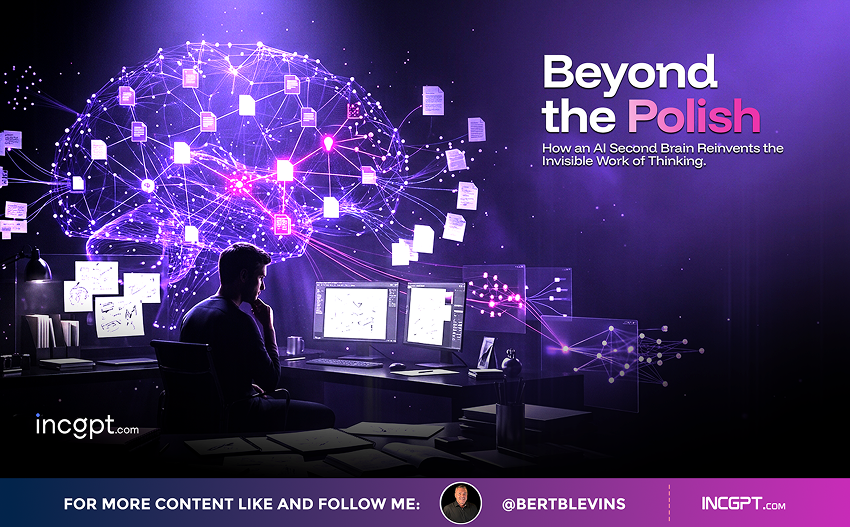
Beyond the Polish: How an AI Second Brain Reinvents the Invisible Work of Thinking
Most organizations have badly underestimated what today’s AI tools can do. Not because the technology is weak, but because they are pointing it at the wrong part of the job. They treat AI as a finishing tool, a way to tidy up emails and documents at the very end of a task. Used that way, even the most capable model can only ever nibble at the edges of how work actually gets done. The real transformation is happening somewhere else entirely, and millions of knowledge workers have already found it.
The Work You Can't See
Here is the core problem: most knowledge work is invisible. The heart of it, the thinking, weighing, planning, judging, and mulling, takes place inside a worker’s head, where no tool can see it. What the world observes is only the residue of that thinking: the finished email, the polished slide deck, the completed report. By the time work reaches that visible layer, the hard part is already over.
Yet the visible layer is exactly where most workplace AI gets deployed. Assistants are bolted onto the outputs, the documents, the chats, the meeting notes, and asked to improve them. That is genuinely useful, but it arrives far too late in the process to change anything fundamental. Polishing a finished draft cannot reshape the thinking that produced it.
The 80 Percent Nobody Is Helping You With
Consider what it actually takes to produce a project deliverable. Roughly 80 percent of the effort goes into wrestling the first draft into existence: gathering the threads, structuring the argument, deciding what matters. The remaining 20 percent is refinement, the polish that turns a rough draft into something presentable. Today’s AI assistants are excellent at that final 20 percent, and that is welcome. But genuinely transforming how work gets done means helping with the unseen 80 percent, the messy, effortful thinking that comes first.
The encouraging news is that AI is fully capable of helping with that 80 percent right now. This does not require waiting for some future breakthrough model or the arrival of artificial general intelligence. It requires only a change in how you use the tools already sitting in front of you, by inviting AI into the invisible thinking stage of your work instead of confining it to the surface.
Use AI the Way Developers Do: Build Context Over Time
Since the start of 2026, this way of working has quietly exploded in popularity, even though the AI vendors have not made it especially obvious. The trick is to stop treating AI as a one-off tool that forgets everything between sessions, and start treating it the way software developers do, as something that accumulates context over time and gets smarter about your work with every interaction.
In practice, that means moving beyond web-based chat windows where every conversation starts from a blank slate. Instead, you build a persistent foundation the AI can return to again and again.
How to Build Your Second Brain
The setup is more straightforward than it sounds, and it follows a clear arc:
- Create a centralized repository. Put your critical files, such as deliverables, meeting notes, and project plans, into a folder the AI can access, and start with the everyday materials that define your work.
- Let the AI interview you. Before doing any actual work, ask it to question you about your working style, your priorities, and your personal preferences, so it begins from genuine understanding rather than guesswork.
- Review and refine its understanding. Have it scan through your files to synthesize your thinking, your recurring ideas, your story arcs, and your writing style, then go back and forth until it truly captures you and your work.
- • Build on every session. Make clear that this is not a one-time exercise but an ongoing process, where the AI continuously creates, maintains, organizes, and updates its understanding, so each new session stands on everything you have done together before.
What you end up with is a personal, Wikipedia-style repository of yourself, an ever-growing context library tuned precisely to you and the way you work. People call this many things: a second brain, an AI context vault, an LLM-powered personal wiki. The label matters less than the principle, and you can build it with virtually any major AI product. Most vendors now let you connect their platforms into your other business systems, such as email, chat, document stores, and productivity suites, so your personal knowledge system plugs straight into the corporate tools and data you already use.
The reaction from people who work this way is striking. Many report a fundamental shift in how they operate within the first few hours. After a few days, a common refrain emerges: they will never go back to the old way of working again.
The Tradeoffs Worth Weighing
None of this comes free, and the complications are sharpest from the organization’s point of view rather than the individual’s.
First, the familiar security questions all still apply, and they get more pointed. How do you know the AI actually did what it claimed to do? How do you know it did not hallucinate? How do you trust it not to spin out of control and fire off nonsense to every contact you have? Addressing this involves measures most people already know about but have not gotten around to, such as setting up separate accounts with restricted permissions for the AI and establishing clear rules for when and how its output gets reviewed.
Second, this approach asks workers to slow down and verify what the AI produces, which is almost the opposite of the speed that drew them to AI in the first place. That tension is real and has to be managed rather than wished away.
Third, there is a visibility problem. A great deal of the back-and-forth that once happened out in the open, where colleagues and managers could see it, now happens privately inside the AI tool and the worker’s personal context vault. Individuals tend to love that privacy. Organizations often see it as a liability.
Finally, ownership becomes a genuine risk. When employees build personal context vaults using their own consumer AI subscriptions, nothing stops them from walking out the door with all that accumulated context when they leave. The answer is for companies to buy proper enterprise AI subscriptions that can be tied into corporate single sign-on and data loss prevention systems. The catch is cost: enterprise AI pricing works nothing like consumer pricing, and a worker using AI this intensively can easily run through thousands of dollars in tokens every month.
The Mindset Reset
The bottom line is simple but demanding. Today’s AI can fundamentally transform knowledge work, but only if there is a deliberate reset in how people think about using it. This new approach genuinely adds complexity, and organizations will need to invest real time in understanding, managing, and securing AI in a different way than they do now. Still, the direction of travel is clear. AI used as a true second brain is not a question of if but when, which means the moment to start treating it that way is already here.