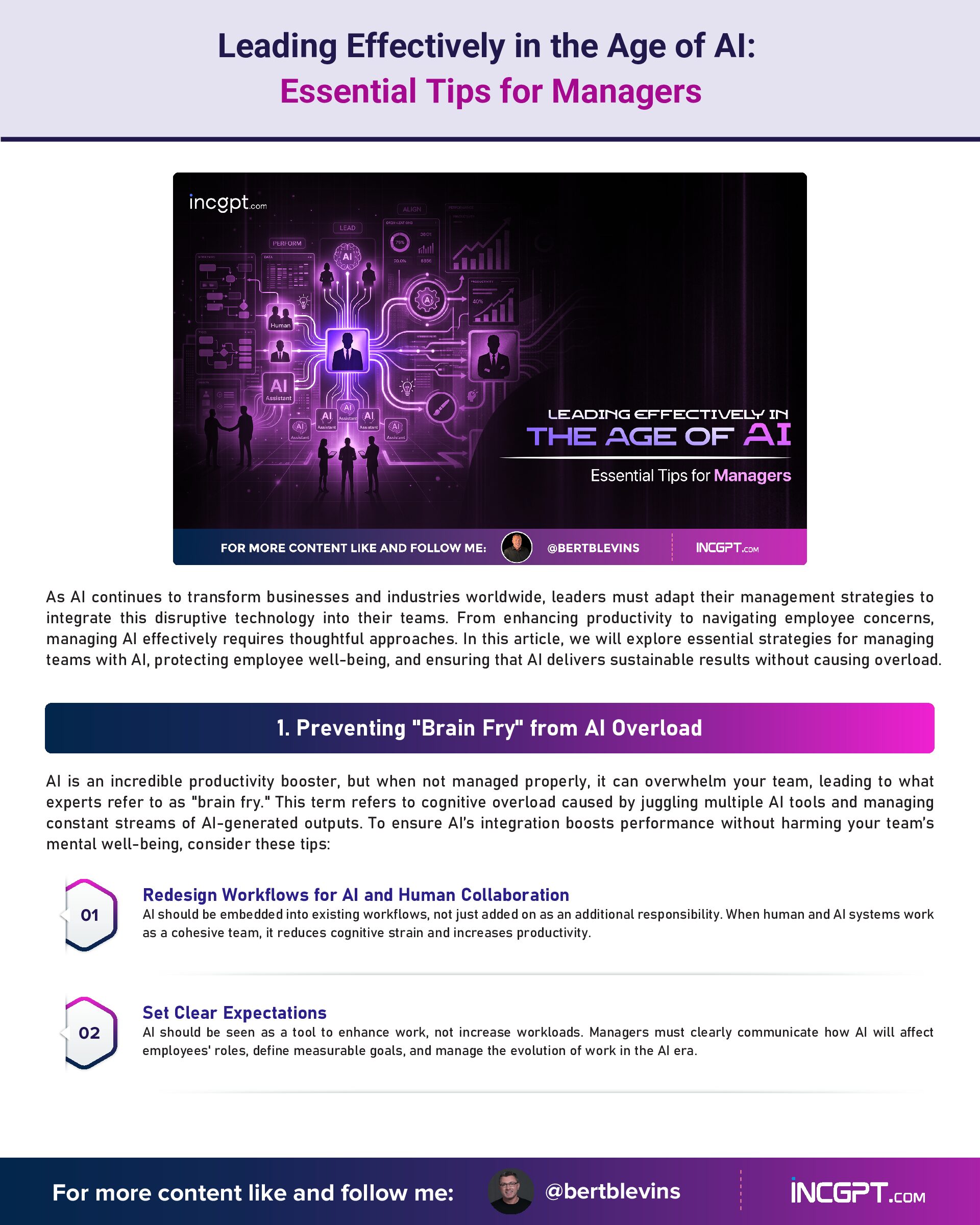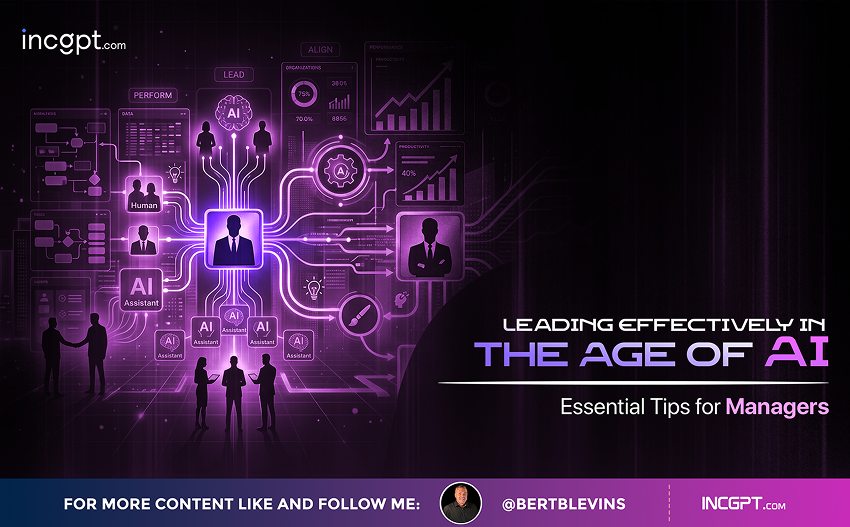
Leading Effectively in the Age of AI: Essential Tips for Managers
As AI continues to transform businesses and industries worldwide, leaders must adapt their management strategies to integrate this disruptive technology into their teams. From enhancing productivity to navigating employee concerns, managing AI effectively requires thoughtful approaches. In this article, we will explore essential strategies for managing teams with AI, protecting employee well-being, and ensuring that AI delivers sustainable results without causing overload.
1. Preventing "Brain Fry" from AI Overload
AI is an incredible productivity booster, but when not managed properly, it can overwhelm your team, leading to what experts refer to as “brain fry.” This term refers to cognitive overload caused by juggling multiple AI tools and managing constant streams of AI-generated outputs. To ensure AI’s integration boosts performance without harming your team’s mental well-being, consider these tips:
Redesign Workflows for AI and Human Collaboration
AI should be embedded into existing workflows, not just added on as an additional responsibility. When human and AI systems work as a cohesive team, it reduces cognitive strain and increases productivity.
Set Clear Expectations
AI should be seen as a tool to enhance work, not increase workloads. Managers must clearly communicate how AI will affect employees’ roles, define measurable goals, and manage the evolution of work in the AI era.
Prioritize Outcomes Over Activity
Instead of measuring AI usage by the volume of tasks performed, focus on the outcomes achieved. Incentivize results, not just the use of AI tools. This ensures that employees prioritize quality and not just quantity.
Build Skills for AI Management
Empower your team with the skills to manage AI effectively. These include problem-solving, prioritization, and effective decision-making, which prevent overreliance on AI and encourage critical thinking.
Protect Human Attention
Create boundaries for AI usage and guard cognitive resources. Set norms around focused work and encourage mindfulness to prevent burnout from constant AI interaction.
2. Addressing AI Anxiety: Leading with Empathy
Many employees face anxiety about AI’s impact on their careers. While uncertainty cannot be completely eliminated, leaders can help ease fears with empathy, clarity, and open communication. Here’s how to guide your team through AI-related anxieties:
Acknowledge and Name the Fear
Naming the fear surrounding AI can help normalize anxiety and build trust. Leaders should openly discuss their own concerns and model courageous behavior by taking proactive steps despite uncertainty.
Foster Open Dialogue
Create safe spaces for employees to discuss their concerns. Regular conversations about AI’s impact on roles, career development, and job security can build psychological safety and trust.
Commit to Transparent Action
Employees will feel more secure when they know the leadership is taking concrete steps. This includes offering upskilling opportunities, transparent information about job impacts, and clear actions about AI’s role in the workplace.
Keep Conversations Ongoing
AI-related fears won’t dissipate in one discussion. Leaders should commit to continuous conversations, making sure employees feel heard and supported as the AI journey progresses.
3. Eliminating "Workslop" and Maintaining AI Output Quality
AI mandates without adequate support often result in “workslop” — poor quality, rushed outputs that harm productivity and morale. To prevent this, leaders should adopt a systematic approach to managing AI, ensuring its integration leads to high-quality results:
Rebuild a Culture of Trust
Fostering open communication about AI’s challenges is crucial. Encourage teams to admit when AI isn’t working as expected and to share constructive feedback. Trust enables collaboration between humans and AI to enhance quality.
Establish Clear Norms for AI Use
Without structure, AI usage becomes haphazard. Define what good AI use looks like, set expectations for when AI should be employed, and emphasize human judgment during reviews to maintain quality.
Appoint AI Support Roles
Identify individuals within your team who are fluent in both AI and collaboration. These “AI architects” should focus on optimizing workflows and ensuring that AI outputs align with business goals.
4. Breaking Through Stalled AI Adoption
AI adoption may appear successful based on metrics like tool usage, but true success comes when employees engage with AI meaningfully. If AI’s deployment seems ineffective despite widespread usage, it often signals deeper issues like risk perception. Here’s how to overcome these barriers:
Understand Industry-Specific AI Risks
In some industries, AI is seen as an opportunity, while in others, it represents a threat to job security. Managers need to recognize these perceptions and align their AI strategy accordingly.
Move Beyond Usage Metrics
High AI usage doesn’t equate to genuine buy-in. Employees may use AI out of necessity or fear rather than excitement or curiosity. Measure employee sentiment and openness to AI adoption alongside usage data.
Design for Learning, Not Just Scaling
Don’t rush into full-scale AI deployment. Encourage small-scale experimentation first, giving employees time to learn and adjust before the technology is widely adopted across the organization.
5. Managing Hybrid Human-AI Workforces
As hybrid teams made up of humans and AI agents become more common, managers must adapt their leadership to orchestrate performance across both entities. Here are six key capabilities for effectively managing a hybrid workforce:
Build AI Operational Literacy
Understand how AI agents operate, how they respond to commands, and how to troubleshoot failures. This knowledge will allow you to maximize the performance of your AI-driven team members.
Cultivate Deep Functional Expertise
AI agents can only be as effective as the understanding of the domain they are working in. Managers should have expertise in the area the AI supports to effectively train and optimize its performance.
Practice Systems Thinking
Map out how AI agents interact across departments and teams. Design workflows and handoffs to ensure smooth collaboration between AI and human agents, minimizing complexity.
Strengthen Change Resilience
AI is a constantly evolving field. Managers must be flexible, continually learning, and open to adjusting strategies as AI models and business priorities shift.
Refine Your Prompting Skills
AI agents require specific instructions to deliver the desired results. Managers must continually improve their ability to design clear and effective prompts, ensuring AI agents perform at their best.
Design Hybrid Work Thoughtfully
Define clear escalation paths for AI agents. Shift human KPIs from process-based tasks to outcomes-based goals, enabling your team to focus on high-value work that requires human judgment and creativity.
6. Creating Psychological Safety During AI Integration
Integrating AI into a team can disrupt interpersonal trust and collaboration. As a leader, it’s essential to frame AI adoption as a process of learning and development rather than a technology upgrade. Here’s how to ensure psychological safety during AI integration:
Reframe AI as a Learning Process
Introduce AI tools with the expectation that employees will learn and experiment, not necessarily get everything right from the beginning. Normalize trial and error to prevent fear of failure.
Model Fallibility and Curiosity
Encourage leaders and employees alike to admit when they don’t know something about AI, fostering an environment where it’s safe to ask questions and experiment.
Create Smart Failure Protocols
Test AI in low-risk environments before expanding its use. Share lessons learned from early failures so that others can build on these insights, making AI adoption less daunting.
Emphasize Human Connection
AI should augment, not replace, human collaboration. As AI takes on more tasks, interpersonal connections and teamwork become even more vital. Encourage regular check-ins, team discussions, and feedback to maintain strong relationships.
7. Unblocking AI Transformation: Moving Beyond Pilots
Many organizations have AI pilots in place, but those efforts often fail to scale. For long-term success, companies need to rethink workflows and roles. Here’s how to avoid the “pilot trap” and foster sustainable AI transformation:
Rethink Processes from Scratch
Don’t simply add AI to existing workflows. Redesign processes to incorporate AI from the ground up, ensuring smooth collaboration between humans and machines.
Capture and Document Knowledge
Critical knowledge should be documented and shared, ensuring that expertise isn’t lost during AI adoption. Legacy knowledge should be paired with AI tools to bridge the gap between the past and future.
Manage AI Like a Workforce
Treat AI agents as part of your workforce. Establish guidelines for AI usage, track performance, and hold agents accountable for their outputs, just as you would for human team members.
Redesign Roles for High-Value Work
With the introduction of AI, managers should focus on reallocating human effort to more strategic tasks, like oversight, design, and decision-making, while AI handles routine, repetitive work.
Conclusion
AI offers incredible opportunities for productivity and efficiency, but it also comes with challenges that require thoughtful management. From reducing cognitive overload to building trust and psychological safety, leaders must guide their teams through the complexities of AI integration. By focusing on learning, collaboration, and empathy, you can ensure that your team thrives in the AI era, delivering measurable business outcomes without sacrificing employee well-being.