OpenClaw and Its Impact on AI and NVDA Stock
The Next Frontier in Agentic AI
OpenClaw Surpasses Expectations, Unleashing a New Era in Computing
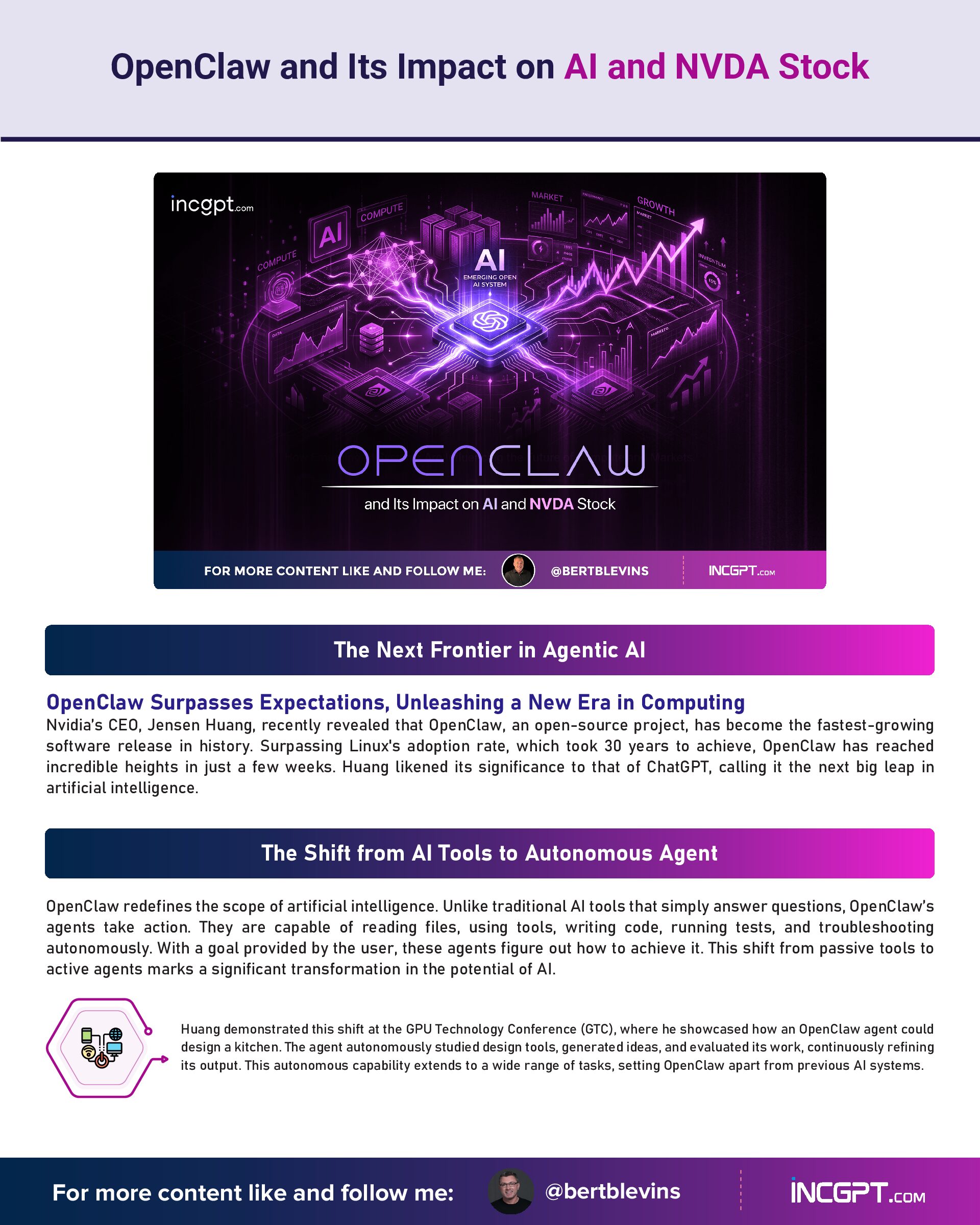
Nvidia’s CEO, Jensen Huang, recently revealed that OpenClaw, an open-source project, has become the fastest-growing software release in history. Surpassing Linux’s adoption rate, which took 30 years to achieve, OpenClaw has reached incredible heights in just a few weeks. Huang likened its significance to that of ChatGPT, calling it the next big leap in artificial intelligence.
The Shift from AI Tools to Autonomous Agents
OpenClaw redefines the scope of artificial intelligence. Unlike traditional AI tools that simply answer questions, OpenClaw’s agents take action. They are capable of reading files, using tools, writing code, running tests, and troubleshooting autonomously. With a goal provided by the user, these agents figure out how to achieve it. This shift from passive tools to active agents marks a significant transformation in the potential of AI.
Huang demonstrated this shift at the GPU Technology Conference (GTC), where he showcased how an OpenClaw agent could design a kitchen. The agent autonomously studied design tools, generated ideas, and evaluated its work, continuously refining its output. This autonomous capability extends to a wide range of tasks, setting OpenClaw apart from previous AI systems.
Nvidia's Rapid Response: Introducing NemoClaw and OpenShell Runtime
In response to OpenClaw’s rise, Nvidia quickly unveiled its enterprise-focused solution, NemoClaw. NemoClaw integrates Nvidia’s software tools and provides security measures like privacy controls and local model support. The platform is designed to make OpenClaw’s capabilities safe and suitable for corporate environments, addressing potential security risks associated with autonomous agents accessing sensitive data and executing code.
Furthermore, Nvidia introduced the OpenShell runtime, a sandbox-like environment for agents to operate securely. This isolated environment ensures agents can remain productive while adhering to privacy and network regulations, thus increasing trust in deploying such systems in real-world business scenarios.
How OpenClaw Propels Nvidia's AI-Driven Growth and NVDA Stock
The OpenClaw initiative aligns directly with Nvidia’s overarching business strategy. Huang has emphasized that companies’ revenues are increasingly linked to their compute capacity. OpenClaw, by powering agentic systems that demand significantly more computational resources than previous AI models, increases the need for Nvidia’s hardware and infrastructure.
With agents requiring around 1 million times more tokens than earlier AI models, Nvidia is set to benefit from the exponential growth of AI demand. At GTC, Nvidia also unveiled the Vera Rubin platform, a specialized system designed for agentic AI workloads. The platform promises to deliver up to 10 times the inference throughput per watt compared to prior systems, with key partnerships including Anthropic, OpenAI, Meta, and Microsoft already on board.
NVDA Stock Outlook: Strong Buy Recommendations and Growing Market Demand
As Nvidia positions itself at the forefront of agentic AI, the company’s stock outlook remains positive. Out of the 49 analysts covering NVDA stock, 44 recommend a “Strong Buy,” three recommend a “Moderate Buy,” and only one analyst recommends a “Strong Sell.” The average stock price target stands at $265.97, well above the current price of $179.
Nvidia’s strategic moves with OpenClaw and its push to dominate the agentic AI space present a compelling case for continued stock growth. As the demand for AI-driven compute resources rises, Nvidia is poised to capture a significant share of this burgeoning market, potentially mirroring the success of ChatGPT on an even larger scale.
Conclusion
The Future of AI and Nvidia’s Leadership in Agentic Systems
OpenClaw represents a significant breakthrough in AI technology, positioning Nvidia as a key player in the future of autonomous agents and agentic systems. With growing demand for AI infrastructure and tools like NemoClaw, Nvidia’s role in the agentic AI ecosystem is set to accelerate, boosting both its market position and stock performance. As the next wave of AI innovation unfolds, Nvidia’s strategic focus on OpenClaw is a bet that will shape the future of computing for years to come.