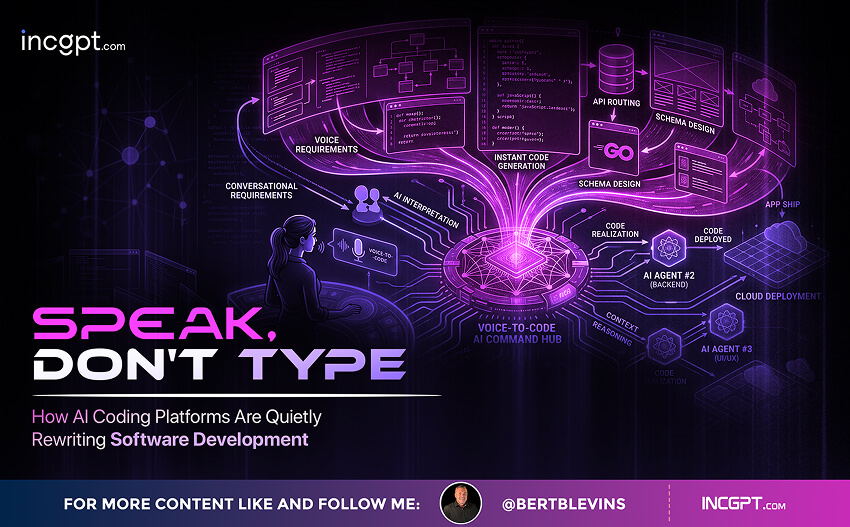
Speak, Don't Type: How AI Coding Platforms Are Quietly Rewriting Software Development
A new generation of AI tools is shifting software creation from writing code to describing it. The productivity story is real, but so are the cracks beneath the surface.
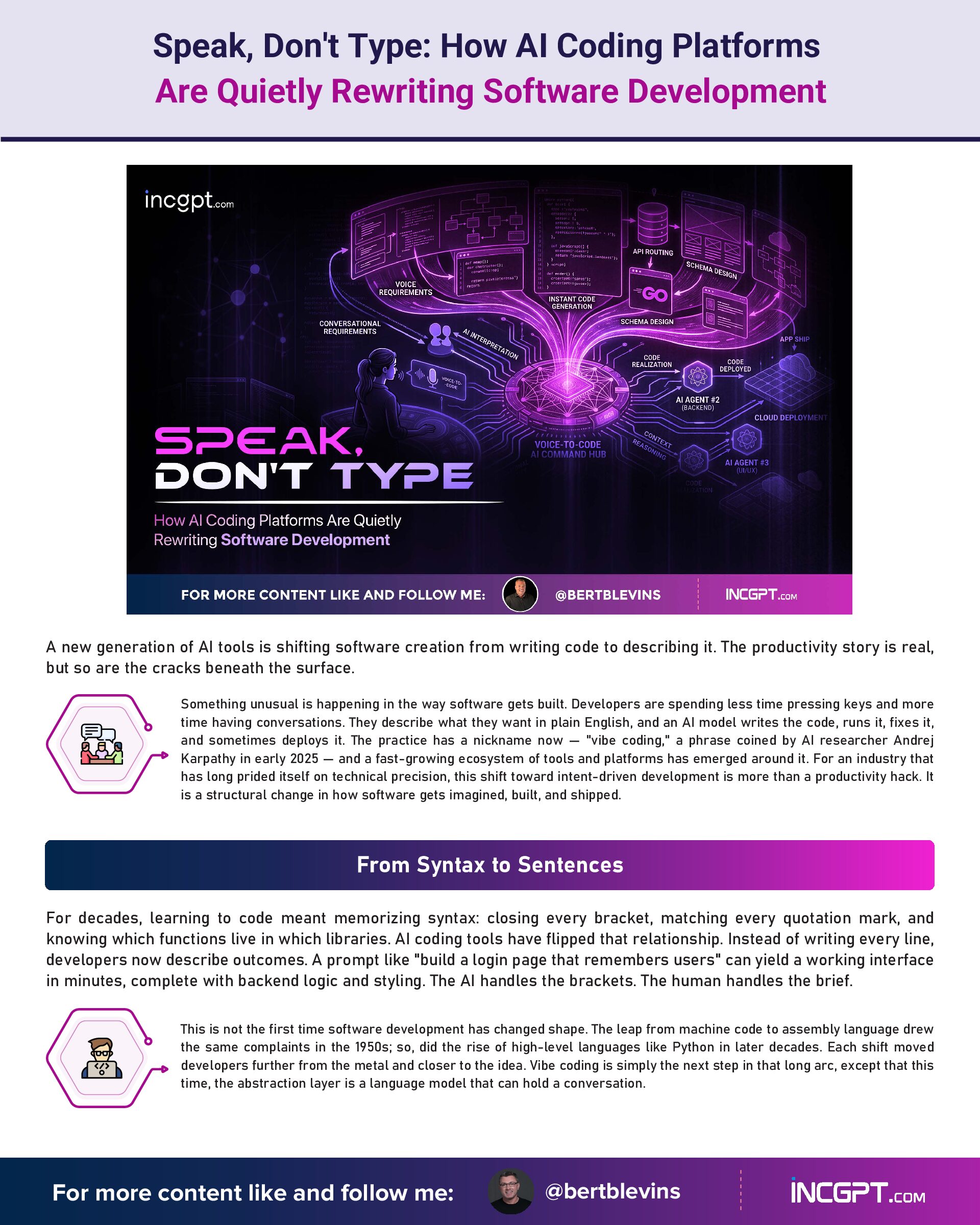
Something unusual is happening in the way software gets built. Developers are spending less time pressing keys and more time having conversations. They describe what they want in plain English, and an AI model writes the code, runs it, fixes it, and sometimes deploys it. The practice has a nickname now — “vibe coding,” a phrase coined by AI researcher Andrej Karpathy in early 2025 — and a fast-growing ecosystem of tools and platforms has emerged around it. For an industry that has long prided itself on technical precision, this shift toward intent-driven development is more than a productivity hack. It is a structural change in how software gets imagined, built, and shipped.
From Syntax to Sentences
For decades, learning to code meant memorizing syntax: closing every bracket, matching every quotation mark, and knowing which functions live in which libraries. AI coding tools have flipped that relationship. Instead of writing every line, developers now describe outcomes. A prompt like “build a login page that remembers users” can yield a working interface in minutes, complete with backend logic and styling. The AI handles the brackets. The human handles the brief.
This is not the first time software development has changed shape. The leap from machine code to assembly language drew the same complaints in the 1950s; so, did the rise of high-level languages like Python in later decades. Each shift moved developers further from the metal and closer to the idea. Vibe coding is simply the next step in that long arc, except that this time, the abstraction layer is a language model that can hold a conversation.
The Platforms Driving the Shift
Two broad categories of tools have emerged. The first group is full-stack AI app builders. Platforms like Replit, Lovable, Bolt, and Base44 let users describe an entire application in natural language and receive a working product, often with hosting, databases, and deployment included. A founder with no coding background can build a functional MVP in an afternoon. The barrier between idea and prototype, once measured in weeks, has collapsed to hours.
The second group is AI coding assistants that live inside a developer’s existing environment. Tools like GitHub Copilot, Cursor, and Claude Code embed themselves in code editors and terminals, offering smart completions, multi-file edits, and autonomous task execution. Unlike the app builders, these assist professional developers working on production codebases rather than replacing the editor entirely. A senior engineer might use Cursor to refactor a function across a hundred files. A student might use Replit to build their first web app. Different tools, same underlying shift.
The Productivity Bargain
The numbers behind the trend are striking. A GitHub survey found that roughly 92 percent of developers now use AI coding tools in some form. Controlled trials at Microsoft, Accenture, and a Fortune 100 company found that developers using AI assistants completed more than 25 percent more tasks than those without. McKinsey has reported that generative AI can shorten product time-to-market by 5 percent and lift productivity by as much as 40 percent. For less experienced developers, the gains tend to be even larger. The technology compresses the experience gap, helping juniors produce code closer to what their senior colleagues would write.
Beyond raw output, AI coding has changed what daily work feels like. Tedious tasks — writing boilerplate, navigating unfamiliar APIs, drafting documentation — now resolve in seconds. Developers report being able to stay in flow longer, with fewer interruptions to look up syntax or hunt through documentation. A 2025 survey of engineering leaders found that 95 percent believed AI tools can help reduce burnout.
The Cracks in the Vibe
The optimism is not universal. A late-2025 analysis of 470 open-source pull requests found that AI co-authored code contained roughly 1.7 times more major issues than human-written code. Logic errors, misconfigurations, and security vulnerabilities all appeared at elevated rates. A separate METR study found that experienced open-source developers were actually 19 percent slower when using AI tools — even though they believed they had been faster.
Critics point to a deeper concern: code without specifications. A program’s behavior is supposed to be defined before it is evaluated, but AI-generated code often arrives without that contract. Developers may accept output that works in the moment but drifts from requirements over time, creating maintenance debt that surfaces only later. The ACM’s Technology Policy Council recently warned that current vibe coding platforms have no mechanism to enforce specifications, leaving long-term reliability at risk.
Security is the other pressure point. As coding platforms add agentic capabilities — the ability to not just write code but execute it across networked systems — the attack surface widens. Prompt injection, where hidden instructions in third-party content hijack the AI’s behavior, remains an unsolved problem.
Where This Is Heading
None of these concerns are slowing adoption. Satya Nadella has said roughly a quarter of code in Microsoft’s internal repositories is now AI-generated. Mark Zuckerberg has predicted that half of Meta’s development work could be done by AI within a year. The direction is clear, even if the destination is not.
What seems likely is a bifurcation. Vibe coding will continue to lower the barrier for prototypes, internal tools, and weekend projects, opening software creation to a wider population of builders. But for production systems where reliability and security matter, the role of the experienced engineer is not disappearing — it is shifting. The future developer’s value will lie less in writing code and more in shaping it: defining specifications, reviewing AI output, catching the edge cases the model misses, and architecting systems that hold up under load.
The conversation between humans and machines is now part of how software is made. The question is no longer whether to use these tools, but how to use them well — and how to build the guardrails that turn good vibes into good code.