Goodbye Docker: RunPod Flash Brings Pure-Python Deployment to Serverless GPUs
A new MIT-licensed Python SDK aims to remove the container tax from AI development, letting engineers ship a function to a remote GPU as easily as running a local script.
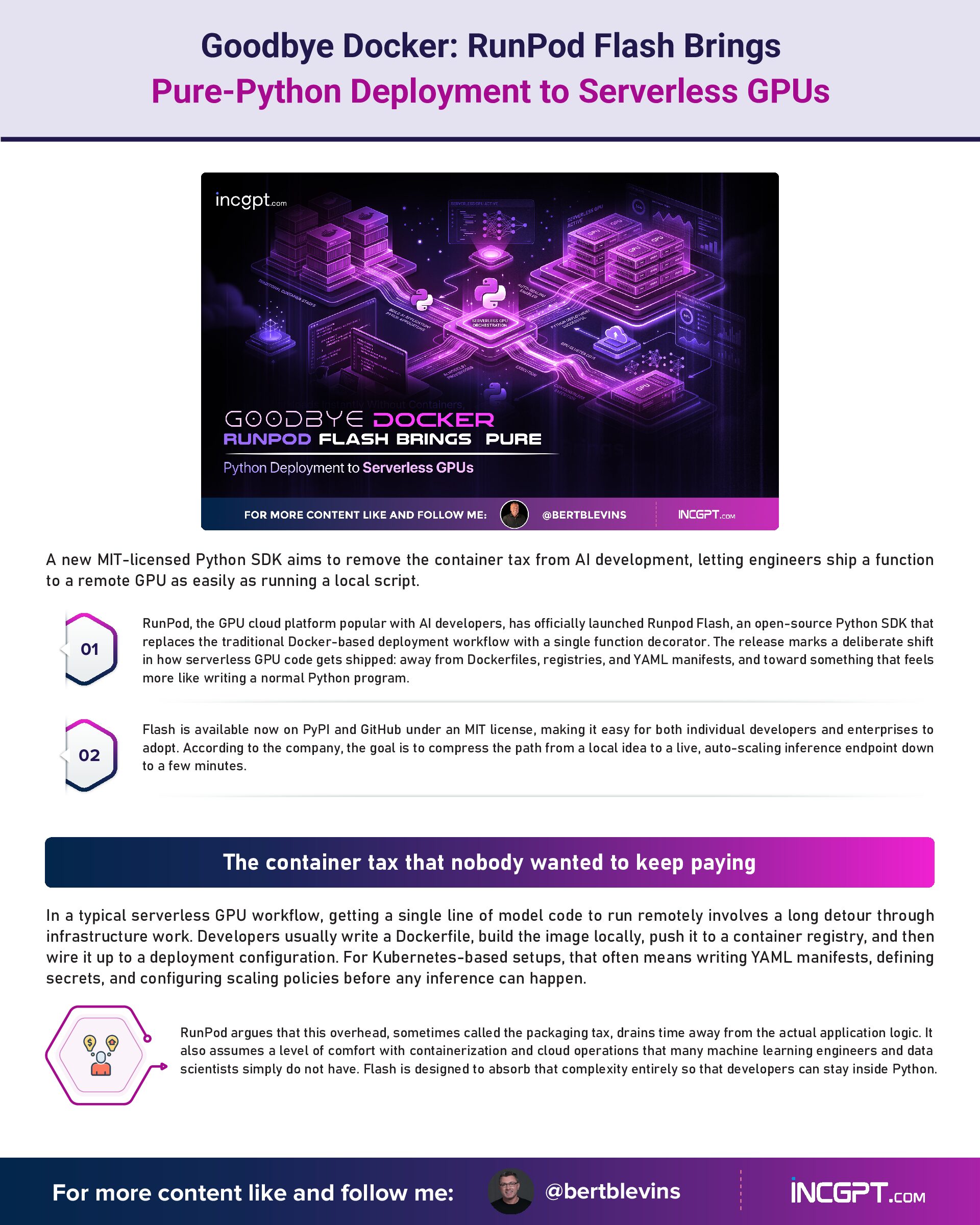
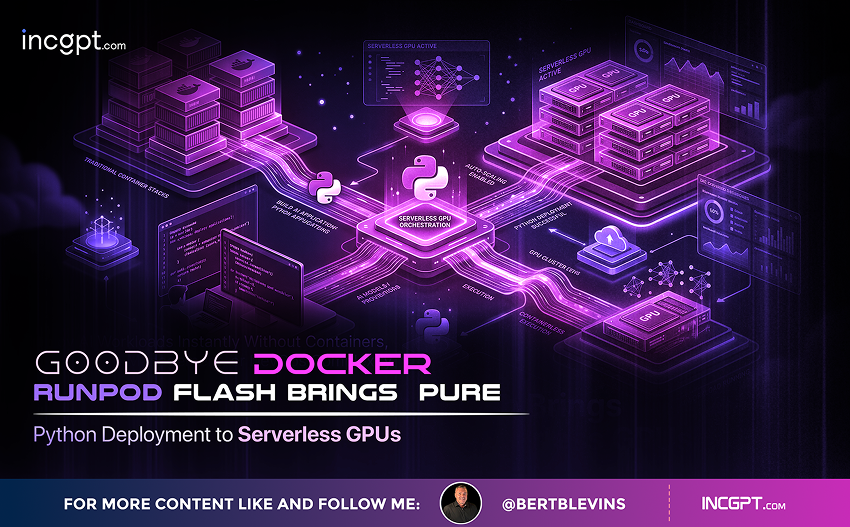
RunPod, the GPU cloud platform popular with AI developers, has officially launched Runpod Flash, an open-source Python SDK that replaces the traditional Docker-based deployment workflow with a single function decorator. The release marks a deliberate shift in how serverless GPU code gets shipped: away from Dockerfiles, registries, and YAML manifests, and toward something that feels more like writing a normal Python program.
Flash is available now on PyPI and GitHub under an MIT license, making it easy for both individual developers and enterprises to adopt. According to the company, the goal is to compress the path from a local idea to a live, auto-scaling inference endpoint down to a few minutes.
The container tax that nobody wanted to keep paying
In a typical serverless GPU workflow, getting a single line of model code to run remotely involves a long detour through infrastructure work. Developers usually write a Dockerfile, build the image locally, push it to a container registry, and then wire it up to a deployment configuration. For Kubernetes-based setups, that often means writing YAML manifests, defining secrets, and configuring scaling policies before any inference can happen.
RunPod argues that this overhead, sometimes called the packaging tax, drains time away from the actual application logic. It also assumes a level of comfort with containerization and cloud operations that many machine learning engineers and data scientists simply do not have. Flash is designed to absorb that complexity entirely so that developers can stay inside Python.
How Flash actually works
At its core, Flash is a Python SDK for distributed inference and orchestration. A developer writes a normal async function, places an @Endpoint or @remote decorator on top of it, and specifies things like the GPU type, worker count, and pip dependencies as arguments. When the script runs, Flash inspects the function, packages the code along with its declared dependencies, provisions a serverless worker on the requested hardware, executes the function, returns the result, and tears the worker back down. Billing only covers the time the code actually ran.
Behind the scenes, a cross-platform build engine handles a problem that often trips developers up. A function written on an Apple Silicon Mac will be compiled and packaged for a Linux x86_64 GPU environment automatically, with no manual cross-compilation. Flash also detects the local Python version, enforces binary wheels, and bundles dependencies into an artifact that gets mounted at runtime on RunPod’s serverless fleet. Mounting the artifact, instead of pulling a multi-gigabyte container image for every cold start, helps shrink the lag between a request landing and the code running.
Persistent storage, environment variables, and other quality-of-life details
Flash ships with a NetworkVolume object that gives developers first-class access to persistent storage spanning multiple data centers. Files mounted at the /runpod-volume/ path can hold cached model weights and large datasets that survive across deployments, which is particularly useful for cutting down cold-start pain when an endpoint scales out.
Environment variables get similar treatment. They are deliberately excluded from the configuration hash that determines whether an endpoint needs a rebuild, which means rotating an API key or flipping a feature flag no longer triggers a full redeploy. Developers can also reach existing RunPod resources by ID through the same SDK, treating Flash as a Python client for endpoints that were spun up elsewhere.
Two deployment patterns under one umbrella
Flash supports two main execution patterns. Queue-based endpoints, which use the @Endpoint decorator, are tuned for batch and asynchronous jobs. Load-balanced endpoints, built around an Endpoint object plus route definitions, are designed for low-latency real-time inference traffic. Both styles let developers declare their compute needs and dependencies directly inside Python, with provisioning, scaling, and teardown handled by the platform.
There is also a CLI for engineers who prefer working from the terminal. Commands like flash login, flash init, flash run, flash build, flash deploy, and flash env give teams a unified workflow for authentication, scaffolding, local development with auto-reload, building deployable artifacts, shipping to production, and managing separate environments such as staging and production.
A platform built with AI coding agents in mind
One of the more interesting design choices is how explicitly Flash is targeted at AI coding agents. RunPod has released dedicated skill packages for tools such as Claude Code, Cursor, and Cline. These packages give the agents structured context about the Flash SDK, which the company says reduces hallucinated syntax and lets agents write functional deployment code without trial-and-error guessing.
That focus aligns with where development is heading. As more engineers delegate scaffolding and deployment work to autonomous coding assistants, the surfaces those agents touch matter as much as the ones humans use directly. A Python-native deployment layer is far easier for an agent to manipulate than a stack that requires generating valid Dockerfiles, registry credentials, and Kubernetes manifests in sequence.
Why this matters for the inference economy
RunPod is positioning Flash against a backdrop of changing AI spend. Training workloads dominated the first wave of GPU demand, but inference is now the faster-growing slice of cloud bills, driven by production applications that serve real users. Inference workloads behave very differently from training: they are bursty, latency-sensitive, and need to scale up and back down quickly without burning money on idle hardware.
That kind of behavior is also a natural fit for agentic AI systems. Agents call multiple models in sequence, route between different compute types, and generate unpredictable load. A container-first deployment model, designed for long-lived static services, was never really built for that pattern. Flash Apps, which let developers compose multiple endpoints with different hardware configurations into one deployable service, are aimed squarely at this orchestration problem. Combined with scale-to-zero billing, the company sees Flash as a compute backbone for agent workloads that should pay for compute only when they are actually using it.
RunPod's growing footprint
The launch lands at a moment when RunPod has real scale to lean on. The company says more than 750,000 developers now use the platform to build and deploy AI, with 37,000 serverless endpoints created in March 2026 alone and over 2,000 developers spinning up new endpoints every week. Production inference customers reportedly include Glam Labs, CivitAI, and Zillow, and the company has hit $120 million in annual recurring revenue. RunPod also describes itself as the most cited AI cloud on GitHub, a sign that it has captured developer mindshare in addition to enterprise spend.
Pricing remains a key part of the pitch. RunPod offers more than 30 GPU SKUs and bills by the millisecond, which lets short-lived inference jobs avoid the rounding overhead common to per-minute or per-hour cloud GPU pricing.
The bigger shift Flash is betting on
The release reflects a wider transition in how software gets built. As development moves toward intent-based coding, where engineers describe the outcome they want and let tools figure out the execution details, the value of an infrastructure layer that hides containers, registries, and provisioning steps grows quickly. Flash is RunPod’s attempt to be that bridge between local Python and global GPU capacity.
There are tradeoffs worth watching. Cold start latency on the first invocation of a heavy function, especially one bringing in libraries like torch and diffusers, can still take several minutes while the worker is built. Windows is not yet supported, with Flash currently requiring Python 3.10 or newer on macOS or Linux. Even so, for the large category of teams whose biggest blocker has been the gap between a working notebook and a deployed endpoint, Flash makes a credible claim that the most painful step in that journey can be removed.