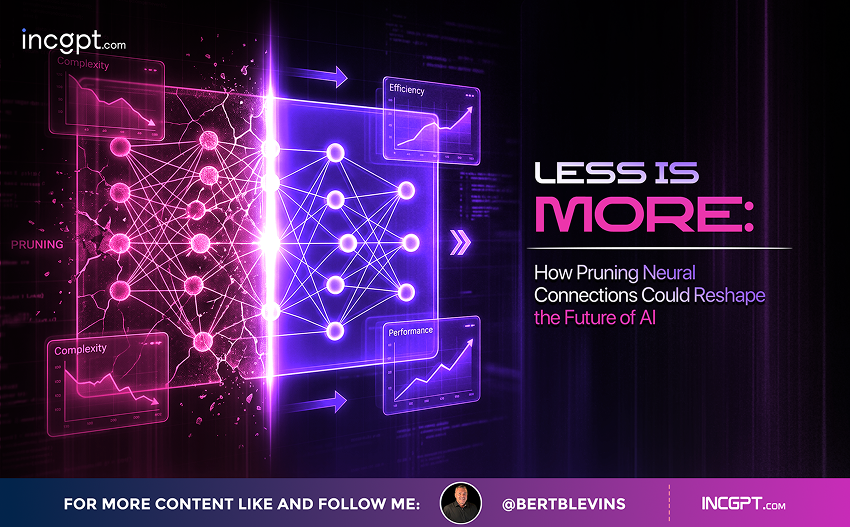
Less Is More: How Pruning Neural Connections Could Reshape the Future of AI
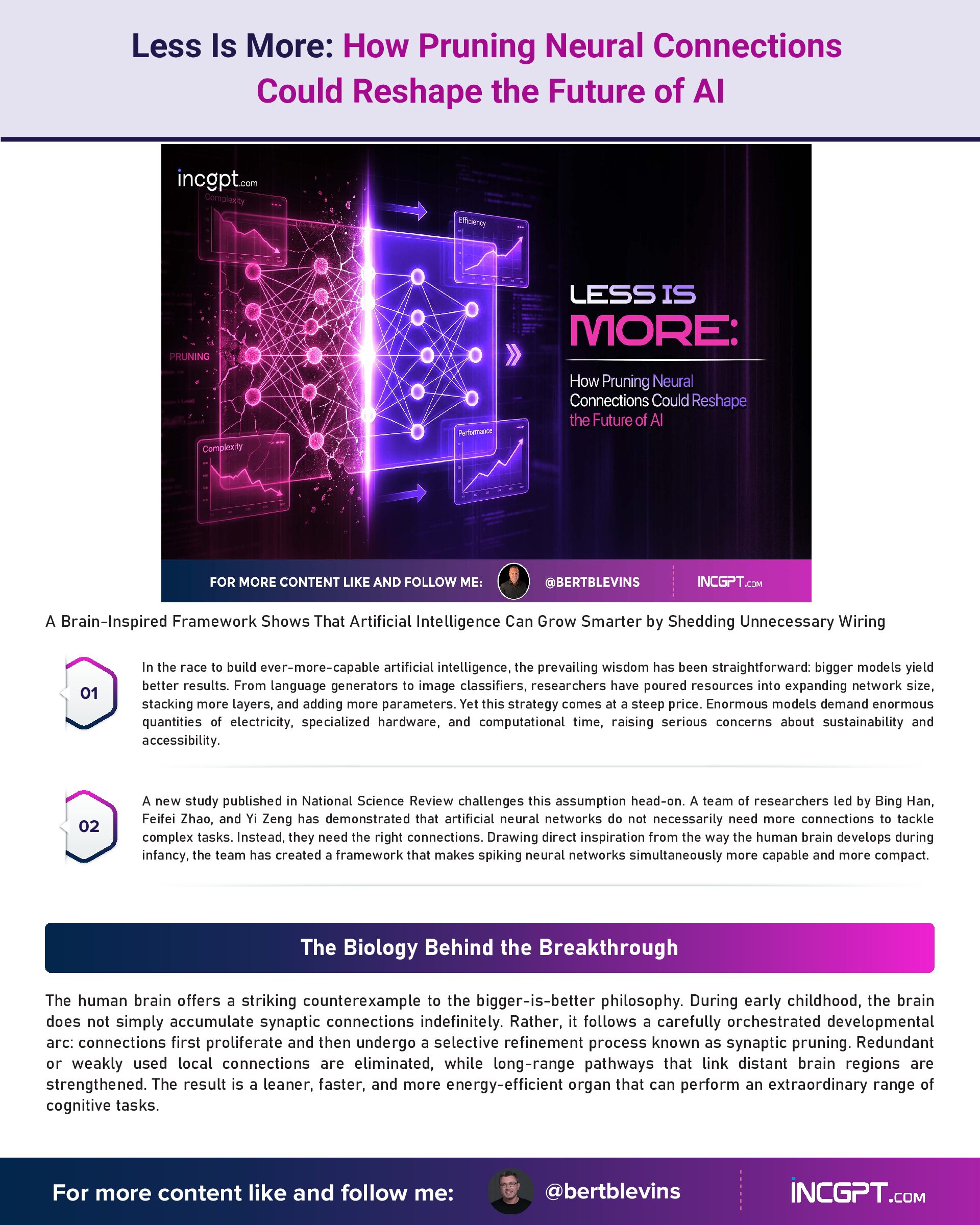
A Brain-Inspired Framework Shows That Artificial Intelligence Can Grow Smarter by Shedding Unnecessary Wiring
In the race to build ever-more-capable artificial intelligence, the prevailing wisdom has been straightforward: bigger models yield better results. From language generators to image classifiers, researchers have poured resources into expanding network size, stacking more layers, and adding more parameters. Yet this strategy comes at a steep price. Enormous models demand enormous quantities of electricity, specialized hardware, and computational time, raising serious concerns about sustainability and accessibility.
A new study published in National Science Review challenges this assumption head-on. A team of researchers led by Bing Han, Feifei Zhao, and Yi Zeng has demonstrated that artificial neural networks do not necessarily need more connections to tackle complex tasks. Instead, they need the right connections. Drawing direct inspiration from the way the human brain develops during infancy, the team has created a framework that makes spiking neural networks simultaneously more capable and more compact.
The Biology Behind the Breakthrough
The human brain offers a striking counterexample to the bigger-is-better philosophy. During early childhood, the brain does not simply accumulate synaptic connections indefinitely. Rather, it follows a carefully orchestrated developmental arc: connections first proliferate and then undergo a selective refinement process known as synaptic pruning. Redundant or weakly used local connections are eliminated, while long-range pathways that link distant brain regions are strengthened. The result is a leaner, faster, and more energy-efficient organ that can perform an extraordinary range of cognitive tasks.
Primary sensory and motor regions mature first, laying the groundwork for higher-order cognitive functions such as planning, language, and social reasoning. This staged development ensures that foundational capabilities are solidly in place before the brain attempts more complex operations. The researchers recognized that this biological strategy could be translated into a powerful blueprint for machine learning.
Translating Development into Code
The framework the team developed is called TD-MCL, short for Temporal Development-inspired Multiple Cognitive Learning. It operates on spiking neural networks (SNNs), a class of artificial networks that process information through discrete electrical pulses, much as biological neurons do. Unlike conventional deep learning models that pass continuous values between layers, SNNs communicate through timed spikes, which makes them inherently more energy-efficient.
TD-MCL mirrors the infant brain’s developmental stages. The system begins by mastering simple perception tasks, then progresses to motor control, and finally takes on interactive, multi-modal challenges. As it advances through each stage, two complementary processes unfold. First, long-range connections between different cognitive modules are gradually strengthened, enabling the network to transfer and reuse knowledge from earlier tasks. Second, a feedback mechanism identifies and removes redundant local connections associated with previously learned tasks, trimming the network’s overall size.
The critical insight is that these two processes work in tandem. The selective pruning does not erase the knowledge gained from earlier stages. Instead, that knowledge has already been encoded in the long-range pathways, allowing the network to recall and apply it even after the local wiring has been stripped away. The network literally gets smaller as it learns more.
Overcoming Catastrophic Forgetting
One of the most persistent problems in artificial intelligence research is catastrophic forgetting. When a standard neural network is trained on a new task, it tends to overwrite the parameters it learned for previous tasks, effectively erasing its earlier competencies. Over the decades, researchers have devised various workarounds, including regularization penalties that discourage parameter changes, experience replay buffers that periodically re-expose the network to old training data, and weight-freezing techniques that lock certain parameters in place.
Each of these strategies carries significant drawbacks: regularization can limit the model’s flexibility, experience replay demands additional memory and computation, and weight freezing can leave the network rigid and unable to adapt. TD-MCL sidesteps all of these approaches. Because it preserves prior knowledge through structural reorganization rather than parameter constraints, the network retains what it has learned without needing any of the conventional crutches. Experimental results show that the model significantly reduces forgetting while continuing to acquire new capabilities, even as its overall size shrinks.
Results That Defy Expectations
The researchers tested TD-MCL across multiple cognitive domains, spanning perception, motor control, and interaction tasks, and benchmarked it against several widely used continual learning methods. The model consistently outperformed baselines, including those that relied on direct training or naïve pruning. On established benchmarks such as CIFAR-100 and ImageNet, TD-MCL achieved competitive or superior accuracy while using fewer parameters than its counterparts.
Detailed analysis of the network’s internal dynamics revealed a pattern strikingly reminiscent of biological development. Local connections initially expanded rapidly during the early phases of learning and were then progressively inhibited and pruned. Meanwhile, cross-regional long-range connections steadily grew stronger, forming the structural backbone that supports knowledge reuse across tasks. This dynamic mirrors the well-documented trajectory of synaptic development in the human brain.
Implications for the Future of AI
The implications of this work extend well beyond a single research paper. As artificial intelligence systems are deployed in an ever-wider array of real-world applications, from autonomous vehicles and medical diagnostics to robotics and environmental monitoring, the demand for models that can learn continuously without ballooning in size and energy consumption will only intensify.
TD-MCL offers a compelling proof of concept that smarter does not have to mean bigger. By taking developmental biology as its guide, the framework demonstrates a viable pathway toward what the researchers call general cognitive intelligence: AI systems that can master a broad repertoire of skills efficiently, sustainably, and without the runaway resource consumption that characterizes today’s largest models.
In an era when the environmental and economic costs of training cutting-edge AI are under growing scrutiny, the idea that a network can become more powerful by becoming smaller is not merely counterintuitive. It may be exactly the paradigm shift the field needs.