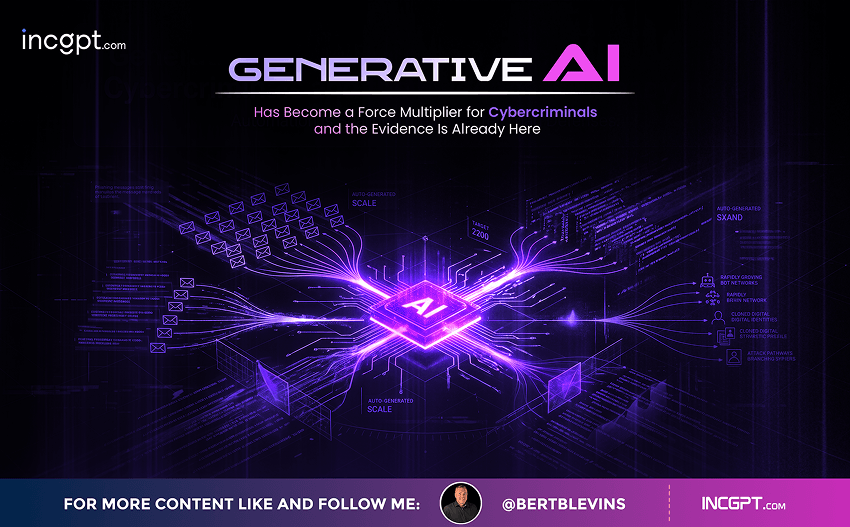
Generative AI Has Become a Force Multiplier for Cybercriminals and the Evidence Is Already Here
For years, cybersecurity experts warned that artificial intelligence would eventually lower the barrier to entry for cybercriminals that the same tools empowering developers and marketers would one day be turned against businesses, governments, and everyday users. That day, it now appears, has already arrived.
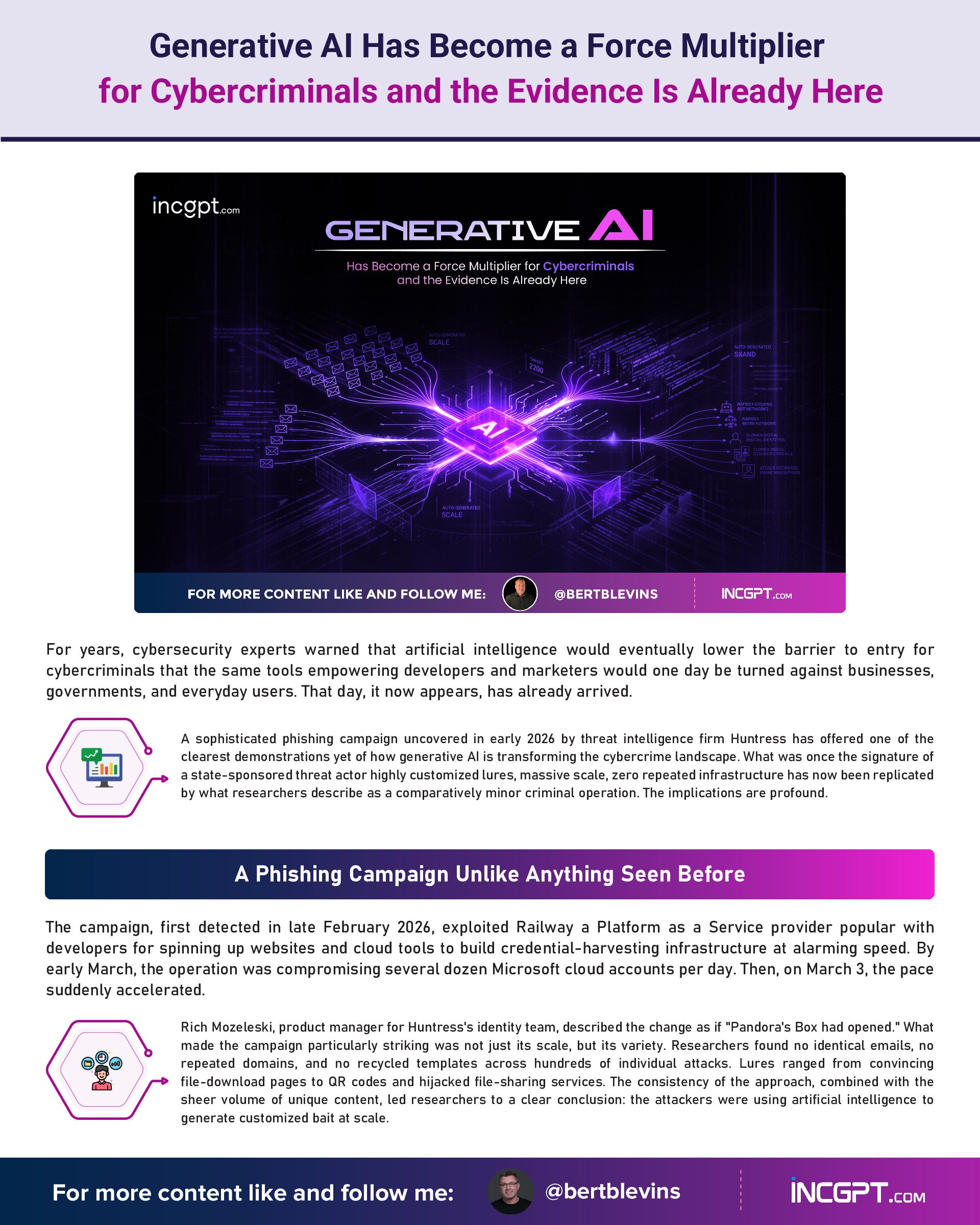
A sophisticated phishing campaign uncovered in early 2026 by threat intelligence firm Huntress has offered one of the clearest demonstrations yet of how generative AI is transforming the cybercrime landscape. What was once the signature of a state-sponsored threat actor highly customized lures, massive scale, zero repeated infrastructure has now been replicated by what researchers describe as a comparatively minor criminal operation. The implications are profound.
A Phishing Campaign Unlike Anything Seen Before
The campaign, first detected in late February 2026, exploited Railway a Platform as a Service provider popular with developers for spinning up websites and cloud tools to build credential-harvesting infrastructure at alarming speed. By early March, the operation was compromising several dozen Microsoft cloud accounts per day. Then, on March 3, the pace suddenly accelerated.
Rich Mozeleski, product manager for Huntress’s identity team, described the change as if “Pandora’s Box had opened.” What made the campaign particularly striking was not just its scale, but its variety. Researchers found no identical emails, no repeated domains, and no recycled templates across hundreds of individual attacks. Lures ranged from convincing file-download pages to QR codes and hijacked file-sharing services. The consistency of the approach, combined with the sheer volume of unique content, led researchers to a clear conclusion: the attackers were using artificial intelligence to generate customized bait at scale.
By the time Huntress published its findings, the campaign had compromised 344 verified victims spanning construction firms, law offices, nonprofits, real estate companies, manufacturers, financial institutions, healthcare providers, and government bodies. Researchers believe the true victim count is far higher potentially running into the thousands globally.
How the Attack Worked: Exploiting Microsoft's Device Authentication Flow
The technical mechanism behind the campaign was as clever as it was troubling. Rather than attempting to steal passwords directly, the attackers exploited a legitimate feature in Microsoft’s authentication system designed for devices that cannot easily display a login page smart televisions, printers, and terminal devices, for example.
This so-called device code authentication flow works by asking users to visit a URL and enter a short code to link their account to the device. The attackers replicated this flow in their phishing pages, tricking victims into handing over valid OAuth tokens essentially digital keys that grant access to a Microsoft cloud account for up to 90 days, with no password or multi-factor authentication check required.
It is an elegant abuse of trusted infrastructure. Because the authentication request appears to come from Microsoft’s own systems, conventional email filters and security tools are poorly equipped to intercept it. Victims, for their part, had little reason to suspect anything was wrong.
Weaponizing Cloud Infrastructure: The Railway Connection
The campaign’s use of Railway as its hosting backbone deserves particular scrutiny. Railway positions itself as a developer-friendly platform that makes it easy to deploy applications without deep technical knowledge. Its own marketing materials highlight how quickly users can spin up self-hosted tools. For a criminal operator, that accessibility is precisely the point.
By routing attacks through Railway’s IP infrastructure, the operators gained a layer of legitimacy that made their traffic harder to block without disrupting legitimate Railway users. When Huntress contacted Railway on March 6 about phishing traffic linked to specific IP addresses and domains, the company confirmed that the accounts were banned and the domains blocked. But the campaign continued.
A Railway solutions engineer acknowledged the challenge, noting that the company’s fraud detection systems rely on correlating signals shared credit cards, overlapping code, repeated infrastructure patterns. When attackers deliberately avoid reusing any of those signals, the system struggles to catch them early. Mozeleski, however, argued that more could be done, pointing to comparable platforms like Mailchimp and HubSpot that impose controls on free-tier users to prevent bulk abuse. His core message was direct: cloud platforms cannot afford to let anonymous users instantly spin up large-scale infrastructure with zero vetting.
The AI Advantage: Why Criminals Are Moving Faster Than Defenders
Perhaps the most unsettling dimension of this campaign is what it reveals about the competitive dynamics of AI adoption in cybersecurity. Defenders particularly in enterprise environments face significant internal friction when deploying AI tools. Legal teams raise concerns about data privacy. Compliance officers worry about model training on sensitive information. Procurement cycles slow things down further.
Criminals face none of those constraints. Prakash Ramamurthy, chief product officer at Huntress, put it bluntly: “We are seeing crooks as the first movers of AI. They don’t have any qualms about PII, they don’t have any qualms about model training.” The result is an asymmetry that security teams are only beginning to grapple with.
John Hultquist, chief analyst at Google’s Threat Intelligence Group, has argued that this dynamic will benefit smaller criminal operations more than it helps state-sponsored hackerswho already have ample resources. For the so-called script kiddie tier of cybercriminals, AI tools effectively close the capability gap between low-level opportunists and sophisticated adversaries. What previously required a team of skilled operators and weeks of preparation can now reportedly be replicated in days by a small group with access to a generative AI model and a cloud hosting account.
An Industry Forced to Respond in Real Time
Huntress’s response to the campaign was itself unprecedented. Faced with more than 50 new compromises per day still flowing through Railway domains, the company pushed a conditional access policy update to 60,000 Microsoft cloud tenants blocking emails originating from Railway infrastructure. Mozeleski described the move as something the company had never done before, a sign of how extraordinary the situation had become.
The incident has prompted renewed calls for the cloud hosting industry to rethink its onboarding and abuse-prevention practices. Critics argue that the free-tier model which allows users to deploy infrastructure almost instantly with minimal identity verification creates an environment that is trivially easy for bad actors to exploit. The economics that make platforms like Railway attractive to legitimate developers are, by their nature, also attractive to criminals.
There are no easy fixes. Overly aggressive fraud detection risks blocking genuine users, as Railway itself discovered in February 2026 when tightening its automated abuse enforcement caused a customer outage. But the alternative maintaining a low-friction environment that criminals can weaponize at scale is no longer tenable.
What Organizations Must Do Now
For organizations on the receiving end of these campaigns, the evolving threat landscape demands an equally adaptive response. The device code authentication attack exploited by this campaign is not new Microsoft has published guidance on restricting it but many organizations have yet to act. Conditional access policies that block device code flow for users who do not require it represent a straightforward and effective mitigation.
More broadly, the campaign underscores the limits of perimeter-based email filtering in a world where AI-generated lures are designed to be unique at every step. Organizations that rely heavily on signature-based detection are increasingly exposed. Behavioral analytics, identity-centric security architectures, and robust incident response capabilities have never been more important.
The AI-powered phishing campaign traced to Railway in early 2026 is almost certainly not an isolated incident. It is, instead, a preview a demonstration of what becomes possible when generative AI tools meet motivated criminal actors unconstrained by the ethical guardrails that govern legitimate enterprise adoption. The pace at which this campaign evolved, from a handful of daily compromises to hundreds in a matter of weeks, should serve as a warning that the cybersecurity community cannot afford to be the slow mover in the AI era