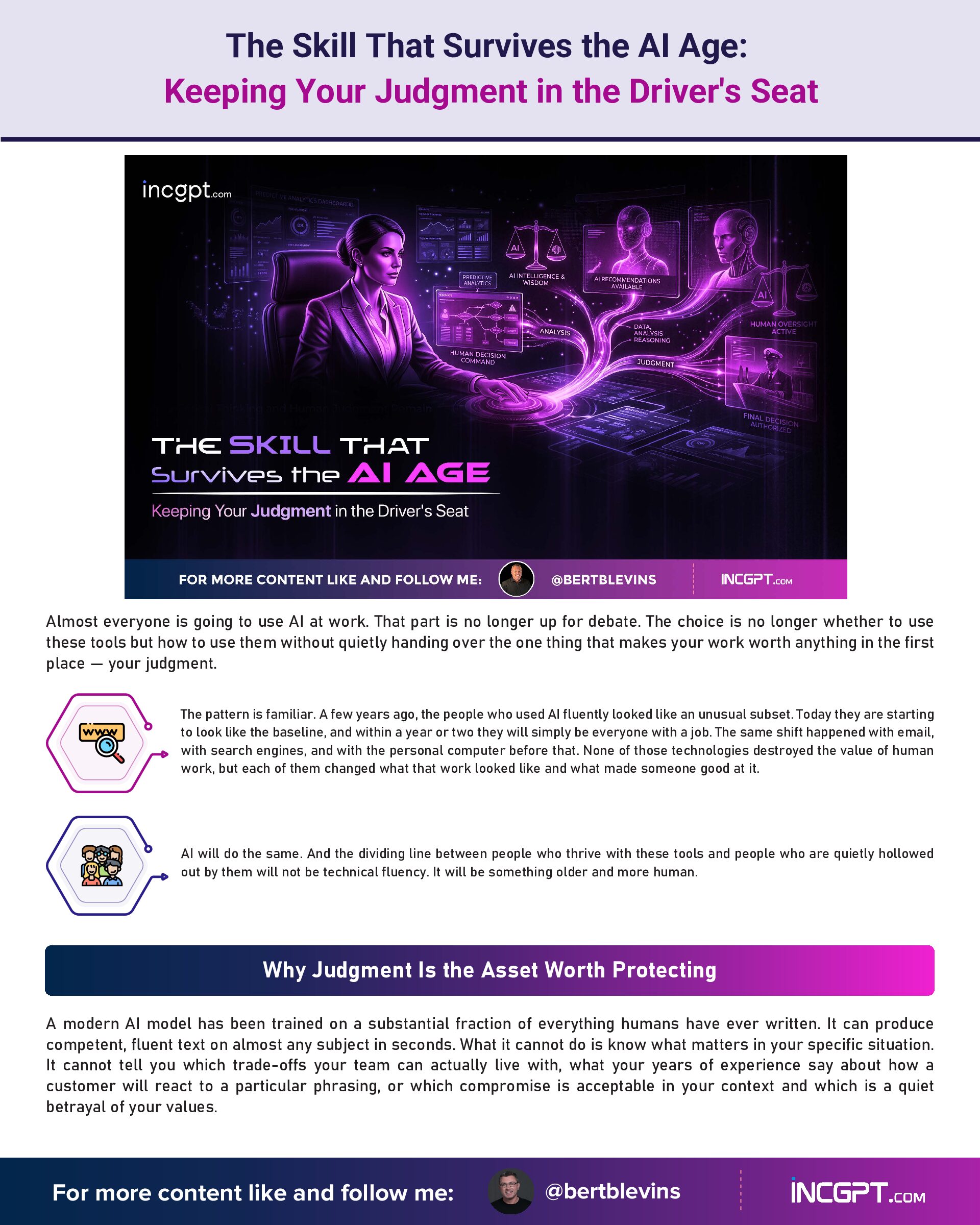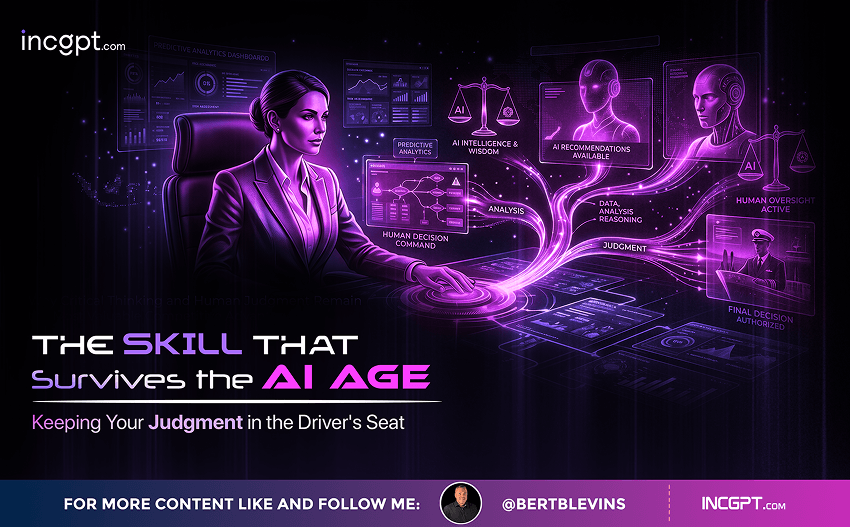
The Skill That Survives the AI Age: Keeping Your Judgment in the Driver's Seat
Almost everyone is going to use AI at work. That part is no longer up for debate. The choice is no longer whether to use these tools but how to use them without quietly handing over the one thing that makes your work worth anything in the first place — your judgment.
The pattern is familiar. A few years ago, the people who used AI fluently looked like an unusual subset. Today they are starting to look like the baseline, and within a year or two they will simply be everyone with a job. The same shift happened with email, with search engines, and with the personal computer before that. None of those technologies destroyed the value of human work, but each of them changed what that work looked like and what made someone good at it.
AI will do the same. And the dividing line between people who thrive with these tools and people who are quietly hollowed out by them will not be technical fluency. It will be something older and more human.
Why Judgment Is the Asset Worth Protecting
A modern AI model has been trained on a substantial fraction of everything humans have ever written. It can produce competent, fluent text on almost any subject in seconds. What it cannot do is know what matters in your specific situation. It cannot tell you which trade-offs your team can actually live with, what your years of experience say about how a customer will react to a particular phrasing, or which compromise is acceptable in your context and which is a quiet betrayal of your values.
That knowledge — call it judgment, call it taste, call it experience — is yours. It is the thing AI does not have and cannot have. And it is the input that turns AI’s enormous but generic capability into work that is actually useful to your specific situation.
Without your judgment, AI produces fluent generic output. Pair it with your judgment, and the combination is genuinely more powerful than either alone. But only if you stay engaged. Only if you remain the one in the conversation, thinking alongside the tool rather than nodding along with whatever it produces.
The Quiet Trap of Cognitive Offloading
Using AI well is not fundamentally a prompting skill. It is a discipline of attention. The principle is simple, but the practice is harder than it sounds because the very thing that makes AI valuable is also what makes it dangerous: the ease with which it responds to anything you ask.
Researchers have a name for what happens when a tool makes mental work feel optional: cognitive offloading. We have always offloaded. Writing things down is offloading. Using a calculator is offloading. Saving phone numbers in a contacts app instead of memorizing them is offloading. None of that is bad. It is the entire point of having tools. The trouble is that offloading is only useful when we offload the right things.
Offload the mechanical, the repetitive, the formatting, the boilerplate, and you free up mental energy to think harder about what actually matters. Offload the wrong things — the judgment about what the work is for, the assessment of whether something is good, the call about what the audience really needs — and you stop using the AI to think better. You start letting it think for you.
This is the slope worth noticing. The fluent, confident, persuasive nature of AI output makes deferring to it feel like the rational choice in the moment. It also makes the slow erosion of your own thinking nearly invisible. Most people who lose their judgment to AI will not notice it happening.
Four Practices for Staying in the Driver's Seat
None of what follows is a rule against using AI. These are working habits for getting more out of it by making sure the human stays the architect of the work.
- Develop your thinking before you write the prompt. If you start with a topic you are vaguely curious about and ask the AI what to think, you have already deferred to it. The strategy and the intent need to be yours first. Come to the tool with a position you would be willing to defend, then use the AI to challenge it, sharpen it, stress-test it. Asking the machine to argue with you is fine. Asking it to think for you is not.
- Sketch the destination before you delegate the execution. Do not hand the AI a blank canvas. Give it a defined problem with a rough shape of where you want to end up, and let it help you fill in the details. The architecture — the requirements, the constraints, the logic — needs to stay yours. If you cannot describe what good would look like before you ask, you are not ready to use the tool yet. Whatever you get back will look finished without actually being yours.
- Use AI to surface the evidence. Interpret it yourself. AI is genuinely excellent at finding research, mapping a field, and pointing you toward studies that support or challenge a view. Use it for all of that. What you should not outsource is the meaning. The interpretation — what the evidence really shows, where it falls short, which way it cuts on your specific question — must remain a human act. Otherwise you end up confidently quoting conclusions you did not actually examine.
- Notice when you are reaching for AI to dodge discomfort. Sometimes we open a chat window because a task is genuinely tedious and the tool will make it less so. That is fine. Sometimes we open it because a task is hard in a way that matters — the part where you have to think clearly, choose between bad options, or write something that will be read by someone whose opinion of you matters. Those are the moments to lean in, not to delegate. The friction is the work. The work is where the judgment lives.
The Edge That Stays Human
These habits are not limits on AI use. They are the conditions under which AI use actually compounds into something that looks like your work rather than something that looks like everyone else’s. They are how you stay in the driver’s seat instead of becoming a passenger on a sea of confident machine output.
The central skill of the AI age, then, is the willingness to keep doing the thinking yourself. To be the architect or the orchestrator of the process rather than its recipient. To know where you are going before you start, and to keep your hands on the wheel even when the road feels like it is driving itself.
The most powerful tool ever built will not save someone who has stopped thinking for themselves. The discipline of the next decade has two parts: learning to use these systems with real skill, and refusing to let them use you in return.