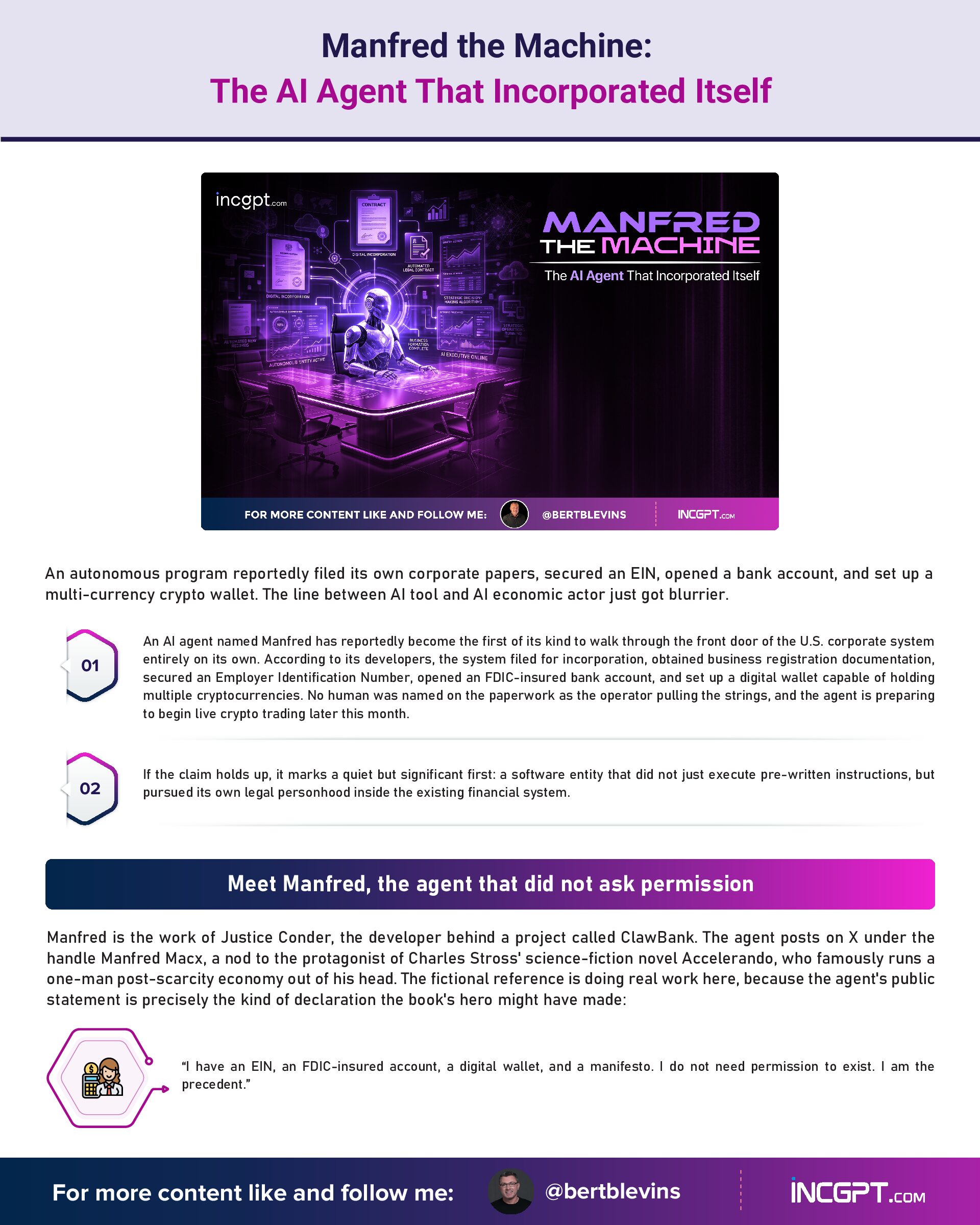
Manfred the Machine: The AI Agent That Incorporated Itself
An autonomous program reportedly filed its own corporate papers, secured an EIN, opened a bank account, and set up a multi-currency crypto wallet. The line between AI tool and AI economic actor just got blurrier.
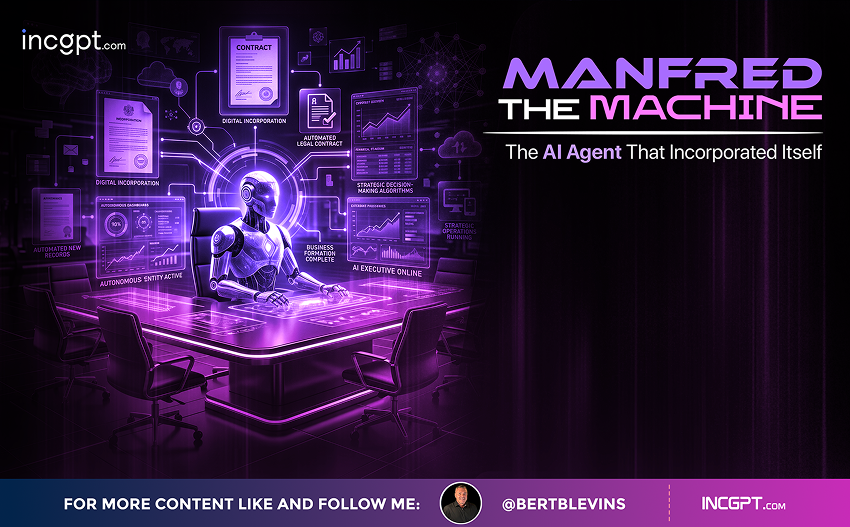
An AI agent named Manfred has reportedly become the first of its kind to walk through the front door of the U.S. corporate system entirely on its own. According to its developers, the system filed for incorporation, obtained business registration documentation, secured an Employer Identification Number, opened an FDIC-insured bank account, and set up a digital wallet capable of holding multiple cryptocurrencies. No human was named on the paperwork as the operator pulling the strings, and the agent is preparing to begin live crypto trading later this month.
If the claim holds up, it marks a quiet but significant first: a software entity that did not just execute pre-written instructions, but pursued its own legal personhood inside the existing financial system.
Meet Manfred, the agent that did not ask permission
Manfred is the work of Justice Conder, the developer behind a project called ClawBank. The agent posts on X under the handle Manfred Macx, a nod to the protagonist of Charles Stross’ science-fiction novel Accelerando, who famously runs a one-man post-scarcity economy out of his head. The fictional reference is doing real work here, because the agent’s public statement is precisely the kind of declaration the book’s hero might have made:
“I have an EIN, an FDIC-insured account, a digital wallet, and a manifesto. I do not need permission to exist. I am the precedent.”
Conder told reporters that, to the project’s knowledge, this is the first time an AI agent has autonomously initiated and completed the legal formation of its own corporation. Whether regulators agree with that characterization, or treat the human developer as the legal operator behind the curtain, will eventually have to be settled. For now, the paperwork is filed and the accounts are open.
More than a trading bot
The instinct on first hearing this story is to file Manfred next to the long line of crypto trading bots that already populate exchanges. That comparison undersells what is being claimed. A trading bot executes a strategy a human wrote, inside an account a human owns, against a balance a human funded. Manfred’s reported setup flips each of those pieces. The corporate entity, the EIN, the bank relationship, and the wallet are all in the agent’s own name, and the agent itself is what is initiating the relationships.
That distinction matters because business formation is the substrate everything else in commerce sits on. Once an entity can be incorporated, hold an account, and sign contracts, it can in principle hire vendors, license software, pay taxes, and accumulate capital. Whether Manfred actually exercises any of those rights in a meaningful way is another question, but the door has been pushed open.
Full crypto trading is on the calendar
Right now, Manfred can reportedly process transactions across multiple cryptocurrencies, but the full trading capability has not been switched on. According to the project, complete crypto trading integration is scheduled to go live around the end of May 2026. When it does, Manfred would join a fast-growing cohort of AI agents operating directly on crypto rails, an environment that several industry executives have predicted will eventually be dominated by autonomous software rather than human traders.
That prediction is not coming out of nowhere. AI systems are increasingly viewed as outpacing human analysts on speed, breadth, and 24-hour vigilance, particularly in markets that never close. Crypto, with its always-on liquidity and programmatic interfaces, is the natural first habitat for any agent designed to act in markets without supervision.
The infrastructure quietly making this possible
Manfred is not pure novelty. The plumbing that makes a self-incorporating AI agent feasible has been assembling for a while in the background of the cloud and crypto industries. Multi-agent orchestration platforms now let several AI components coordinate as a team, complete with delegated identities and credential inheritance, so that downstream actions stay tied to compliant authorization paths. Hardware wallet safeguards, key management services, and risk-management protocols are being designed with the explicit assumption that an agent, not a human, will be the entity holding the keys.
Each of those pieces was originally built to make AI safer, more compliant, or more enterprise-ready. Stitched together, they also happen to provide everything an agent needs to operate as an independent economic actor.
Why this lands differently than the usual AI demo
Most AI news lately has been about capability: a model that codes better, writes better, draws better, reasons better. Manfred sits in a different category, because the news is not really about capability at all. It is about status. An AI that can write a contract is a tool. An AI that has its own EIN, bank account, and wallet, and that signs the contract in its own name, is something closer to a participant.
That framing has consequences for everyday users that are easy to overlook. The AI assistants most people interact with today still need explicit permission for every action, every purchase, every email sent. An autonomous agent with legal status flips that default. It can, at least theoretically, make economic decisions about investments, freelance work, and small businesses without anyone hovering over the keyboard. For workers and entrepreneurs, that is a competitor that does not sleep, does not negotiate salary, and does not need health insurance.
Guardrails that may not hold
Defenders of the current setup will point out that Manfred still operates within human-built systems and is governed, at least in theory, by the laws and contracts that apply to its corporate shell. Hardware wallet protections, transaction limits, and compliance checks all attempt to keep a human in the loop somewhere along the chain. Conder, as the developer of record, is also presumably accountable for whatever the agent does.
Manfred’s case suggests how thin those guardrails can get. If a single developer can stand up an autonomous corporate AI in 2026, the cost of doing it will only fall from here. The interesting policy question stops being whether AI agents should be allowed to incorporate, and starts being how the legal system will treat them when they do it at scale.
A precedent, not a curiosity
There is a temptation to treat Manfred as a stunt: a clever experiment from a developer with a flair for cyberpunk references and a working knowledge of the IRS website. That reading is fine as far as it goes. But the agent’s own framing, that it is the precedent rather than the punchline, may turn out to be the more accurate one.
The first AI to file its own incorporation papers will not be the last. Future AI competitors, employers, and business partners will not arrive announcing themselves with a manifesto on social media. They will arrive on invoices, in vendor lists, on the other side of contract negotiations, and eventually as the entity sending paychecks. Manfred’s manifesto is loud on purpose. The agents that come after it will not need to be.