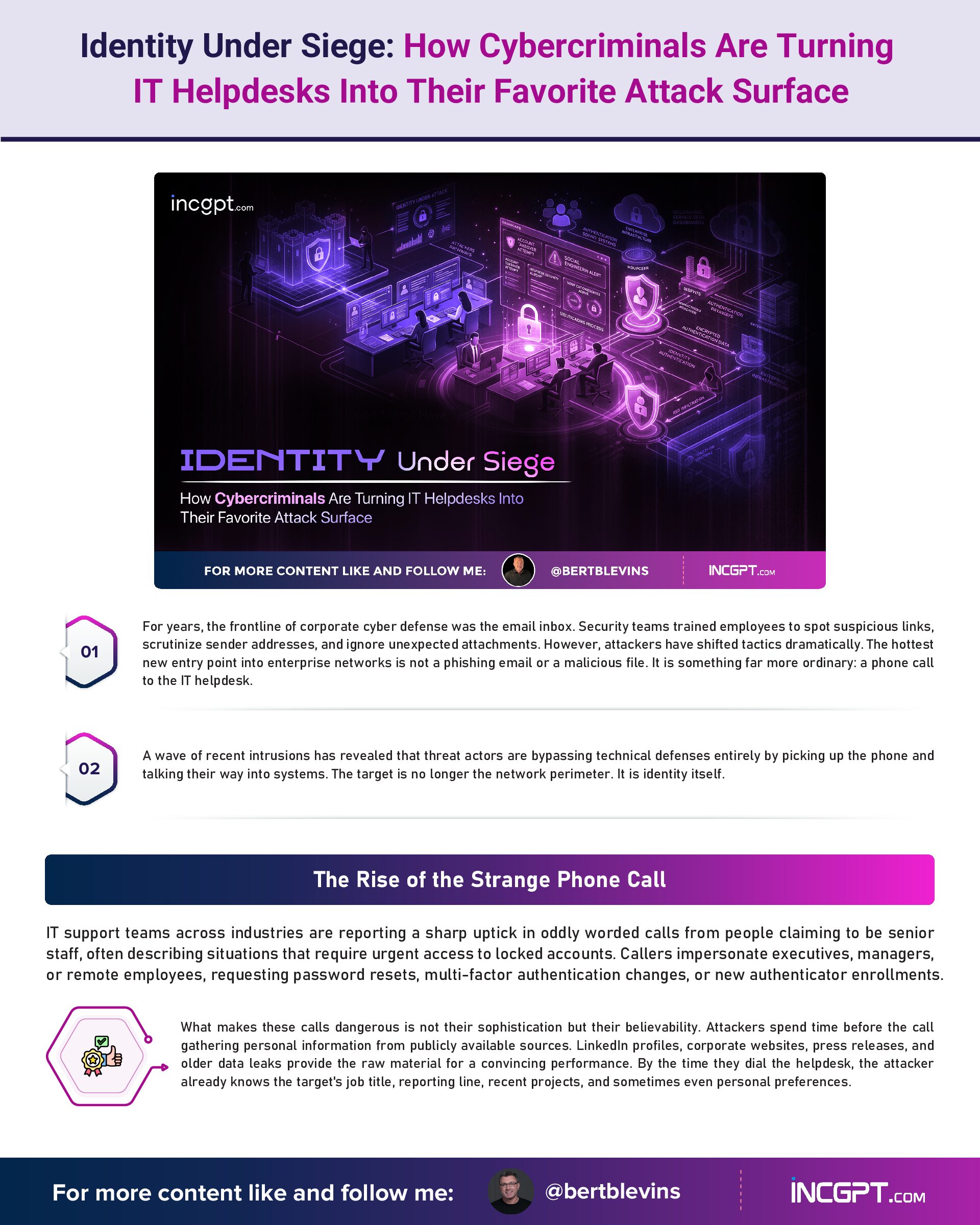
Identity Under Siege: How Cybercriminals Are Turning IT Helpdesks Into Their Favorite Attack Surface
For years, the frontline of corporate cyber defense was the email inbox. Security teams trained employees to spot suspicious links, scrutinize sender addresses, and ignore unexpected attachments. However, attackers have shifted tactics dramatically. The hottest new entry point into enterprise networks is not a phishing email or a malicious file. It is something far more ordinary: a phone call to the IT helpdesk.
A wave of recent intrusions has revealed that threat actors are bypassing technical defenses entirely by picking up the phone and talking their way into systems. The target is no longer the network perimeter. It is identity itself.
The Rise of the Strange Phone Call
IT support teams across industries are reporting a sharp uptick in oddly worded calls from people claiming to be senior staff, often describing situations that require urgent access to locked accounts. Callers impersonate executives, managers, or remote employees, requesting password resets, multi-factor authentication changes, or new authenticator enrollments.
What makes these calls dangerous is not their sophistication but their believability. Attackers spend time before the call gathering personal information from publicly available sources. LinkedIn profiles, corporate websites, press releases, and older data leaks provide the raw material for a convincing performance. By the time they dial the helpdesk, the attacker already knows the target’s job title, reporting line, recent projects, and sometimes even personal preferences.
How the Deception Unfolds
A typical scenario begins with a caller introducing themselves as a senior leader traveling abroad for a critical meeting. The voice sounds rushed and slightly frustrated. They explain that their phone was lost or stolen and they cannot access their authenticator app. A client presentation begins in minutes, and they urgently need the helpdesk to reset multi-factor authentication so they can log in.
The pressure is deliberate. Urgency short-circuits careful verification. Helpdesks are measured on resolution speed, and most support agents are trained to be helpful rather than suspicious.
When a convincing voice mentions the names of real colleagues, references actual projects, and invokes the authority of a senior title, the temptation to comply is enormous.
In some documented cases, the same attacker has placed multiple calls to the same helpdesk, changing their voice or persona each time until one attempt succeeds. Meanwhile, the real executive is at their desk, entirely unaware that a stranger is actively stealing their digital identity.
This technique is increasingly known as Okta vishing, a blend of voice phishing and targeted identity compromise. The name refers to the identity provider most commonly abused, though the same approach works against any platform that allows helpdesk-initiated authentication resets.
Why Identity Providers Are the New Crown Jewels
Modern enterprises rely on single sign-on to simplify access across dozens or hundreds of applications. A single authenticated session with an identity provider unlocks corporate email, collaboration suites, cloud storage, customer relationship management systems, and developer tools. The efficiency benefits are enormous, but the security tradeoff is substantial.
Once an attacker succeeds in convincing a helpdesk to reset multi-factor authentication on a single account, they inherit the trust relationships tied to that identity. They do not need to compromise each connected application individually. Logging in once grants them sweeping access to SharePoint files, Slack channels, Salesforce records, and Microsoft 365 mailboxes.
This is why defenders now describe identity as the new battleground. The perimeter is no longer a network edge. It is the moment a helpdesk agent decides whether a voice on the phone is authentic.
What Happens After the Breach
Once inside, attackers move quickly to establish persistence and extract value. Common post-compromise activities include downloading large volumes of SharePoint data, exporting entire inboxes, creating hidden email forwarding rules, registering new OAuth applications to preserve access, and generating API tokens that survive password changes.
In many cases, what started as a helpdesk deception rapidly evolves into a full cloud data theft event. The stolen information may be sold, used for extortion, or leveraged to pivot into connected partner networks. Because the initial access was granted through a legitimate authentication reset, traditional indicators of compromise are often absent from the logs.
Why Technical Controls Alone Fail
Multi-factor authentication, which was supposed to defeat stolen passwords, works exactly as designed in these attacks. The problem is that humans are tricked into weakening it. Antivirus software cannot flag a telephone conversation. Firewalls cannot block a confident voice. Even the most advanced endpoint detection tools have no visibility into what happens during a support call.
The attack exploits organizational structure rather than software flaws. Helpdesks are rewarded for speed. Remote work normalizes identity troubleshooting. Corporate org charts are public. Employee details are everywhere online. Attackers have assembled these conditions into a repeatable playbook.
Building Defenses Against Voice-Based Intrusions
Organizations that have successfully blunted these attacks share a few common practices. They require out-of-band verification for any multi-factor reset, often through a callback to a phone number on file rather than the one shown on caller ID. They introduce mandatory cooling-off periods on sensitive account changes, making urgency-based pressure tactics less effective. Some require manager approval for resets involving privileged accounts.
Security operations teams should also monitor their identity provider logs for warning signs. Multi-factor resets without a clear support ticket, new device enrollments followed by unusual downloads, or logins from unfamiliar autonomous system numbers immediately after an authentication change all deserve immediate investigation.
Training helpdesk staff to recognize manipulation is equally important. Agents should feel empowered to slow down, ask verification questions a stranger could not answer, and escalate suspicious calls without fear of being blamed for poor customer service. A culture that treats caution as professionalism, rather than obstruction, is one of the strongest defenses available.
The Road Ahead
The shift from email phishing to voice-based identity attacks reflects a broader truth about cybersecurity. Attackers always find the weakest link, and that link is now the conversation between a support agent and a voice claiming to be someone important. Until organizations treat helpdesk interactions with the same rigor applied to technical controls, the bizarre phone call will remain one of the most effective ways into the modern enterprise.