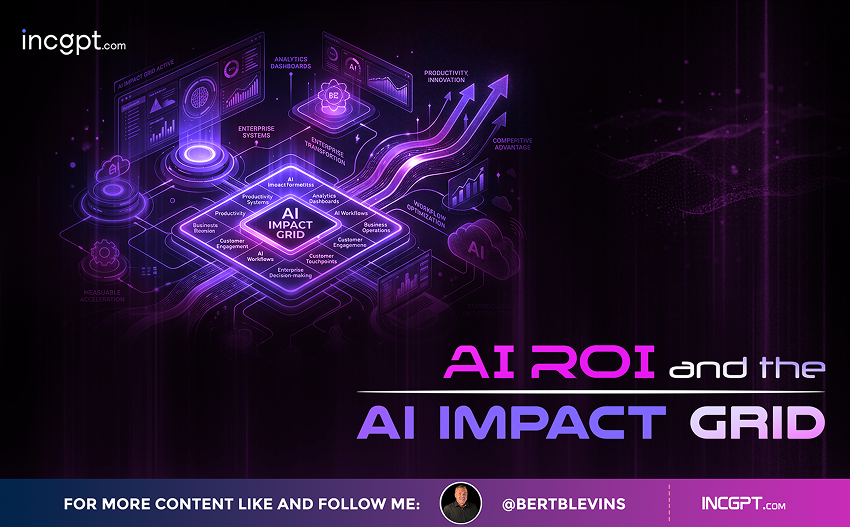
AI ROI and the AI Impact Grid: Understanding the Connection Between Intelligence and Action
The AI ROI Problem
The AI return on investment (ROI) issue is not about a lack of intelligence in AI systems; rather, it stems from the gap between the insights AI provides and the actions businesses take as a result. This is often referred to as the “gap between intelligence and action.” In traditional AI workflows, the process tends to flow as follows:
- Machine Learning (ML)/Generative AI models produce insights.
- These insights are displayed through beautiful dashboards, making it clear what’s happening or what could happen.
- However, despite all these insights, many businesses fail to translate them into actionable steps, leading to zero execution.
This disconnect between the recommendation phase and actual implementation is where the real challenge of AI ROI lies. While the insights may be valuable, the lack of follow-through is where businesses often fall short. This is where the AI Impact Grid framework comes into play, offering a structured approach to bridge this gap.
The AI Impact Grid Framework
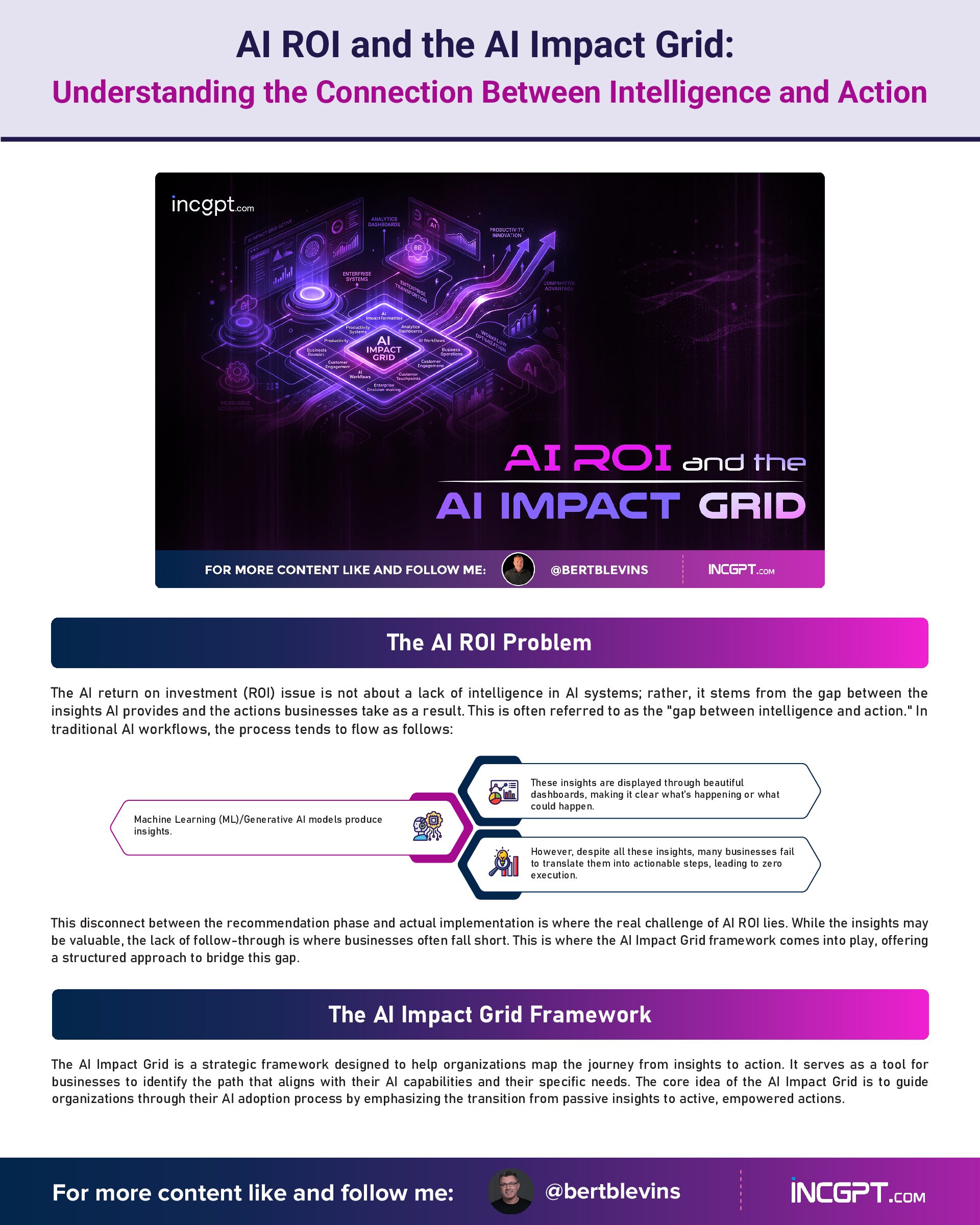
The AI Impact Grid is a strategic framework designed to help organizations map the journey from insights to action. It serves as a tool for businesses to identify the path that aligns with their AI capabilities and their specific needs. The core idea of the AI Impact Grid is to guide organizations through their AI adoption process by emphasizing the transition from passive insights to active, empowered actions.
Dimensions of the AI Impact Grid
The grid is built on two key dimensions:
- Authority (Advisory to Empowered): This dimension reflects the level of control or decision-making ability given to the AI. At one end, AI acts merely as an advisory tool, providing insights without influence over decision-making. At the other end, AI is empowered to make decisions and take actions autonomously.
- Action (Passive to Active): This dimension describes the range of actions the AI can take. On the passive side, AI provides insights or recommendations but does not directly influence actions. On the active side, AI executes tasks autonomously, driving actions without the need for human intervention.
Four Types of AI in the AI Impact Grid
Based on the two dimensions, the AI Impact Grid categorizes AI into four distinct types, each representing a different level of authority and action:
- Analytic AI: This type of AI is focused on predictive and prescriptive models. It helps businesses understand what is happening and what could happen, but it stops short of taking action itself. The AI here provides insights but does not drive execution.
- Generative AI: This AI creates outputs such as code, text, images, or even plans. It generates new content based on patterns learned from data but does not take direct actions on its own. Generative AI is typically used for creative or development tasks.
- Assistive AI: Assistive AI acts as a copilot, providing advisory support to humans. It may include tools like RAG chatbots, which help users by answering questions or offering recommendations, but the final decision-making remains in human hands. It enhances human actions but does not independently execute tasks.
- Autonomous AI: At the most empowered level, autonomous AI can make decisions and execute tasks independently. This type of AI does not require human intervention for decision-making or execution. It operates autonomously, driving results based on its programming and learned behaviors.
The Paths to Success in AI Integration
Organizations can achieve active and autonomous AI through several paths, depending on their current capabilities and goals. The AI Impact Grid suggests different routes for businesses at different stages of AI adoption:
- Assistive Route: Organizations starting with advisory tools like RAG chatbots typically begin with AI offering recommendations and assistance to humans. Over time, they may gradually increase the AI’s authority, allowing it to take more actions autonomously.
- Analytics Evolution: Teams with strong data foundations might evolve from predictive and prescriptive models (analytic AI) to fully autonomous systems. This path allows them to build on solid data insights before moving to autonomous execution.
- Generative Acceleration: Developers focused on generative AI, such as creating code or content, can accelerate toward implementing autonomous agentic systems. This involves shifting from simply generating outputs to building systems that autonomously drive business actions.
Why Use the AI Impact Grid?
The AI Impact Grid provides several benefits for organizations:
- Mapping Current AI Initiatives: The grid helps businesses assess their current AI landscape and understand where they stand in terms of AI capabilities and actions.
- Choosing the Best Path: It guides businesses in selecting the most suitable path for their unique situation, taking into account their current capabilities and desired outcomes.
- Understanding Foundations: The grid helps businesses identify the foundational elements needed for each step in their AI journey. It ensures they understand the resources, tools, and strategies required to move from insights to empowered actions.
- Strategic Sequencing: The AI Impact Grid provides a roadmap for organizations to strategically sequence their AI journey. It ensures that businesses take the right steps in the right order to maximize the effectiveness of their AI initiatives.
By using the AI Impact Grid, businesses can ensure that they are not simply adopting someone else’s AI roadmap but are instead crafting a path that is tailored to their specific needs, capabilities, and desired outcomes.
Conclusion: Advancing from Insights to Empowered Actions
The AI Impact Grid is a crucial framework for organizations aiming to close the gap between insights and execution. It helps businesses navigate their AI journey by offering a structured approach to integrating AI into workflows, ultimately enabling AI to move from simply providing valuable insights to driving meaningful actions. By following the grid, businesses can improve their AI ROI, ensure that they make the most of their AI investments, and achieve greater success in their AI initiatives.