Google Just Gave Karpathy's LLM Wiki Idea the Standard It Was Missing
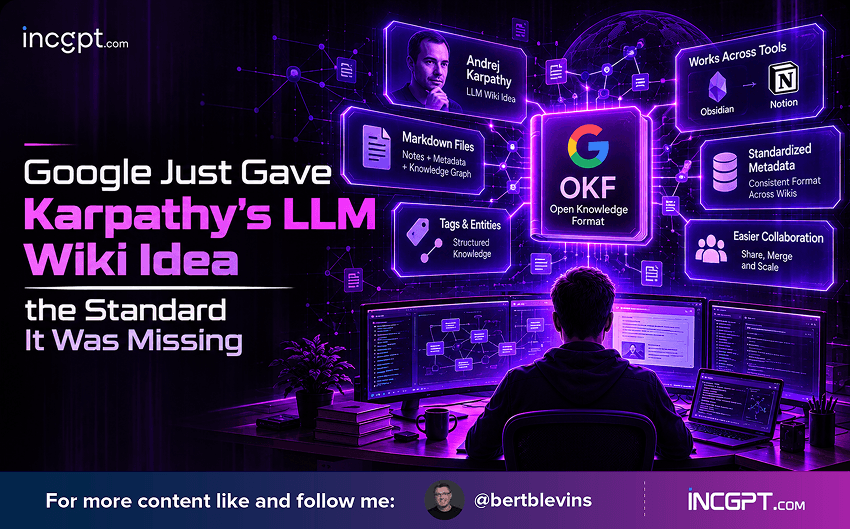
There’s a familiar arc in software: someone shares a clever personal workflow, a community runs with it, and within a year the idea has fractured into a dozen incompatible versions of itself. That’s roughly what happened to Andrej Karpathy’s LLM wiki concept — the idea of using markdown files, tags, and metadata to let a language model build and navigate a personal knowledge graph. It caught on fast. It also splintered fast, because nobody had agreed on what the underlying files should actually look like. Google’s new Open Knowledge Format, or OKF, is an attempt to fix that at the root.
The premise behind Karpathy’s original idea was simple enough: instead of storing notes as inert text, structure them so a model could traverse relationships between them — pulling connected concepts, following tags, building context on the fly. It worked well for individuals tinkering with their own second brain. The trouble started the moment more than one person, or more than one tool, got involved. One person’s tagging scheme wasn’t another’s. A wiki built for Obsidian didn’t necessarily play nicely with Notion. And without any shared convention for what counted as valid metadata, keeping a knowledge base consistent over time became a chore that mostly fell on whoever was technical enough to fix it.
Where things were breaking down
Three problems kept showing up as these wikis scaled past a single user. Metadata conventions varied so much from one wiki to the next that combining or comparing them was messy at best. Hooking a wiki into external tools required custom glue work every time, because there was no common interchange format to build against. And ongoing upkeep — the unglamorous work of keeping tags, categories, and entity references coherent — tended to fall apart once a project grew beyond whoever originally set it up, especially for people without a technical background.
None of these issues were fatal on their own. Together, they capped how far the idea could scale. A format that only works cleanly for its original author isn’t really a format — it’s a habit.
What OKF actually changes
According to Cole Medin, whose commentary on the release framed much of the initial discussion, OKF’s fix is less about adding new capability and more about agreeing on the basics. It defines a consistent set of metadata fields — how tags, categories, and entities should be represented — so that a wiki built by one person, on one tool, remains legible to another person on a completely different setup. That consistency is also what makes it plug into existing note-taking software like Obsidian and Notion without the custom scripting that used to be required.
The other half of the design is restraint. OKF was deliberately kept minimal rather than feature-rich, on the logic that a knowledge format’s biggest enemy is its own learning curve. The lower the barrier to producing a compliant wiki, the more likely people are to actually adopt the standard instead of working around it. It’s the same logic that’s made plenty of lightweight, unglamorous formats outlast their more elaborate competitors.
What this unlocks in practice
The most immediate benefit is collaborative: once metadata means the same thing across wikis, sharing and merging knowledge bases stops being a manual translation exercise. A team can build a shared repository — say, a curated reference set on a research topic or an internal technical domain — without someone having to normalize everyone’s tagging habits first. Because the structure is standardized, querying agents can also traverse and extract information more reliably, since they’re no longer guessing at how a given wiki organizes itself.
That combination is what makes OKF useful for building what amount to portable knowledge bundles — structured, metadata-rich collections on a specific subject that can be handed off, extended, or queried by an LLM without extensive reformatting first.
For teams doing collaborative research or maintaining shared technical documentation, that portability is the actual point.
The pushback
Not everyone is convinced minimalism is a virtue here. The criticism that’s surfaced most is that OKF’s stripped-down design, while easy to adopt, may not have enough expressive range for more elaborate use cases — the kind of deeply interlinked, domain-specific knowledge graphs some power users were already building by hand. Whether that’s a real limitation or simply a sign the format hasn’t finished evolving is still an open question. Supporters tend to read the simplicity as a feature rather than a gap: a foundation deliberately built to be extended later, rather than a finished product trying to do everything at once.
The bigger picture
Standards rarely win by being the most capable option on paper — they win by being the one enough people actually agree to use. If OKF’s minimalism is what gets it broad adoption, that alone could be enough to reshape how personal and team knowledge bases get built going forward, even if more sophisticated formats eventually branch off from it. For now, it gives Karpathy’s original idea something it never quite had: a shared baseline that lets people build on each other’s work instead of quietly maintaining their own incompatible version of the same concept.