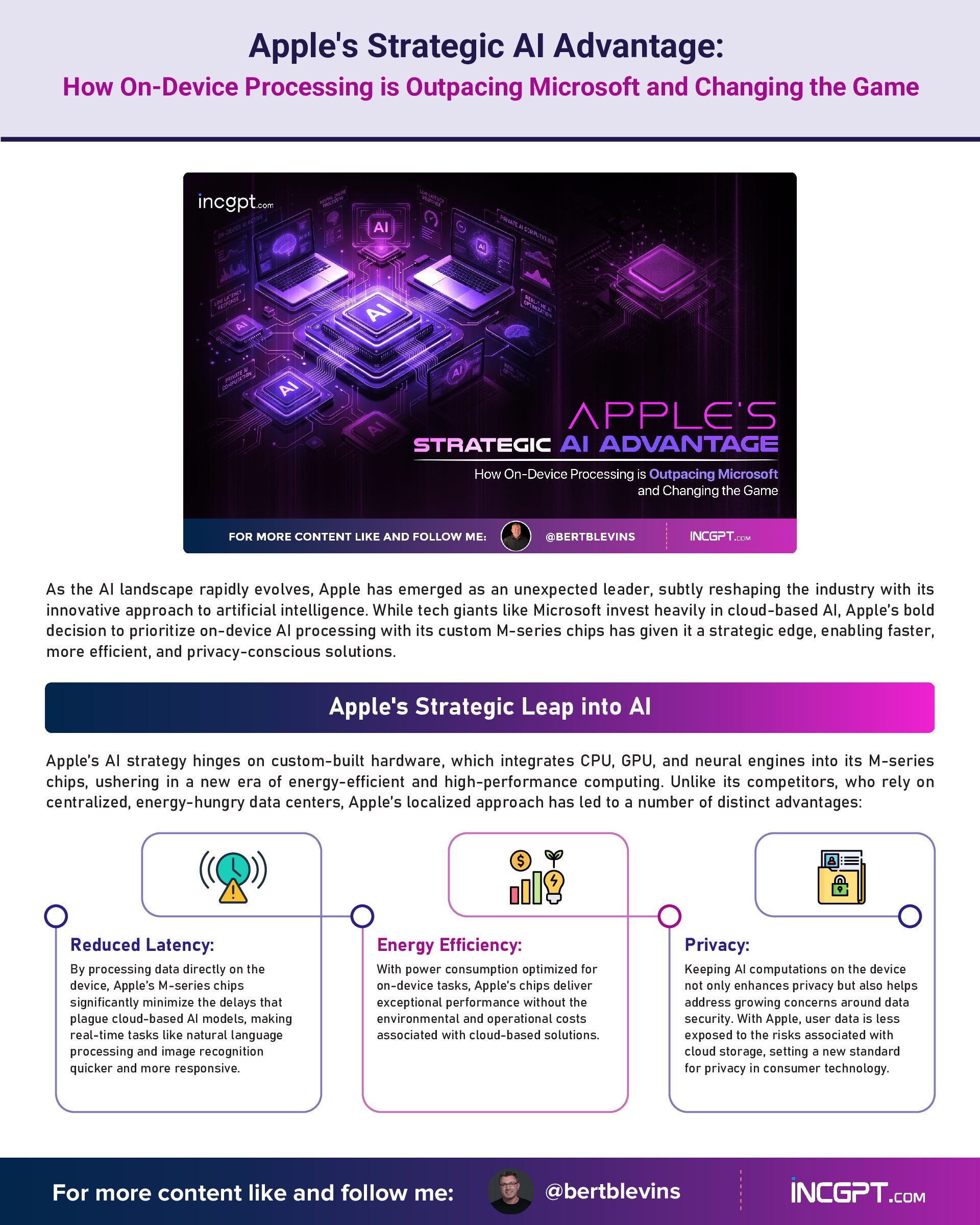

Apple's Strategic AI Advantage: How On-Device Processing is Outpacing Microsoft and Changing the Game
As the AI landscape rapidly evolves, Apple has emerged as an unexpected leader, subtly reshaping the industry with its innovative approach to artificial intelligence. While tech giants like Microsoft invest heavily in cloud-based AI, Apple’s bold decision to prioritize on-device AI processing with its custom M-series chips has given it a strategic edge, enabling faster, more efficient, and privacy-conscious solutions.
Apple's Strategic Leap into AI
Apple’s AI strategy hinges on custom-built hardware, which integrates CPU, GPU, and neural engines into its M-series chips, ushering in a new era of energy-efficient and high-performance computing. Unlike its competitors, who rely on centralized, energy-hungry data centers, Apple’s localized approach has led to a number of distinct advantages:
- Reduced Latency: By processing data directly on the device, Apple’s M-series chips significantly minimize the delays that plague cloud-based AI models, making real-time tasks like natural language processing and image recognition quicker and more responsive.
- Energy Efficiency: With power consumption optimized for on-device tasks, Apple’s chips deliver exceptional performance without the environmental and operational costs associated with cloud-based solutions.
- Privacy: Keeping AI computations on the device not only enhances privacy but also helps address growing concerns around data security. With Apple, user data is less exposed to the risks associated with cloud storage, setting a new standard for privacy in consumer technology.
Apple’s focus on a unified architecture in its M-series chips—combining CPU, GPU, and neural engines—ensures seamless integration of AI tasks, from performance to energy efficiency. This strategic shift to hardware-first AI places Apple ahead of its competitors in terms of delivering sustainable, efficient, and consumer-centric AI solutions.
Microsoft’s Cloud-Centric AI: Opportunities and Challenges
In contrast, Microsoft’s AI strategy revolves around its Azure platform, providing cloud-based solutions that excel in large-scale data processing. While Azure is well-suited for handling massive datasets and enterprise-level workloads, it faces several limitations:
- High Energy Consumption: The cloud-first approach requires extensive data centers, leading to higher operational costs and environmental concerns.
- Latency Issues: Real-time applications suffer from delays due to the need to send data to and from remote servers.
- Lack of On-Device Processing: With no emphasis on localized AI, Microsoft is unable to meet the growing demand for efficient, privacy-conscious AI solutions.
Although Microsoft’s cloud infrastructure remains robust for large-scale tasks, its lack of on-device AI capabilities puts it at a disadvantage as the demand for privacy, efficiency, and real-time processing grows.
Intel's Missed Opportunities in AI Hardware
Intel, once a dominant force in the processor market, has found itself trailing in the AI race. Unlike Nvidia, whose GPUs are now the backbone of AI, Intel’s focus on integrated graphics has limited its ability to cater to AI-specific workloads. Its lack of specialized AI hardware means it struggles to support advanced AI tasks, such as training large language models or running cutting-edge machine learning frameworks.
This strategic misstep has allowed competitors, particularly Nvidia, to capture the market for AI hardware, with Intel’s failure to adapt resulting in missed opportunities in the evolving AI ecosystem.
Localized AI: Apple's Competitive Edge
Apple’s decision to integrate AI processing directly into its devices represents a significant shift from traditional cloud-based models. By focusing on localized AI, Apple addresses several key challenges:
- Reduced Latency: On-device AI eliminates the delays caused by data transmission, enabling real-time applications like voice assistants and augmented reality experiences to run smoothly.
- Privacy and Security: With data processed locally, users retain control over their information, aligning with growing consumer concerns about data breaches and privacy.
- Energy Savings: Localized AI reduces the energy footprint of AI tasks, making it a more sustainable choice compared to the energy-intensive cloud alternatives.
Apple’s M-series chips are specifically optimized for AI tasks such as matrix multiplication, a fundamental operation in machine learning. This hardware-focused strategy positions Apple as the leader in the consumer AI space, offering a sustainable, efficient, and private solution for AI-driven tasks.
Empowering Developers: Apple's Ecosystem of AI Tools
Apple’s commitment to innovation extends beyond hardware to include a comprehensive ecosystem for developers. Tools like Core ML, a machine learning framework designed to simplify the deployment of AI models on Apple devices, enable developers to fully harness the power of the M-series chips. These resources empower developers to create AI-powered applications that take advantage of Apple’s superior hardware, solidifying its position as an industry leader in AI.
The Future of AI: Hardware Innovation as a Catalyst
Apple’s strategic focus on hardware-first AI processing has set a new benchmark in the industry. While cloud-based models remain essential for large-scale applications, the shift towards localized AI processing marks a fundamental shift in the way AI will be integrated into consumer technology. Apple’s success demonstrates that AI can thrive on consumer devices without the need for heavy reliance on cloud infrastructure, providing a more privacy-conscious and energy-efficient solution for consumers.
The shift from cloud-first to hardware-first AI is reshaping the AI landscape, and Apple’s commitment to performance, privacy, and sustainability is poised to define the future of AI. By embracing innovation in hardware and localized processing, Apple has not only won the race but also set the stage for a future where AI is seamlessly embedded into our everyday lives.