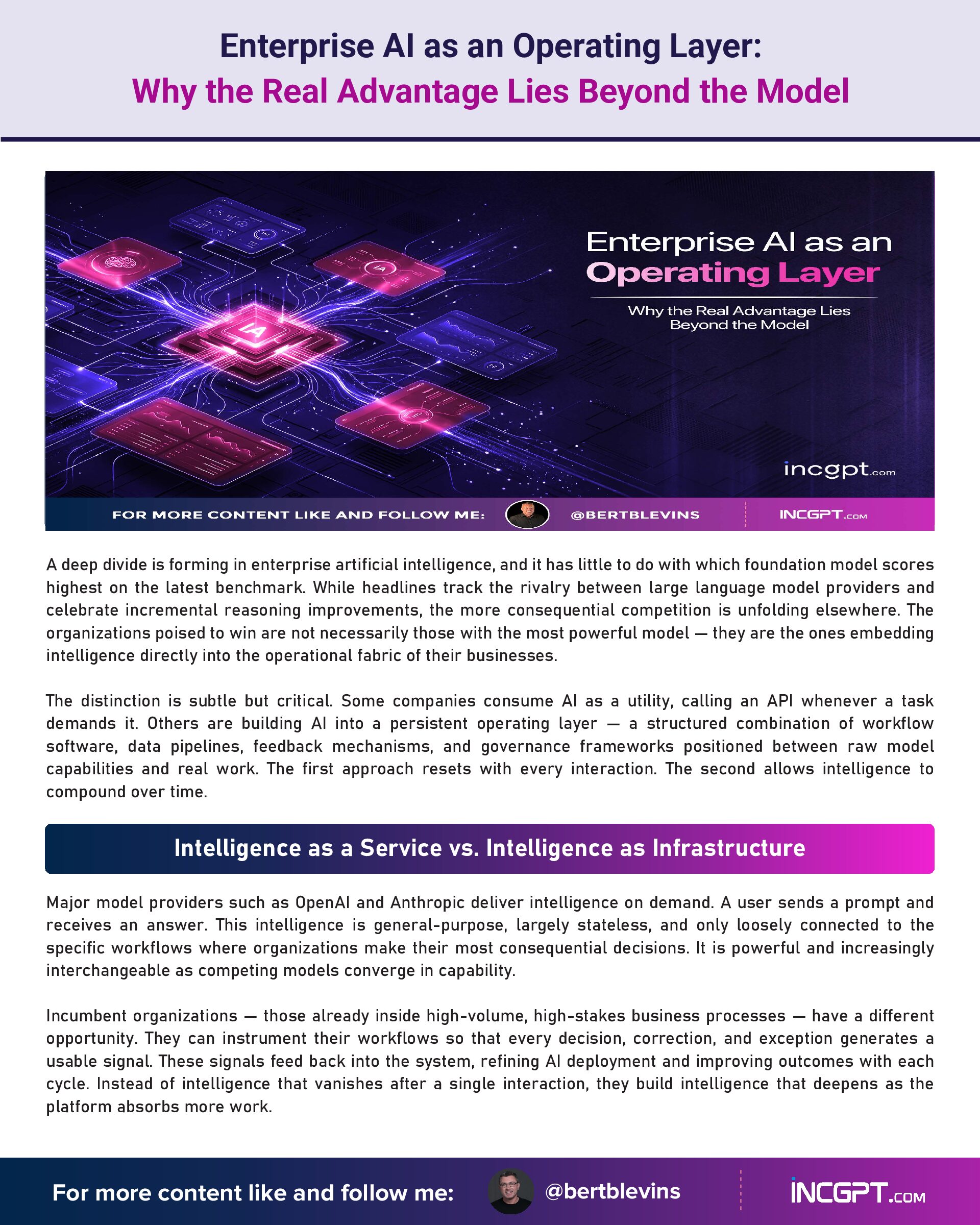
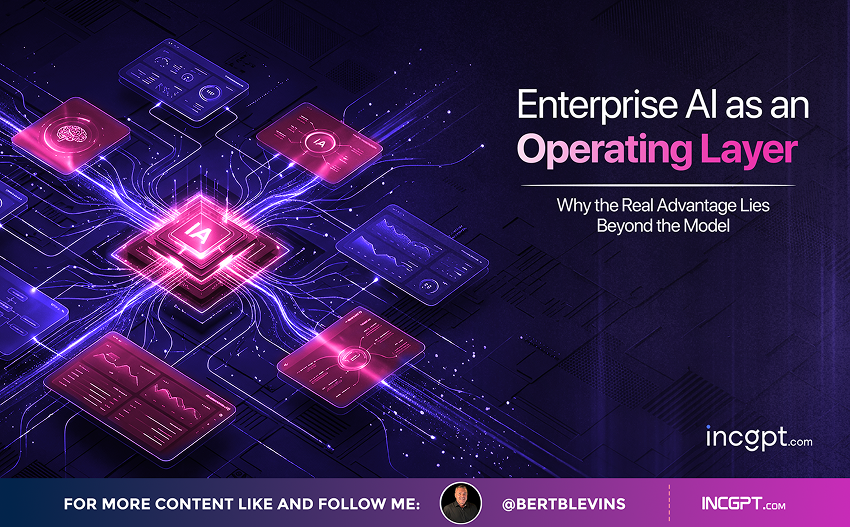
Enterprise AI as an Operating Layer: Why the Real Advantage Lies Beyond the Model
A deep divide is forming in enterprise artificial intelligence, and it has little to do with which foundation model scores highest on the latest benchmark. While headlines track the rivalry between large language model providers and celebrate incremental reasoning improvements, the more consequential competition is unfolding elsewhere. The organizations poised to win are not necessarily those with the most powerful model — they are the ones embedding intelligence directly into the operational fabric of their businesses.
The distinction is subtle but critical. Some companies consume AI as a utility, calling an API whenever a task demands it. Others are building AI into a persistent operating layer — a structured combination of workflow software, data pipelines, feedback mechanisms, and governance frameworks positioned between raw model capabilities and real work. The first approach resets with every interaction. The second allows intelligence to compound over time.
Intelligence as a Service vs. Intelligence as Infrastructure
Major model providers such as OpenAI and Anthropic deliver intelligence on demand. A user sends a prompt and receives an answer. This intelligence is general-purpose, largely stateless, and only loosely connected to the specific workflows where organizations make their most consequential decisions. It is powerful and increasingly interchangeable as competing models converge in capability.
Incumbent organizations — those already inside high-volume, high-stakes business processes — have a different opportunity. They can instrument their workflows so that every decision, correction, and exception generates a usable signal. These signals feed back into the system, refining AI deployment and improving outcomes with each cycle. Instead of intelligence that vanishes after a single interaction, they build intelligence that deepens as the platform absorbs more work.
Rethinking the Startup Advantage
The conventional wisdom holds that nimble startups will outpace established players by building AI-native products from scratch. But in many enterprise domains, AI is fundamentally a systems problem involving integrations, permissions, evaluation, and change management. Advantage in these areas accrues to whoever already occupies critical positions inside established workflows and can convert that foothold into learning and automation.
Startups bring clean architecture and speed. What they often lack is the raw material that makes domain-specific AI defensible at scale: proprietary operational data from years of real transactions, a large expert workforce whose daily decisions produce training signals, and deep knowledge about how complicated work actually gets done. These assets become advantages only when an organization can systematically transform them into AI-ready inputs and feed the results back into its own workflows.
Flipping the Human-AI Relationship
Traditional services organizations follow a familiar pattern: human operators log into systems, navigate workflows, apply judgment, and process cases. Technology is the medium and human expertise is the product. An AI-native operating model inverts this. The system ingests a problem, applies accumulated domain knowledge, and autonomously executes whatever it handles with high confidence. Only when judgment is needed that the system cannot reliably provide does it route targeted sub-tasks to human experts.
This inversion requires a deep foundation of domain expertise, behavioral data, and operational knowledge built up over years. Without that foundation, an AI system lacks the context to know when it can act independently and when it must defer to a specialist.
Converting Tacit Knowledge Into Machine-Readable Signals
In most services organizations, the best operators carry expertise they cannot easily articulate — heuristics developed over years, edge-case intuitions, and pattern recognition operating below conscious reasoning. This tacit knowledge is extremely valuable but perishable. When experienced operators leave, their insights often leave with them.
Addressing this challenge requires deliberate knowledge distillation — the systematic conversion of expert judgment into structured, machine-readable training signals. In healthcare revenue cycle management, for example, systems can be seeded with explicit domain knowledge and then deepened through structured daily interaction with operators. The system identifies gaps, formulates targeted questions, and cross-references answers across multiple experts to capture both consensus views and edge-case nuances, producing a living knowledge base that reflects expert-level reasoning.
Building a Learning Flywheel From Everyday Decisions
Once a system has earned enough trust to operate within defined boundaries, the next question is how it improves without waiting for model upgrades from external providers. The answer lies in everyday operator decisions. Each decision produces more than a completed task — it generates a potential labeled example pairing context with an expert action and often a measurable outcome. Across thousands of operators and millions of decisions, this data stream can power supervised learning, evaluation, and targeted reinforcement that teaches systems to behave like experienced professionals under real conditions.
Consider the scale involved. An organization processing fifty thousand cases per week that captures just three high-quality decision points per case generates one hundred and fifty thousand labeled examples weekly — all without a separate data-collection program. The learning infrastructure is embedded directly in the work.
A more advanced approach places human experts inside the decision process at carefully designed branch points. Operators select from AI-generated options, correct faulty assumptions, and redirect workflows in real time. Each intervention becomes a high-value training signal. When the platform detects an edge case or unexpected deviation, it can prompt the operator for a brief, structured rationale — capturing the reasoning behind a decision without requiring time-consuming documentation.
Amplifying Expertise at Scale
The ultimate objective is to permanently embed the accumulated expertise of thousands of domain specialists into an AI platform that amplifies what every individual operator can accomplish. When this works well, it produces execution quality that neither humans nor AI achieve independently. Organizations gain higher consistency, improved throughput, and measurable operational gains. Operators focus on more consequential work, supported by AI that has already completed analytical groundwork across thousands of analogous prior cases.
What This Means for Enterprise Leaders
The implication for executives is straightforward but significant. Durable advantage in AI will not come from access to general-purpose models alone. Those models are powerful, but they are increasingly available to everyone. The real competitive edge belongs to organizations that can capture, refine, and compound what they know — their data, decisions, and operational judgment — while building the governance controls required for high-stakes environments.
As AI transitions from experimental technology to core infrastructure, the most resilient organizations will be those that understand their own work deeply enough to instrument it and can transform that understanding into systems that improve with every interaction. The model matters, but the operating layer matters more.