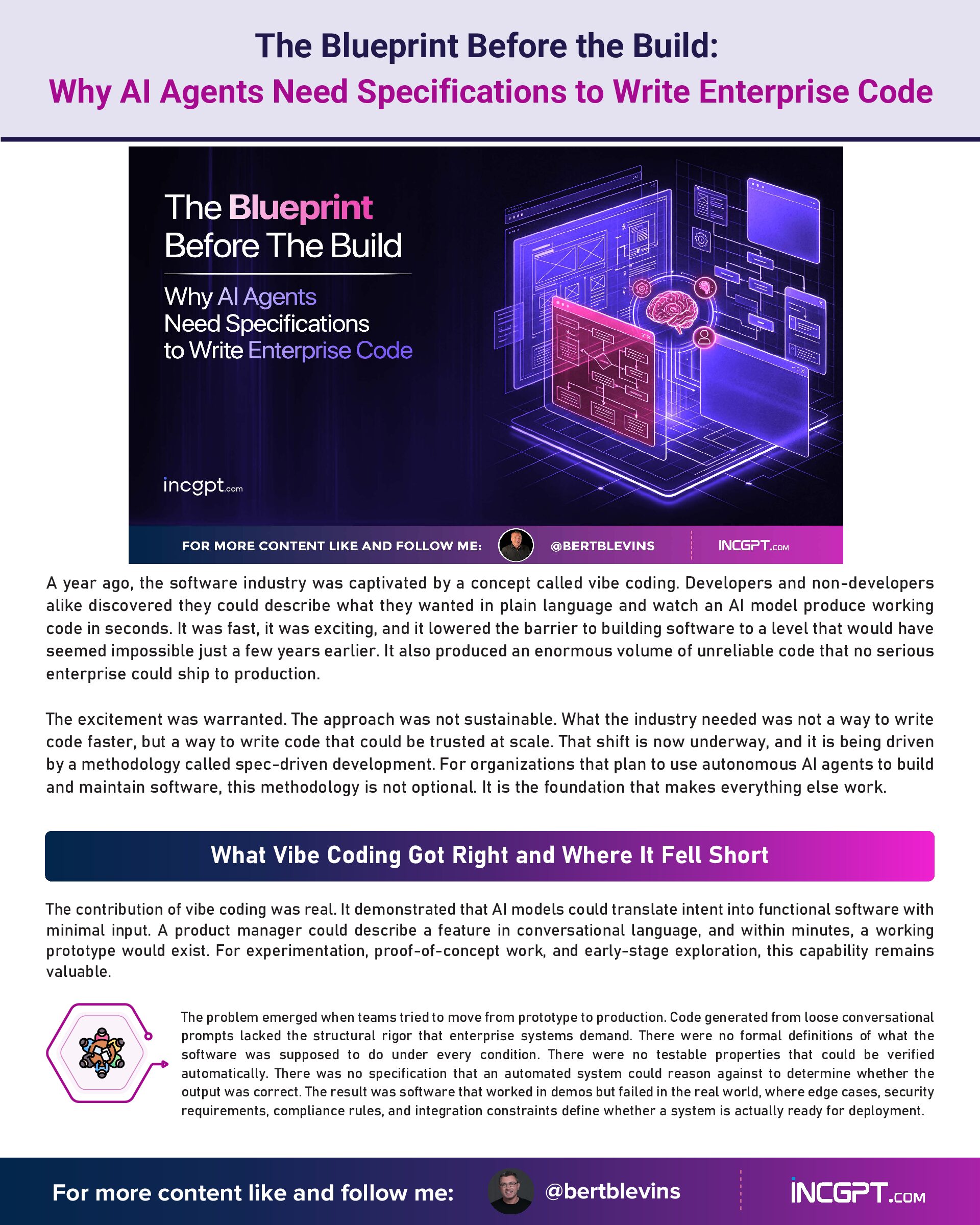
The Blueprint Before the Build: Why AI Agents Need Specifications to Write Enterprise Code
A year ago, the software industry was captivated by a concept called vibe coding. Developers and non-developers alike discovered they could describe what they wanted in plain language and watch an AI model produce working code in seconds. It was fast, it was exciting, and it lowered the barrier to building software to a level that would have seemed impossible just a few years earlier. It also produced an enormous volume of unreliable code that no serious enterprise could ship to production.
The excitement was warranted. The approach was not sustainable. What the industry needed was not a way to write code faster, but a way to write code that could be trusted at scale. That shift is now underway, and it is being driven by a methodology called spec-driven development. For organizations that plan to use autonomous AI agents to build and maintain software, this methodology is not optional. It is the foundation that makes everything else work.
What Vibe Coding Got Right and Where It Fell Short
The contribution of vibe coding was real. It demonstrated that AI models could translate intent into functional software with minimal input. A product manager could describe a feature in conversational language, and within minutes, a working prototype would exist. For experimentation, proof-of-concept work, and early-stage exploration, this capability remains valuable.
The problem emerged when teams tried to move from prototype to production. Code generated from loose conversational prompts lacked the structural rigor that enterprise systems demand. There were no formal definitions of what the software was supposed to do under every condition. There were no testable properties that could be verified automatically. There was no specification that an automated system could reason against to determine whether the output was correct. The result was software that worked in demos but failed in the real world, where edge cases, security requirements, compliance rules, and integration constraints define whether a system is actually ready for deployment.
The Core Idea Behind Spec-Driven Development
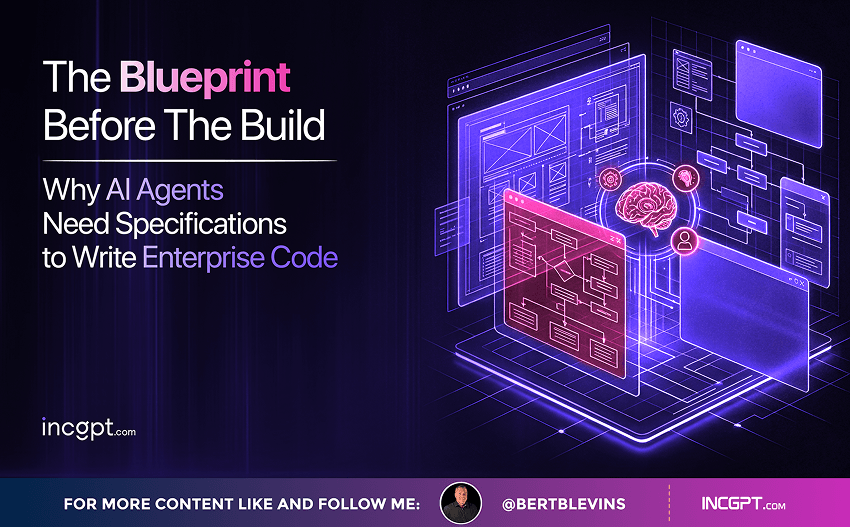
Spec-driven development begins with a straightforward principle. Before an AI agent writes a single line of code, it works from a structured specification that defines what the system is supposed to do, what properties it must satisfy, and what correctness actually looks like in measurable terms. That specification is not documentation written after the fact. It is an artifact that the agent references throughout the entire development process, using it as the basis for code generation, testing, verification, and iteration.
This changes the relationship between the developer and the AI agent fundamentally. Instead of giving the agent a vague description and hoping the output is close enough, the developer provides a precise blueprint that the agent can reason against at every step. The specification becomes the single source of truth, and every piece of generated code can be evaluated against it automatically.
Why This Matters at Enterprise Scale
The scale problem is what makes spec-driven development essential rather than merely useful. When an individual developer uses an AI assistant to write a function or a component, manual review is still feasible. The developer can read the output, test it, and decide whether it meets the requirement. But enterprise teams using autonomous agents are operating at a fundamentally different velocity. A single developer working with an AI agent can produce 150 code check-ins per week. No human reviewer can keep pace with that volume manually.
Without a formal specification, that code has no automated mechanism for verification beyond basic syntax checking and unit tests. With a specification, the system can employ property-based testing and advanced verification techniques that automatically generate hundreds of test cases derived directly from the spec. These tests probe edge cases that no human developer would think to write by hand. They do not just confirm that the code runs without errors. They prove that the code satisfies the defined properties of the specification, moving the standard from functional to provably correct.
The enterprise implications are significant. Teams that have adopted this approach have reported compressing feature development timelines from weeks to days. One engineering team completed an 18-month architecture project, originally planned for 30 developers, with a team of six in under three months. Another team shipped a major consumer-facing feature two months ahead of schedule. These are not hypothetical projections. They are production outcomes from organizations that build, ship, and maintain software at global scale.
From One-Shot Generation to Continuous Autonomous Development
Traditional AI-assisted development operates as a single transaction. The developer provides a prompt, the agent generates code, and the developer evaluates the result. If the output is wrong, the developer rewrites the prompt and tries again. This cycle works for small tasks but breaks down for complex systems that require sustained development over time.
Spec-driven development enables a different model. Because the specification defines what correct behavior looks like, the agent can operate in a continuous loop. It generates code, runs verification against the spec, identifies failures, diagnoses the root cause, and iterates until the output satisfies all defined properties. This loop can run autonomously, with the agent improving its own output without human intervention at each step. The developer’s role shifts from writing and reviewing code to defining specifications and evaluating system behavior at a higher level of abstraction.
This is where the real transformation happens. The developer is no longer constrained by the speed at which they can write or review code. They are constrained only by the quality and precision of the specifications they define. The better the spec, the more the agent can accomplish independently. The worse the spec, the more the agent produces unreliable output that requires human correction. The specification becomes the bottleneck, and improving it becomes the highest-leverage activity a developer can perform.
The Infrastructure Catching Up to the Methodology
One reason spec-driven development is gaining traction now rather than five years ago is that the supporting infrastructure has matured simultaneously. Autonomous agents are no longer running locally on a developer’s laptop. They operate in cloud environments, executing in parallel at scale, with secure communication between agent systems. Organizations can run agentic coding workloads with the same governance, cost controls, and reliability guarantees they apply to any enterprise-grade distributed system.
Development environments are also evolving to support this workflow natively. New integrated development environments are embedding spec-driven workflows directly into the coding experience, making it possible for developers to define specifications, generate code, run verification, and iterate within a single interface. The tooling gap that previously made this methodology impractical for most teams is closing rapidly.
What This Means for the Developer Role
The developers who will thrive in this environment are not necessarily the fastest coders. They are the ones who can think precisely about system behavior, define properties rigorously, and architect specifications that agents can execute against effectively. The skill set is shifting from syntax fluency to systems thinking, from writing code to defining intent with enough precision that an autonomous system can act on it reliably.
This does not mean developers become less important. It means the nature of their contribution changes. They become architects of intent, defining what software must do and verifying that it does so correctly, while agents handle the implementation. The ceiling for what a small team can accomplish rises dramatically, but only for teams that invest in the discipline of specification. Speed without specification produced vibe coding. Specification without speed was traditional waterfall development. The combination of both is what spec-driven development offers, and it is the methodology that will define how enterprise software is built for the foreseeable future.