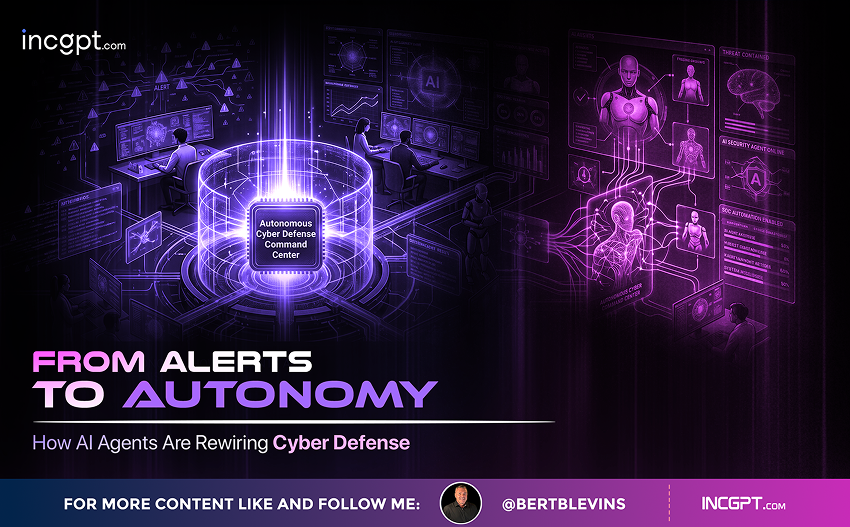
From Alerts to Autonomy: How AI Agents Are Rewiring Cyber Defense
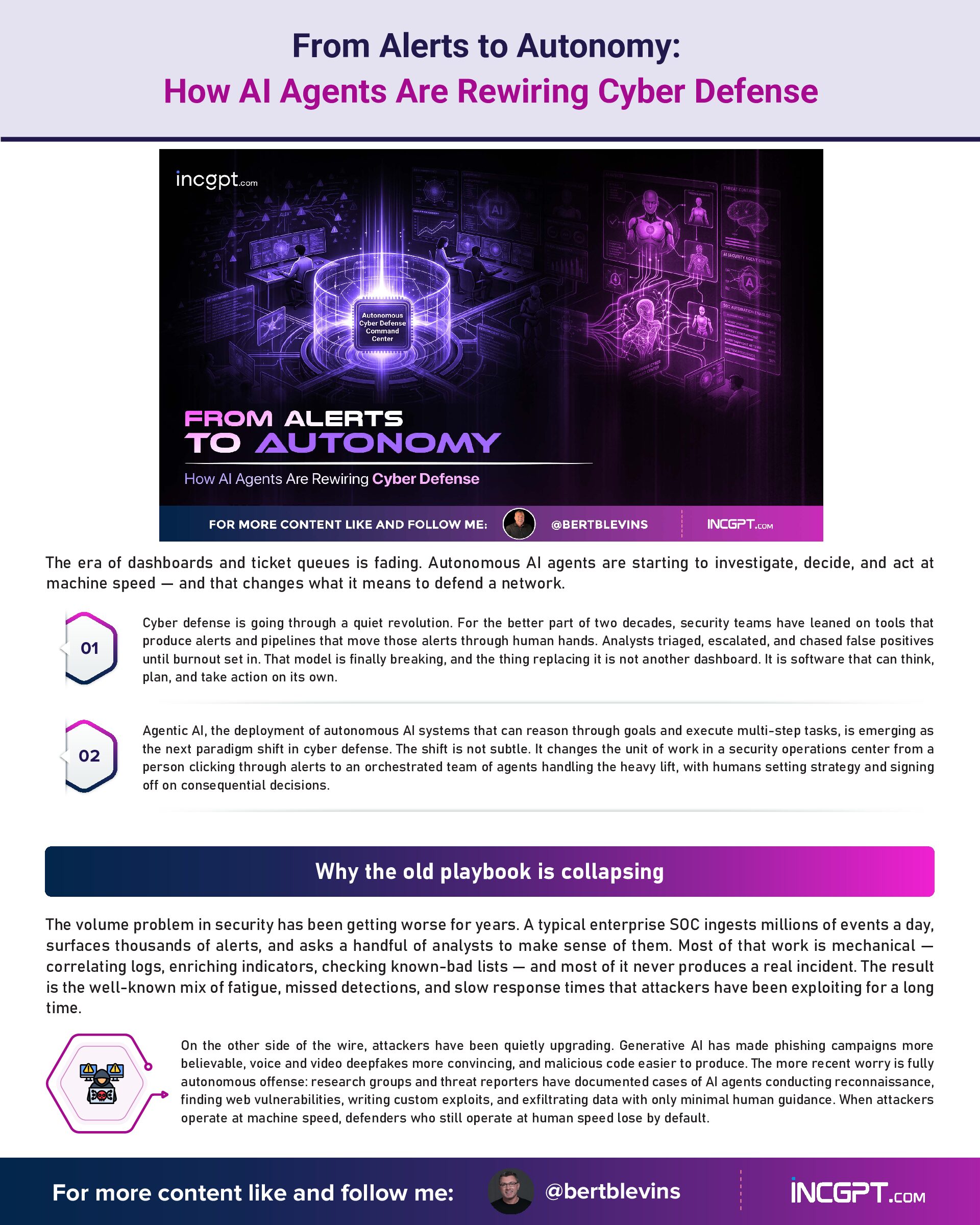
The era of dashboards and ticket queues is fading. Autonomous AI agents are starting to investigate, decide, and act at machine speed — and that changes what it means to defend a network.
Cyber defense is going through a quiet revolution. For the better part of two decades, security teams have leaned on tools that produce alerts and pipelines that move those alerts through human hands. Analysts triaged, escalated, and chased false positives until burnout set in. That model is finally breaking, and the thing replacing it is not another dashboard. It is software that can think, plan, and take action on its own.
Agentic AI, the deployment of autonomous AI systems that can reason through goals and execute multi-step tasks, is emerging as the next paradigm shift in cyber defense. The shift is not subtle. It changes the unit of work in a security operations center from a person clicking through alerts to an orchestrated team of agents handling the heavy lift, with humans setting strategy and signing off on consequential decisions.
Why the old playbook is collapsing
The volume problem in security has been getting worse for years. A typical enterprise SOC ingests millions of events a day, surfaces thousands of alerts, and asks a handful of analysts to make sense of them. Most of that work is mechanical — correlating logs, enriching indicators, checking known-bad lists — and most of it never produces a real incident. The result is the well-known mix of fatigue, missed detections, and slow response times that attackers have been exploiting for a long time.
On the other side of the wire, attackers have been quietly upgrading. Generative AI has made phishing campaigns more believable, voice and video deepfakes more convincing, and malicious code easier to produce. The more recent worry is fully autonomous offense: research groups and threat reporters have documented cases of AI agents conducting reconnaissance, finding web vulnerabilities, writing custom exploits, and exfiltrating data with only minimal human guidance. When attackers operate at machine speed, defenders who still operate at human speed lose by default.
What makes an agent different from automation
Security has had automation for years. SOAR platforms run playbooks, scripts close tickets, and rules-based engines block known indicators. Agents are different in a specific way: they are goal-oriented rather than rule-bound. A traditional automation script does exactly what it was told. An agent is given an objective, picks its own tools, and chains together steps to reach it, adjusting along the way when something does not behave the way it expected.
In a security context, that means an agent can be told to investigate a suspicious login rather than to run step one through step seven of a playbook. It can pull identity context, check the device posture, look at recent travel patterns, ask whether similar behavior has shown up elsewhere, and reach a reasoned conclusion. If a step fails or the data is missing, it can route around the problem instead of stopping. That flexibility is what turns AI from an assistant into a teammate.
Where agents are already earning their keep
Several roles inside the SOC are already being reshaped by agentic systems. Triage is the most obvious one. Tier-one alert handling, which has historically eaten the majority of analyst time, can be largely absorbed by agents that read the alert, enrich it, decide whether it is worth escalating, and either close it or hand it to a human with a written summary. Some organizations now report that investigation time on routine alerts has dropped from hours to seconds, freeing senior analysts to focus on the work that genuinely needs experience.
Threat hunting is the next frontier. Rather than waiting for an alert to fire, hunting agents can roam through telemetry looking for patterns that match known adversary tradecraft or that simply look wrong. Detection engineering agents go a step further, identifying gaps in coverage and proposing new detections for emerging tactics. Other agents focus on third-party intelligence, automatically pulling context from external sources and stitching it into the picture an analyst sees. Together, these specialized agents form a multi-agent system that behaves less like a toolbox and more like a coordinated team.
The new architectural problem: identity for non-humans
Once agents start acting inside production environments, a thorny question shows up. If an agent can read mail, query a database, or change a configuration, it is essentially a user. Treating it like a script is no longer accurate. The emerging consensus across the industry is straightforward: if it can act, it should be governed like an identity.
That has serious implications for identity and access management. Agents need their own credentials, their own least-privilege scopes, and their own behavioral baselines. Defenders need to know what each agent is allowed to do, what it has actually done, and whether its behavior is drifting toward something that looks compromised. Privileged access management, just-in-time access, and continuous validation, which were originally built for human admins and service accounts, are now being stretched to cover an entirely new category of digital actor.
The risks no one should hand-wave away
Agentic defense is powerful, but it brings genuinely new failure modes. Prompt injection is the most discussed: an attacker plants instructions inside a document, ticket, or webpage that an agent later reads, and the agent obediently follows them. Misaligned agents with broad privileges can amplify damage rather than contain it. Reasoning-driven systems still lack formal safety guarantees, especially under adversarial pressure, which means a sufficiently clever attacker can sometimes steer them in directions their designers did not anticipate.
The mitigations are getting more sophisticated. Sandboxing agent execution, narrowing the scope of what any single agent can touch, requiring human approval for high-impact actions, and deploying quality agents whose only job is to verify the output of other agents are all becoming standard practice. The goal is not to make agents perfectly safe, which is probably impossible, but to make their failure modes bounded and recoverable.
Augmentation, not replacement
It is worth being clear about what this paradigm shift is not. It is not the end of the human analyst. Cybersecurity has always rewarded intuition, pattern recognition built up over years, and the kind of creative thinking that machines still struggle with. Agents are very good at the volume, the repetition, and the speed. Humans remain better at judgment calls, at understanding the business context behind a decision, and at recognizing when the situation is weird in a way the model has not seen before.
The teams getting the most out of agentic defense treat it as a force multiplier. Analysts move up the stack from clicking through alerts to directing AI work, validating high-confidence findings, and focusing their own attention on the small percentage of incidents that genuinely require a human mind. The job title may stay the same, but the day-to-day looks very different.
What leaders should be doing now
For security leaders, the practical question is no longer whether to adopt agentic AI but how to adopt it without creating new problems. Three priorities stand out. First, build the data and governance foundation: agents are only as good as the telemetry they can reason over and the policies that constrain them. Second, define identity and authority for every agent before it goes live, including what it can do, what it cannot do, and how it will be audited. Third, invest in the human side of the transition — training analysts to direct and verify AI work, not just to do the work themselves.
The cybersecurity arms race is not going to slow down. Attackers will keep weaponizing AI, defenders will keep responding with their own, and the gap between the two will be decided by how quickly each side can adapt. Agentic AI is the most significant change in defensive posture in a generation. The organizations that take it seriously now — carefully, with eyes open to the risks — will be the ones still standing when the next wave of machine-speed attacks arrives.