How Apple’s Smallest Desktop Became the Must-Have Machine for the AI Era
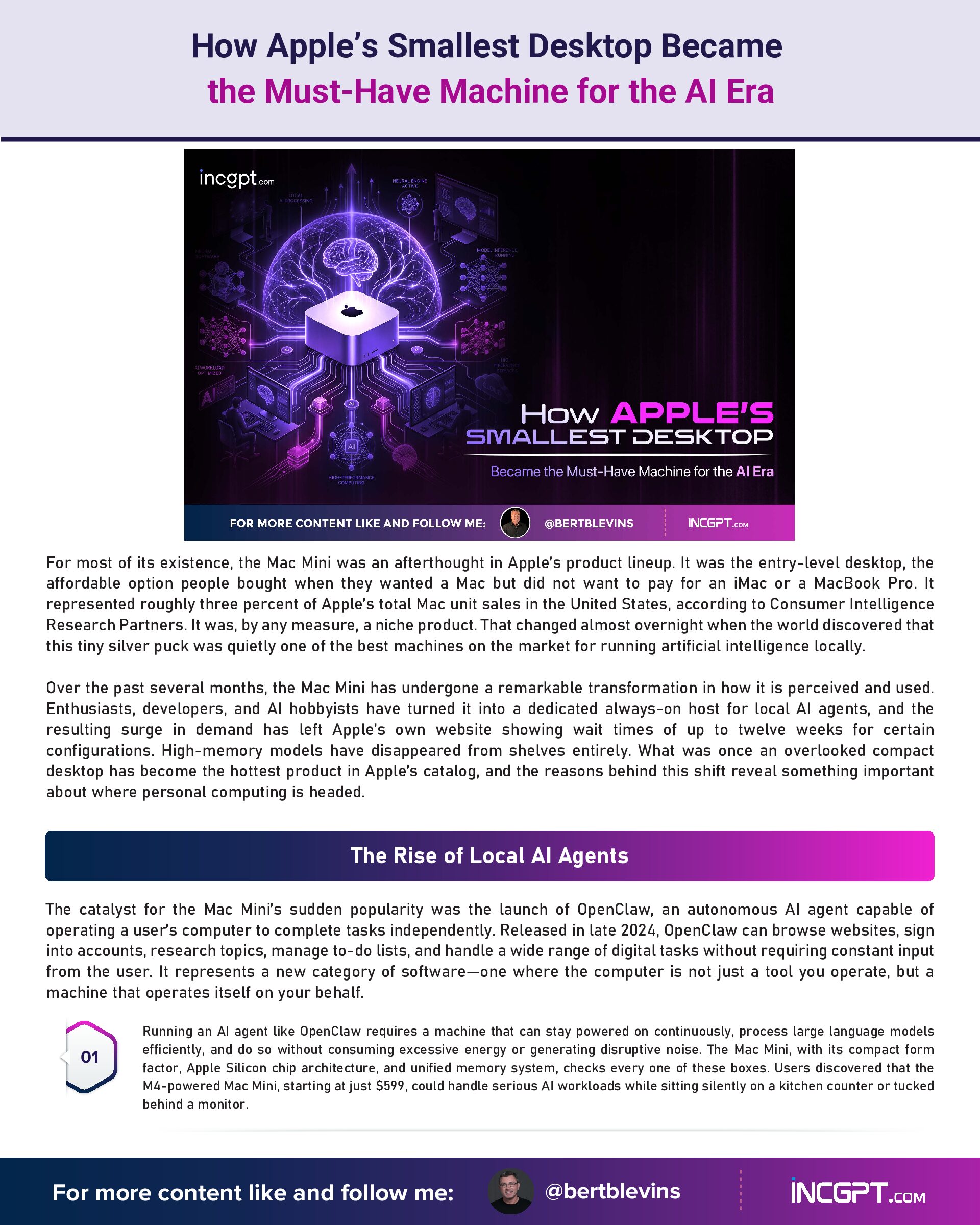
For most of its existence, the Mac Mini was an afterthought in Apple’s product lineup. It was the entry-level desktop, the affordable option people bought when they wanted a Mac but did not want to pay for an iMac or a MacBook Pro. It represented roughly three percent of Apple’s total Mac unit sales in the United States, according to Consumer Intelligence Research Partners. It was, by any measure, a niche product. That changed almost overnight when the world discovered that this tiny silver puck was quietly one of the best machines on the market for running artificial intelligence locally.
Over the past several months, the Mac Mini has undergone a remarkable transformation in how it is perceived and used. Enthusiasts, developers, and AI hobbyists have turned it into a dedicated always-on host for local AI agents, and the resulting surge in demand has left Apple’s own website showing wait times of up to twelve weeks for certain configurations. High-memory models have disappeared from shelves entirely. What was once an overlooked compact desktop has become the hottest product in Apple’s catalog, and the reasons behind this shift reveal something important about where personal computing is headed.
The Rise of Local AI Agents
The catalyst for the Mac Mini’s sudden popularity was the launch of OpenClaw, an autonomous AI agent capable of operating a user’s computer to complete tasks independently. Released in late 2024, OpenClaw can browse websites, sign into accounts, research topics, manage to-do lists, and handle a wide range of digital tasks without requiring constant input from the user. It represents a new category of software—one where the computer is not just a tool you operate, but a machine that operates itself on your behalf.
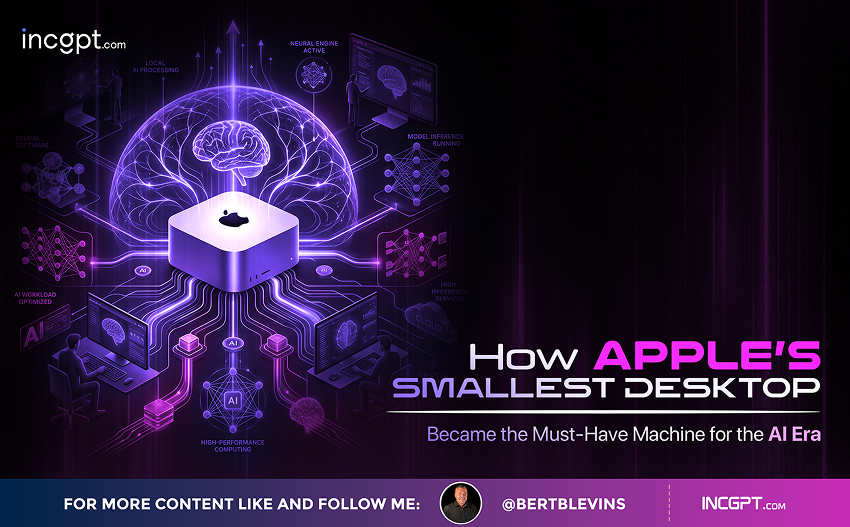
Running an AI agent like OpenClaw requires a machine that can stay powered on continuously, process large language models efficiently, and do so without consuming excessive energy or generating disruptive noise. The Mac Mini, with its compact form factor, Apple Silicon chip architecture, and unified memory system, checks every one of these boxes. Users discovered that the M4-powered Mac Mini, starting at just $599, could handle serious AI workloads while sitting silently on a kitchen counter or tucked behind a monitor.
Why Users Prefer Running AI on Their Own Hardware
The appeal of local AI extends beyond convenience. Privacy is a major motivator. When AI models run directly on a personal device, sensitive data never leaves the machine. There are no cloud servers processing your queries, no third-party providers storing your prompts, and no usage quotas throttling your access during peak hours. For users who want an AI assistant that handles personal email, financial research, or confidential work documents, keeping everything, on-device offers a level of control that cloud-based services simply cannot match.
Cost is another factor. Cloud-based AI services typically charge subscription fees or usage-based pricing that can add up quickly for heavy users. A Mac Mini, by contrast, represents a one-time hardware investment. Once the machine is set up, users can run AI models indefinitely without recurring charges. At a time when memory chip prices are rising globally due to surging AI demand across the industry, locking in a machine with sufficient RAM has become a strategic purchase for many buyers.
A Community Takes Shape
The Mac Mini’s role as a local AI host has spawned an enthusiastic community. OpenClaw conferences have begun appearing in cities around the world, drawing crowds of developers and tinkerers eager to share configurations, workflows, and use cases. In San Francisco, attendees reportedly lined up for hours to get into one such event. Online forums and social media channels dedicated to Mac Mini AI setups have multiplied, with users exchanging tips on optimizing performance, managing multiple agents, and integrating AI assistants into daily routines.
The cultural footprint extends to merchandise and accessories. On platforms like Etsy, vendors sell custom Mac Mini stands shaped like lobster claws—a nod to OpenClaw’s mascot. Developers have created collectible enamel pins featuring the device for Apple’s annual Worldwide Developers Conference. Apple Store employees have reportedly begun referring to the Mac Mini informally as an “OpenClaw machine,” reflecting how deeply this new use case has penetrated even Apple’s own retail culture.
The Supply Problem Nobody Saw Coming
Apple, like most observers, did not anticipate this wave of demand. The Mac Mini has historically been a low-volume product, and Apple’s supply chain was calibrated accordingly.
When AI enthusiasts began purchasing the device in large numbers—particularly the higher-memory configurations with 32GB and 64GB of RAM—inventory evaporated far faster than Apple could replenish it.
Analysts point to several converging factors behind the shortage. The most straightforward explanation is that demand simply outstripped supply for a product Apple never expected to sell in these volumes. Manufacturing lead times for custom chip configurations are measured in months, not weeks, and Apple is understandably cautious about ramping production for a product whose demand could prove temporary. Adding complexity to the situation is a global DRAM shortage driven by the broader AI boom, which has constrained memory chip availability across the entire electronics industry. There is also speculation that Apple may be managing inventory ahead of an anticipated product refresh, as desktop Macs with the newer M5 chips—already available in the MacBook lineup—are widely expected but have not yet been announced.
More Than a Mac Mini Story
Industry analysts see the Mac Mini phenomenon as an early signal of a larger shift in how people think about personal computers. Rather than relying on a single all-purpose machine, consumers are beginning to adopt a distributed approach: one device for daily productivity and entertainment, and a separate dedicated machine for AI workloads. This model mirrors how businesses have long separated their computing infrastructure into specialized roles, and it suggests that the consumer market may be heading in a similar direction.
The Mac Mini is not the only hardware targeting this emerging category. Nvidia’s DGX Spark, unveiled at CES in early 2026, is aimed squarely at local AI enthusiasts, though at a significantly higher price point. Perplexity, the AI search company, recently launched a product called Personal Computer that transforms a dedicated Mac Mini into a persistent AI agent capable of managing local files, native applications, and browser tasks through voice and text commands. These developments point to a future where dedicated AI hardware is as common in homes as routers and smart speakers.
What This Means for the Future of Computing
The Mac Mini’s unexpected rise illustrates a pattern that has repeated throughout the history of technology: a product designed for one purpose finds its true audience in an entirely different context. Apple built the Mac Mini as an affordable entry point into the macOS ecosystem. The AI community turned it into a compact, efficient, always-on inference server. The device did not change. The world around it did.
As AI agents become more capable and more deeply integrated into daily workflows, the demand for dedicated local hardware will only grow. The question is no longer whether people want AI running in their homes and offices, but what kind of machine they want running it. For now, Apple’s smallest desktop has provided a surprisingly compelling answer—and the industry is paying attention.