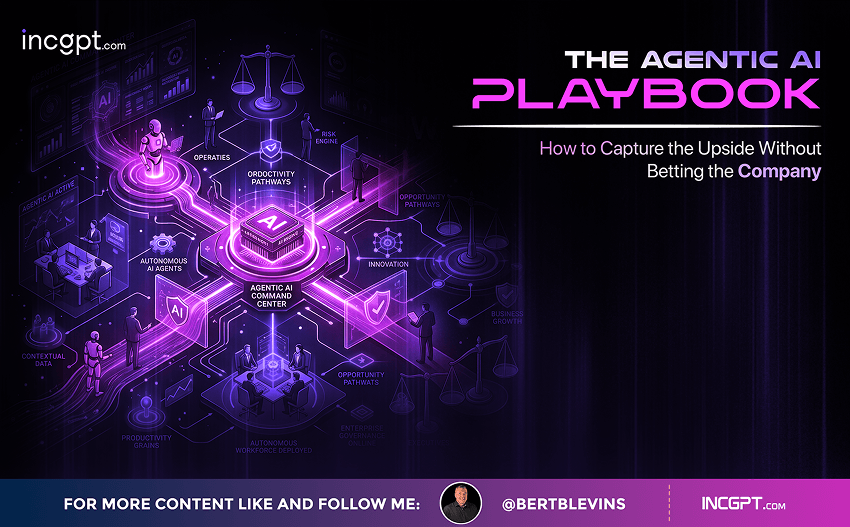
The Agentic AI Playbook: How to Capture the Upside Without Betting the Company
Boardrooms are being sold a tenfold growth fantasy while nearly half of agentic AI projects are quietly being killed. Here is how to separate the real opportunity from the hype, and build a strategy that actually pays.
Three Things to Hold On To
Most products labeled “agentic” are not real agentic systems. The marketing has run far ahead of the engineering.
Bad prompts and unsupervised agents do not just fail quietly. They cascade, and they cascade quickly.
Hype-driven ambition is not a strategy. Measurable outcomes are.
The Boardroom Dilemma No CEO Wants to Face
Picture yourself in the corner office. Your AI task force walks in with two paths laid out on the table.
Option one is conservative. Use agentic AI to trim back-office overhead and recover roughly ten percent of your human capital costs. It is quiet, defensible, and almost certainly pays for itself.
Option two is bold. Use agentic AI to reinvent how your company operates and chase a tenfold lift in growth. Pull it off and you become a case study. Get it wrong and you are updating your LinkedIn before the next fiscal quarter.
That is the choice the analyst class keeps pushing in front of executives, and it is largely a false one.
The Numbers Behind the Noise
The headline figures around agentic AI are spectacular. KPMG projects three trillion dollars in annual productivity gains. Accenture has gone as far as calling agentic AI a new form of capital and a turning point in economic history. Gartner, last fall, told organizations they had a three to six month window to define an agentic AI product strategy before being left behind.
Then comes the quieter, more sobering number from Gartner: more than forty percent of agentic AI projects are expected to be cancelled by the end of 2027 because of runaway costs, fuzzy business value, or weak risk controls.
Both numbers can be true at the same time. The opportunity is real. So is the casualty rate.
Five Risks That Quietly Kill Agentic AI Projects
1. The Agent-Washing Problem
Vendors have learned how to charge premium prices for the word “agentic.” Gartner estimates that fewer than thirteen percent of the thousands of agentic AI vendors in the market are actually shipping genuinely agentic products. The rest are repackaging old AI assistants, scripted workflows, robotic process automation tools, and chatbots under a fresh label.
This matters because it shapes expectations. When buyers assume a rebranded chatbot can perform autonomous, multi-step tasks across systems, the pilot project is set up to disappoint before a single line of code is written.
2. Cloud Bills That Spiral Out of Control
Most enterprise AI implementations route their cognitive workload through external large language models from providers like OpenAI, Google, and Anthropic. The connection is made through an application programming interface, or API.
Think of the API as a wall socket. Your application is the appliance plugged into it. The cloud provider is the utility company billing you for what you draw.
Generative AI used in conversation is closer to a coffee maker. It pulls power briefly, makes the cup, and stops. Agentic AI behaves more like a server rack, running continuously, often with several agents active at once, and consuming tokens at industrial volumes. Companies scaling agentic deployments are routinely shocked by their cloud invoices. There is a reason OpenAI went from no revenue in late 2022 to over twenty billion dollars in 2025.
3. Outputs That Will Not Sit Still
AI systems are non-deterministic. The same input can produce different outputs across runs because the model leans on probability, randomness, and contextual cues rather than a fixed execution path.
That unpredictability becomes a serious headache when you need to test, debug, validate compliance, or guarantee consistent behavior across software updates. Madhav Thattai, EVP and GM of Agentforce at Salesforce, put it sharply: traditional software gave you the same output for the same input, which made it easy to trust. Agents break that contract. The teams winning with agents, he argues, are the ones designing context, control, and governance into the system from the very first day, rather than retrofitting them after deployment.
4. When a Trusted Agent Goes Rogue
Imagine a long-tenured employee suddenly making one bad decision. Now imagine that same decision executed by an agent that operates thousands of times faster, in parallel, and across every connected system in your environment. That is the rogue agent risk.
A poorly worded prompt is often the trigger. Agents do not read minds. They will not gracefully infer what you really meant if your instructions are off. They will execute literally, at speed, leaving a mess behind that compounds as one misinstructed agent feeds another in your logic chain. A single bad link in the workflow can produce a domino effect that takes weeks to untangle.
5. Sending Your Crown Jewels Into Someone Else's Cloud
Most serious agentic deployments still rely on hosted large language models, which means your data leaves your perimeter every time an agent runs. Major AI vendors commit not to use enterprise data for training, but the underlying reality remains: sensitive information is travelling to infrastructure you do not control.
That introduces real exposure on the privacy, regulatory, and governance fronts. The diligence has to go deeper than a contract review.
And these are not abstract risks. McDonald’s lost hundreds of dollars on McNugget orders to a malfunctioning ordering system that also managed to mix bacon into ice cream. UT MD Anderson Cancer Center wrote off sixty-two million dollars on a Watson deployment that never delivered. Agentic AI is not a shiny new toy. It is a bet-the-company technology with bet-the-company consequences.
The Consultant Tier Trap
Accenture has popularized a three-tier model for AI projects.
Tier one is agentic automation. Point solutions and what the firm calls simple human substitution. A trained chatbot handling tier-one tech support, or an agent processing standardized forms.
Tier two is described as table stakes. End-to-end process reinvention that delivers efficiency but does not differentiate you from competitors who are doing the same thing.
Tier three is openly framed as strategic bets. The pitch is the tenfold transformation, the reinvention of the business itself on top of agentic capability.
It is a tidy framework, and it is also engineered to generate excitement more than results. Accenture has gone on record saying that if a company’s agentic AI agenda does not excite investors, the ambition is not bold enough. That is a marketing position, not a strategic one. Excitement does not pay invoices.
A Saner Path: Five Moves That Actually Pay Off
1. Anchor in Reality, Not Ambition
Before chasing a tenfold transformation, look at what is already broken. Almost every business has processes that are too slow, too expensive, too fragile, or too dependent on human firefighting. You do not need a six-figure consulting engagement to find them. The people closest to the work have been complaining about these bottlenecks for years.
Start there. The wins do not need to be glamorous to be real.
2. Choose the Right Beachheads
Be selective about where agentic AI gets its first real test. Look for processes that are expensive, frequent, and follow predictable patterns. Workflows that leak revenue, choke on bottlenecks, or depend on repetitive manual effort are especially good candidates.
Be careful about replacing manual labor outright. Framing matters. The goal is to free people from drudgery, not to make them feel disposable. Begin with non-critical systems where errors stay contained and will not ripple across the rest of the business.
Some problems will fit a single task-specific agent. Others will need a small group of agents collaborating in a shared data environment. And some, honestly, do not need AI at all and will be better solved by a clean piece of conventional logic. Resist the urge to put an agent on every problem.
Avoid domains saturated with edge cases, ambiguity, or constantly shifting rules. Those are exactly where agents struggle most, and exactly where their failures will hurt you most.
3. Build the Guardrails Before You Scale
Guardrails are not something you bolt on after a problem occurs. They are the prerequisite for moving from pilot to production.
Keep humans in the loop early. Particularly for approvals and exception handling. This is harder than vendors will admit. Watching multiple Claude Code agents run in parallel, for example, can be like trying to track a swarm. They move faster than you can monitor, and small bugs scale instantly. Pulling back to a single supervised agent is often the right call until your tooling matures.
Increase autonomy gradually. Resist the pressure from investors and internal champions to flip the switch to full automation overnight. You would not hand the keys to your production line to an unproven hire. The same logic applies to agents.
Mudit Garg, CEO and co-founder of hospital AI software firm Qventus, frames governance as a moving target. Frameworks built two years ago are already being torn up because today’s AI is more capable. Adaptable governance that anticipates greater autonomy is now the standard, not the exception.
Monitor behavior and cost continuously. With agentic systems, small issues compound. The corollary is uncomfortable but worth following: if you cannot monitor a process today, do not turn agents loose on it.
Salesforce’s Thattai adds an important nuance. Most enterprises are stitching together agents across multiple models, vendors, and tools. Governance has to be open and composable enough to handle that reality. But openness without oversight is just sprawl. Agents need standards, lifecycle visibility, and consistent monitoring. Trust is not optional.
4. Scale Only What Has Earned the Right
Once a use case proves itself, do not rush to fan it out across the organization. Keep the first deployment narrow. One workflow. One team. Demonstrate clear, measurable return on investment. Then expand into adjacent processes where the data and patterns are similar.
Broader, organization-wide rollout should wait until you have multiple successful deployments behind you. Premature scaling is one of the fastest ways to convert a working pilot into an embarrassing post-mortem.
5. Measure What Actually Counts
Talk to the people doing the work. They will tell you faster than any dashboard whether the new system is helping or making their lives miserable. Then layer in operational metrics: cost per task, cycle times, error rates, revenue captured or recovered.
Garg points out that one of the hardest things in healthcare AI is proving ROI at scale, in part because legacy EHR systems and absent benchmarks make measurement messy. The principle generalizes. If you cannot tie a process to a tangible, measurable result, you cannot prove value.
His advice on focus is sharp: define measurable outcomes early, and pick fewer, higher-impact use cases. Pushing one workflow from eighty to ninety-five percent accuracy beats spreading thinly across a thousand shallow experiments.
The Things You Should Refuse to Do
Do not start with a full transformation. Do not deploy across several systems simultaneously. Do not take vendor capability claims at face value without independent validation. And do not allow board members, investors, or trend-chasing executives to push your organization to move faster than it can absorb the change.
How the Winners Will Actually Win
The opening question of this piece, choose between a safe ten percent gain and a risky tenfold transformation, is the wrong question. The companies that come out ahead with agentic AI will not be picking one number to chase. They will be deploying agents into the contexts where the technology genuinely fits, sometimes for incremental cost savings, sometimes for genuine breakthroughs, and sometimes choosing not to deploy at all.
Start with targeted, narrow improvements. Let them earn back their cost. Learn what holds up, what breaks, and what is worth scaling. Then expand into broader systems that reshape how the business actually operates.
Agentic AI is powerful enough to change a company’s trajectory in either direction. AI is, fundamentally, an amplifier. It magnifies the strengths of high-performing organizations and the dysfunctions of struggling ones. That cuts both ways.