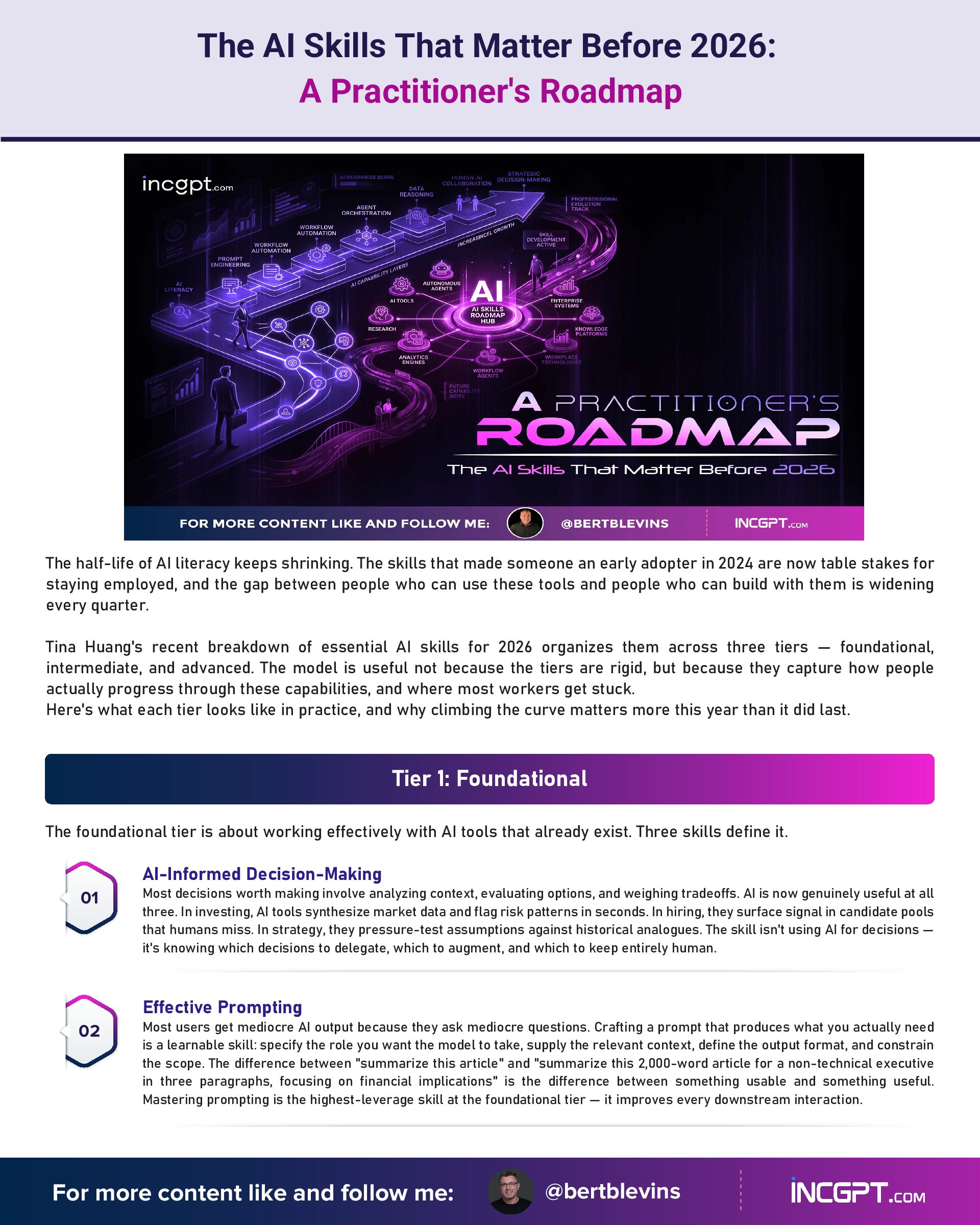
The AI Skills That Matter Before 2026: A Practitioner's Roadmap
The half-life of AI literacy keeps shrinking. The skills that made someone an early adopter in 2024 are now table stakes for staying employed, and the gap between people who can use these tools and people who can build with them is widening every quarter.
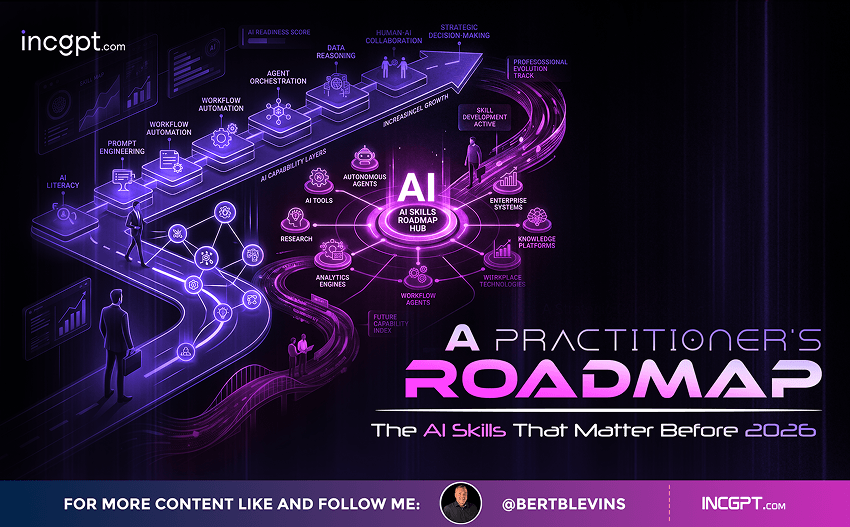
Tina Huang’s recent breakdown of essential AI skills for 2026 organizes them across three tiers — foundational, intermediate, and advanced. The model is useful not because the tiers are rigid, but because they capture how people actually progress through these capabilities, and where most workers get stuck.
Here’s what each tier looks like in practice, and why climbing the curve matters more this year than it did last.
Tier 1: Foundational
The foundational tier is about working effectively with AI tools that already exist. Three skills define it.
AI-Informed Decision-Making
Most decisions worth making involve analyzing context, evaluating options, and weighing tradeoffs. AI is now genuinely useful at all three. In investing, AI tools synthesize market data and flag risk patterns in seconds. In hiring, they surface signal in candidate pools that humans miss. In strategy, they pressure-test assumptions against historical analogues. The skill isn’t using AI for decisions — it’s knowing which decisions to delegate, which to augment, and which to keep entirely human
Effective Prompting
Most users get mediocre AI output because they ask mediocre questions. Crafting a prompt that produces what you actually need is a learnable skill: specify the role you want the model to take, supply the relevant context, define the output format, and constrain the scope. The difference between “summarize this article” and “summarize this 2,000-word article for a non-technical executive in three paragraphs, focusing on financial implications” is the difference between something usable and something useful. Mastering prompting is the highest-leverage skill at the foundational tier — it improves every downstream interaction.
Fluency Across the Major Tools
ChatGPT, Claude, and Gemini cover most general-purpose work. Perplexity dominates research workflows. Specialized platforms like Jasper for marketing or Notion AI for productivity each have their lanes. Knowing which tool fits which job — and accepting that no single tool wins every category — is the foundational skill most people skip. The cost is wasted time and inconsistent output.
Tier 2: Intermediate
The intermediate tier shifts from using AI to directing it. The skills here are about workflow, not interaction.
Working With AI Agents
An AI agent is a system that takes multi-step actions on your behalf — scheduling meetings, monitoring accounts, summarizing inbound threads, surfacing relevant updates. The skill at this tier is setting up agents that match your actual work, not the demos. A useful agent compiles your morning brief from the sources you actually read. A useful agent flags account activity that breaks your normal patterns. The technical setup matters less than the discipline of specifying what you want the agent to do.
Implementing Local AI Agents
For work involving sensitive data, regulated industries, or privacy-critical contexts, running models locally beats anything cloud-based. Open-source models like Llama, Mistral, and Qwen now match much of what proprietary providers offer on common tasks, with no data ever leaving your machine. Setting up a local agent isn’t trivial, but it’s no longer hard. The skill is knowing when local matters and being capable of executing.
Data Analysis and Visualization
The intermediate user pairs AI with the analytics tools they already know — Tableau, Power BI, the Python data stack. AI accelerates the workflow without replacing the judgment. The valuable skill is learning to use AI as a faster analyst, not a smarter one — generating hypotheses to test, surfacing trends in messy data, drafting visualizations you then refine.
Tier 3: Advanced
The advanced tier is where people stop using AI tools and start shipping AI products. Four skills define it.
Building AI Agents
There is a meaningful gap between using off-the-shelf agents and designing your own. Production-grade agents — for customer onboarding, fraud detection, financial reporting — require thinking through reliability, cost, fallback behavior, and observability. The shift is from “this prompt works” to “this system works for ten thousand users a day.” The technical chops needed are real, but the harder part is the engineering discipline.
Building Multi-Component Pipelines
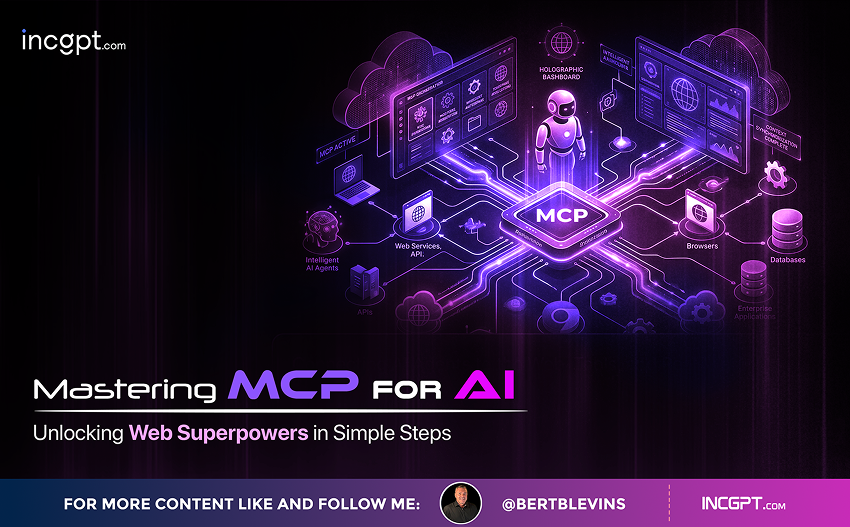
Model Context Protocol and similar integration architectures let AI agents connect to your CRM, your inbox, your file storage, your ticketing system. An MCP turns an isolated chatbot into something that can actually do the work — update a record, escalate an issue, run a report, and book the follow-up. The market for engineers who can architect these pipelines is heating up faster than any other AI specialization.
AI-Driven Software Development
Writing code with AI assistance is now standard. Writing code well with AI assistance is a separate skill. The advanced practitioner uses AI to accelerate the mechanical parts of development — boilerplate, refactors, debugging — while keeping a tight grip on architecture, edge cases, and correctness. The risk of shipping production systems built on “the AI said so” is real. The discipline to avoid it is the differentiator.
Ethical AI Development
This is the skill most articles handle weakly, but it’s the most consequential of the advanced tier. Building AI systems that are transparent about their reasoning, fair in their outcomes, and resilient against misuse is now table stakes for anyone deploying these tools at scale. The work involves bias audits, fairness testing, explainability infrastructure, and regulatory alignment — not just intent. Companies that get this right ship products that survive scrutiny. Companies that don’t get sued, regulated, or shut down.
Where This Leaves You
The three-tier model isn’t a checklist. It’s a description of where the market is pricing labor right now. Workers fluent at the foundational tier are competing with anyone who has been online for the last two years. Workers comfortable at the intermediate tier earn meaningful productivity multipliers. Workers building at the advanced tier are commanding salaries that didn’t exist three years ago.
The half-life of any given skill at any tier keeps shrinking. The tools change. The protocols change. The best practices change. What doesn’t change is the discipline of climbing the curve.
The workers who stay relevant in 2026 won’t be the ones who picked the right tool or the right framework. They’ll be the ones who treated AI literacy as a moving target — and kept moving with it.
Source: Tina Huang’s AI skills framework for 2026.