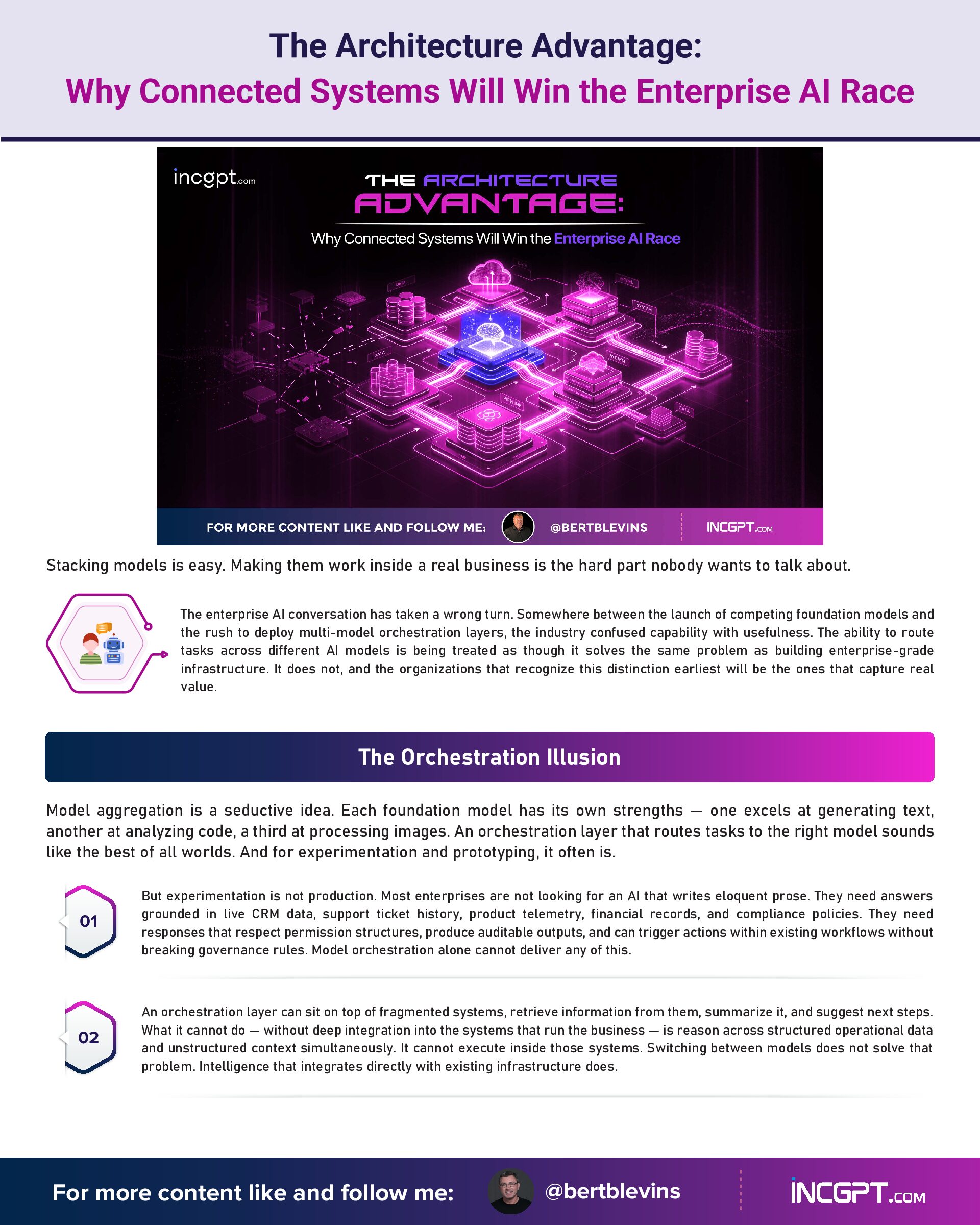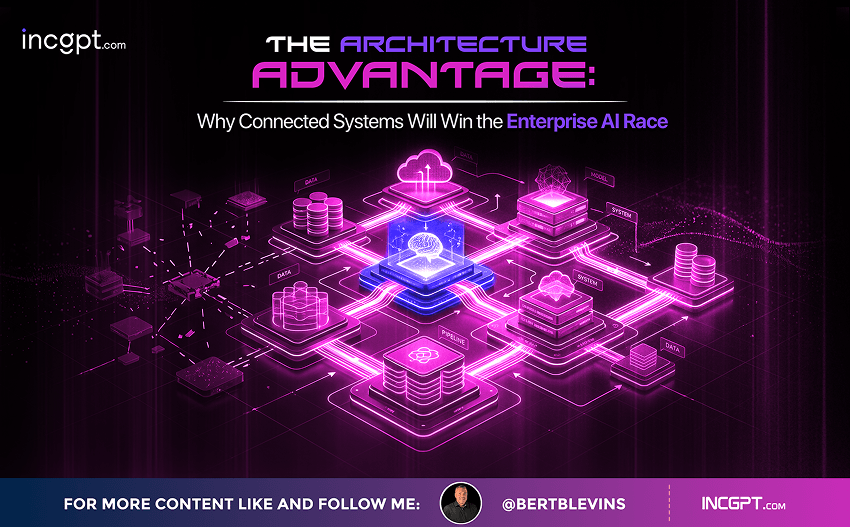
The Architecture Advantage: Why Connected Systems Will Win the Enterprise AI Race
Stacking models is easy. Making them work inside a real business is the hard part nobody wants to talk about.
The enterprise AI conversation has taken a wrong turn. Somewhere between the launch of competing foundation models and the rush to deploy multi-model orchestration layers, the industry confused capability with usefulness. The ability to route tasks across different AI models is being treated as though it solves the same problem as building enterprise-grade infrastructure. It does not, and the organizations that recognize this distinction earliest will be the ones that capture real value.
The Orchestration Illusion
Model aggregation is a seductive idea. Each foundation model has its own strengths — one excels at generating text, another at analyzing code, a third at processing images. An orchestration layer that routes tasks to the right model sounds like the best of all worlds. And for experimentation and prototyping, it often is.
But experimentation is not production. Most enterprises are not looking for an AI that writes eloquent prose. They need answers grounded in live CRM data, support ticket history, product telemetry, financial records, and compliance policies. They need responses that respect permission structures, produce auditable outputs, and can trigger actions within existing workflows without breaking governance rules. Model orchestration alone cannot deliver any of this.
An orchestration layer can sit on top of fragmented systems, retrieve information from them, summarize it, and suggest next steps. What it cannot do — without deep integration into the systems that run the business — is reason across structured operational data and unstructured context simultaneously. It cannot execute inside those systems. Switching between models does not solve that problem. Intelligence that integrates directly with existing infrastructure does.
The Real Bottleneck Is Not Intelligence — It’s Connectivity
Enterprise systems were designed for humans to navigate, not for machines to reason about. ERP platforms, CRM databases, ticketing systems, and financial ledgers all contain critical business data, but they were built to be accessed through interfaces, not interpreted by AI. The gap between what AI models can do in isolation and what they can accomplish inside a real organization is almost entirely a connectivity problem.
Consider what an enterprise actually needs from AI. Not a summary of what it found across disconnected data sources, but a computed answer that draws from structured and unstructured data simultaneously — within the organization’s permission model. The difference between “here’s what I found” and “here’s what’s true and here’s what to do next” is a fundamental architectural shift. The first is retrieval. The second is reasoning. Retrieval is a solved problem. Reasoning inside enterprise constraints is the frontier.
Trust Cannot Be Bolted On After the Fact
As AI systems move closer to core decision-making, trust becomes the central operating requirement. In enterprise environments, trust is not an abstract concept — it has very specific dimensions. Executives need to understand where an answer came from and whether it reflects the current state of the business. Compliance teams need assurance that access controls were respected in every step of the AI’s reasoning process. IT leaders need visibility into how actions are logged, audited, and reversed if necessary.
When intelligence is integrated directly with systems of record, it inherits the permission structures and audit trails that already exist. It does not need to guess who should see what information, because the access rules are built into the data layer it reads from. When intelligence sits on top of systems through an orchestration layer without deep integration, it must reconstruct those rules externally — a process that is fragile, error-prone, and difficult to audit. The distinction matters enormously when AI outputs affect revenue, compliance, or operational decisions.
The Historical Pattern: Integration Always Wins
This is not the first time the technology industry has faced this choice. Search engines did not transform the web by indexing more pages — they transformed it by delivering the right result at the right moment. E-commerce did not scale because websites became more visually appealing — it scaled because payments, identity verification, and logistics were integrated into reliable, interconnected systems. In both cases, the winners were not the platforms with the broadest capabilities but the ones with the deepest connections to the infrastructure that mattered.
Enterprise AI is following the same trajectory. The organizations building the most impressive multi-model demos will not necessarily be the ones generating the most business value. The value will accrue to those who solve the harder, less glamorous problem of connecting AI to the systems where work actually happens — where contracts are managed, where inventory is tracked, where customer histories live, and where compliance rules are enforced.
What a New Layer of AI-Native Infrastructure Looks Like
A new category of software is emerging — not as a replacement for existing enterprise systems, but as an intelligence layer built directly on top of them. Unlike orchestration tools that route queries to different models, this infrastructure reasons within the business context by connecting to the data, permissions, and workflows that define how an organization operates.
This means AI that does not just retrieve a customer’s support history but understands the contract terms governing that relationship, the escalation paths available to the service team, and the compliance requirements that constrain what can be offered as resolution. It means AI that can initiate a procurement workflow because it is connected to the approval chain, the budget system, and the vendor database — not because a human copied information between three screens and prompted a chatbot.
The Strategic Imperative for Enterprise Leaders
The implication for business leaders is direct: the AI strategy that matters is not which models you use, but how deeply those models are connected to the systems that run your operations. Multi-model flexibility is useful at the experimentation stage, but production value comes from integration depth.
This requires a shift in how enterprises evaluate AI investments. Rather than asking which platform offers the most models or the most sophisticated orchestration, the relevant question is which approach provides native access to existing systems of record, enforces governance by design, and produces outputs that can be traced, audited, and acted upon within established workflows.
Stacking models behind an interface might generate headlines. But running an enterprise requires architecture — intelligence grounded in connected systems, accountable by design, and capable of operating at the speed and scale that real business demands. The organizations that understand this will not just adopt AI. They will be transformed by it.