A Generational Divide
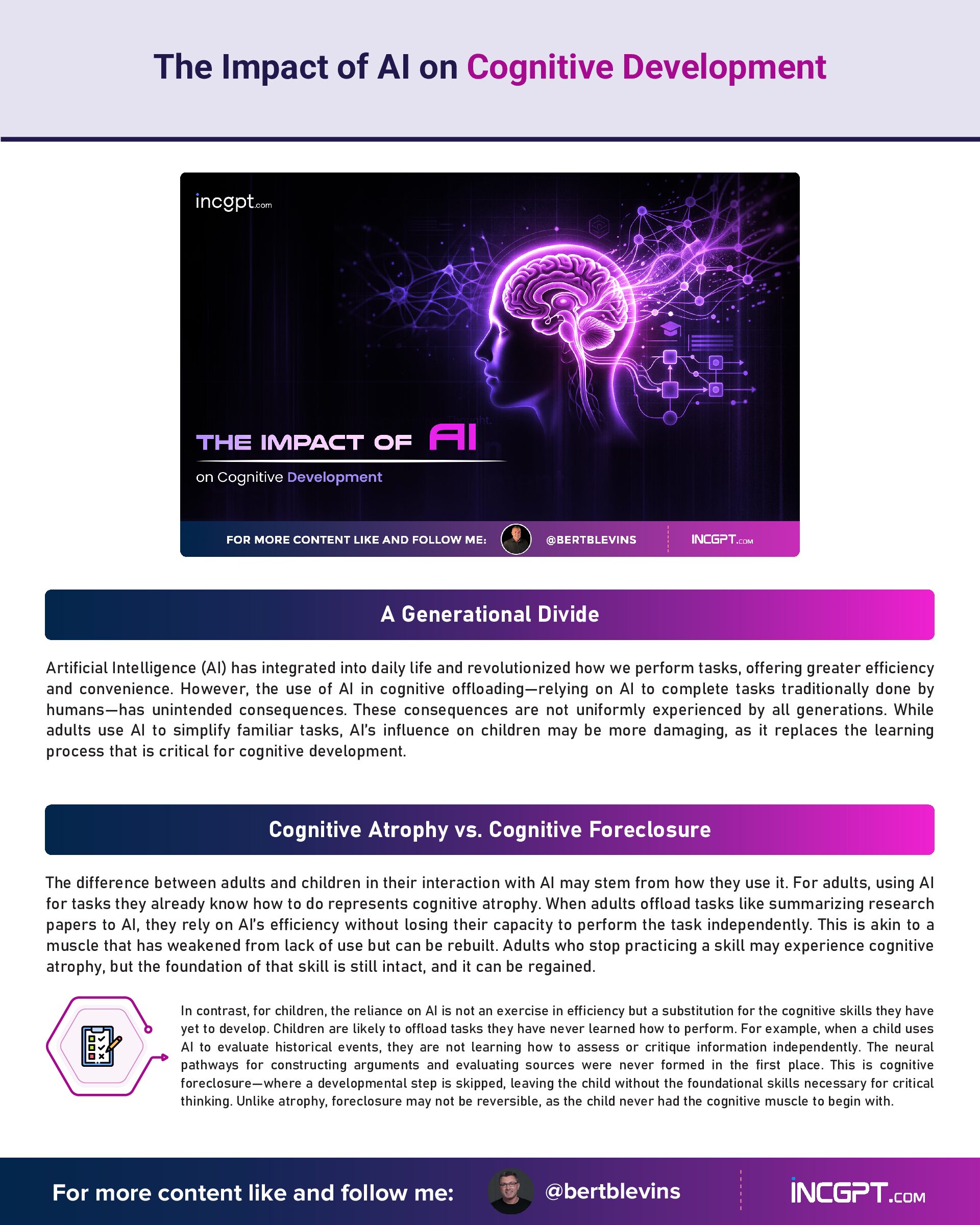
Artificial Intelligence (AI) has integrated into daily life and revolutionized how we perform tasks, offering greater efficiency and convenience. However, the use of AI in cognitive offloading—relying on AI to complete tasks traditionally done by humans—has unintended consequences. These consequences are not uniformly experienced by all generations. While adults use AI to simplify familiar tasks, AI’s influence on children may be more damaging, as it replaces the learning process that is critical for cognitive development.
Cognitive Atrophy vs. Cognitive Foreclosure
The difference between adults and children in their interaction with AI may stem from how they use it. For adults, using AI for tasks they already know how to do represents cognitive atrophy. When adults offload tasks like summarizing research papers to AI, they rely on AI’s efficiency without losing their capacity to perform the task independently. This is akin to a muscle that has weakened from lack of use but can be rebuilt. Adults who stop practicing a skill may experience cognitive atrophy, but the foundation of that skill is still intact, and it can be regained.
In contrast, for children, the reliance on AI is not an exercise in efficiency but a substitution for the cognitive skills they have yet to develop. Children are likely to offload tasks they have never learned how to perform. For example, when a child uses AI to evaluate historical events, they are not learning how to assess or critique information independently. The neural pathways for constructing arguments and evaluating sources were never formed in the first place. This is cognitive foreclosure—where a developmental step is skipped, leaving the child without the foundational skills necessary for critical thinking. Unlike atrophy, foreclosure may not be reversible, as the child never had the cognitive muscle to begin with.
The AI Audit Problem
One of the critical aspects of adult AI use is the ability to audit the output. Adults with domain knowledge can check AI-generated results, notice when information is oversimplified, and evaluate competing interpretations. For instance, when an adult asks AI to summarize a scientific paper, they can spot discrepancies or missing arguments because they have the foundational knowledge to understand the subject matter. This process of auditing the AI’s output is a critical skill for adults, and it allows them to use AI as an assistant rather than a replacement.
However, this skill is not naturally available to children. A child does not have the domain knowledge to critically assess AI’s interpretation of complex topics. Without prior knowledge of a subject, the child cannot recognize when AI makes mistakes, oversimplifies, or leaves out crucial details. For children, AI’s outputs become unquestioned truths, further hindering the development of cognitive skills.
The Homogenization of Thinking
One alarming side effect of AI reliance in children is the potential for homogenized thinking. When all students in a classroom interact with the same AI language model, they are exposed to the same reasoning structures and perspectives embedded within the model. These models, like those behind ChatGPT, are trained on vast amounts of data that reflect mainstream, often Western, perspectives. As children interact with these systems, they begin to adopt the same reasoning patterns and worldviews.
The risk here is that children are not just learning from AI but becoming shaped by it. Their thinking becomes standardized and aligned with the biases and perspectives embedded in the AI. When children use AI to process information or write essays, they may be absorbing not only factual information but also the underlying logic and assumptions of the AI. Over time, this can restrict the development of independent, creative thinking and result in children who cannot think critically outside of the AI’s framework.
Substitution vs. Delegation: A Developmental Concern
The core issue with children using AI is that it substitutes critical developmental steps. Adults may delegate tasks to AI to increase efficiency, but they still retain the capability to perform those tasks independently. For children, however, the process is more of a substitution. AI does not just make tasks easier for them; it takes over the cognitive processes they should be developing.
The work done by Shen and Tamkin (2026) with software developers highlights this issue. In their study, adult developers using AI to help with coding were able to produce working code, but they struggled with conceptual understanding and debugging. These developers were already familiar with coding, but AI’s assistance led to a deeper reliance on automation, leaving them less capable of understanding the code they had produced. Now, imagine a child encountering programming for the first time, with no prior expertise to fall back on. When they use AI to create code, they lack the baseline knowledge to evaluate the AI’s output. This can lead to a generation that is disconnected from the foundational knowledge needed to understand and solve complex problems independently.
The Implications for Education and Cognitive Development
The growing reliance on AI in education raises crucial questions about the future of cognitive development. As children increasingly rely on AI for everyday tasks, they may miss out on the essential learning experiences that foster independent thinking and problem-solving skills. The use of AI in the classroom should be carefully managed to ensure that it supports—not substitutes—the development of critical thinking.
The most significant impact may be on children’s ability to develop independent judgment. As AI provides answers and guidance, children may never learn to assess sources, critique arguments, or form their own conclusions. These are the essential cognitive skills that form the foundation for future learning and success. Without these skills, children may struggle in environments that demand independent thought, such as higher education and the workforce.
Protecting Cognitive Development in the Age of AI
The challenge is not necessarily to stop children from using AI, but to ensure that AI does not replace the developmental steps children need to grow intellectually. Educators and parents should be aware of the dangers of cognitive foreclosure and take steps to create opportunities for children to build their thinking skills. This includes fostering critical thinking exercises, encouraging problem-solving without AI, and helping children understand the limitations of AI.
AI can be a powerful tool for education, but it should be used in a way that complements, rather than replaces, the cognitive development process. Children must be given the space to struggle, make mistakes, and think critically—skills that AI cannot provide. As we move forward in this AI-driven age, it is essential to strike a balance between utilizing technology and nurturing the cognitive skills that will prepare the next generation for the complexities of the world.
Conclusion
AI presents an unprecedented opportunity for adults and children alike, but the implications for cognitive development are profound. While adults can use AI to offload tasks they already know how to do, children may face irreversible consequences in their development if they use AI to substitute critical learning experiences. As AI continues to play a larger role in education and daily life, we must ensure that it serves as a tool for growth rather than a crutch that stunts cognitive development. For children, protecting the space to develop foundational thinking skills is not just important—it is essential for their future success.