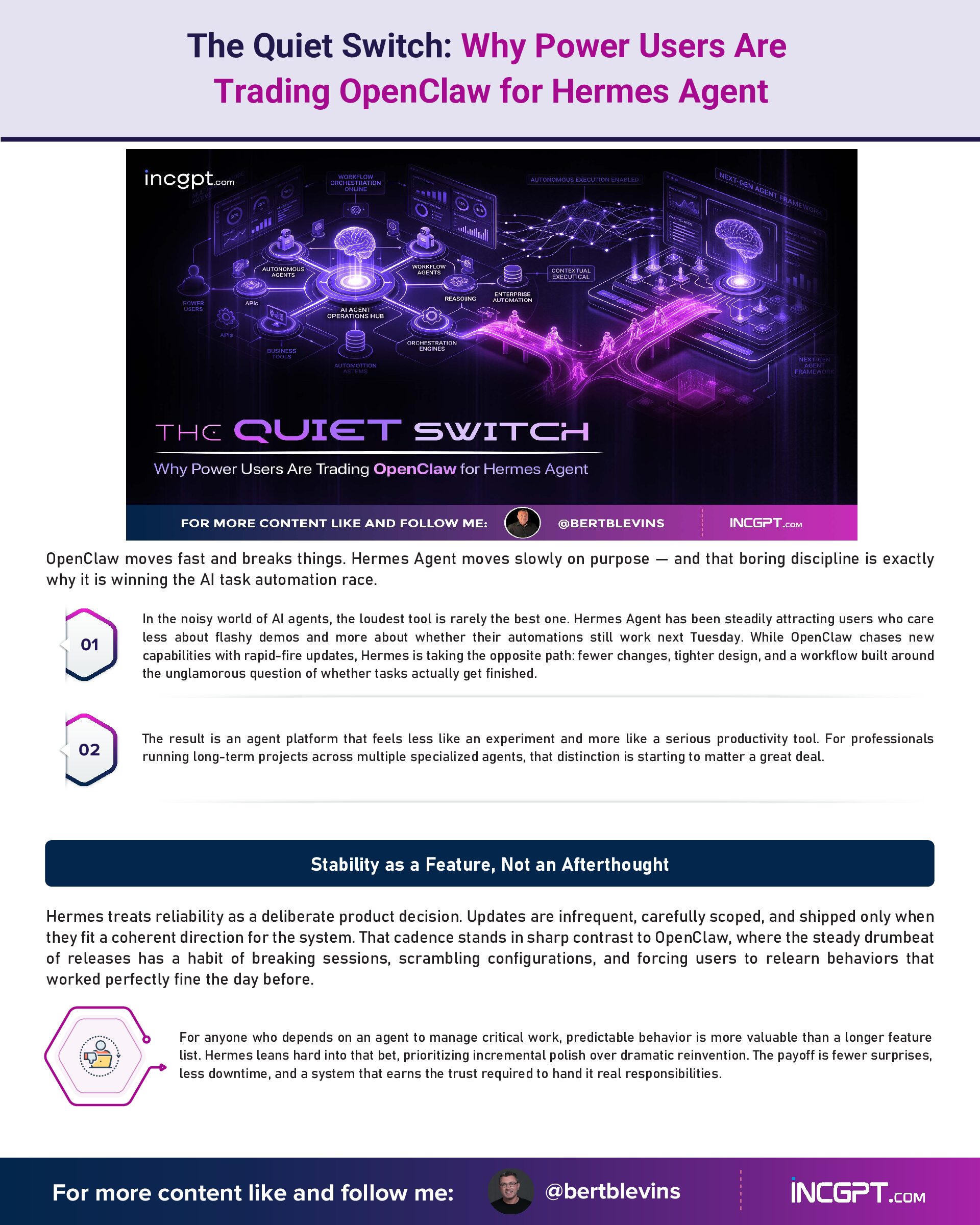
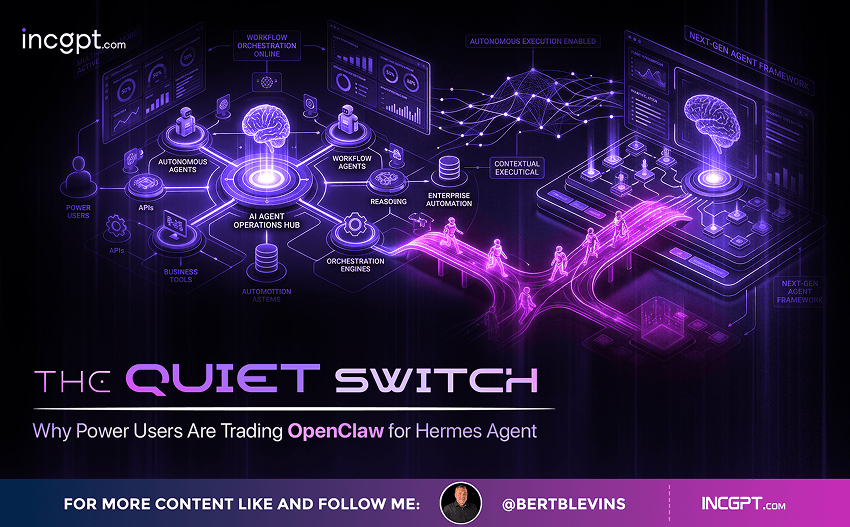
The Quiet Switch: Why Power Users Are Trading OpenClaw for Hermes Agent
OpenClaw moves fast and breaks things. Hermes Agent moves slowly on purpose — and that boring discipline is exactly why it is winning the AI task automation race.
Walk into almost any enterprise experimenting with internal AI right now and you’ll find the same scene: a slick assistant that can summarize the roadmap, pull from the company wiki, and answer questions about open deals — and a data flow that nobody on the security team has actually traced end to end. The assistant works. That is precisely what makes it dangerous.
The result is an agent platform that feels less like an experiment and more like a serious productivity tool. For professionals running long-term projects across multiple specialized agents, that distinction is starting to matter a great deal.
Stability as a Feature, Not an Afterthought
Hermes treats reliability as a deliberate product decision. Updates are infrequent, carefully scoped, and shipped only when they fit a coherent direction for the system. That cadence stands in sharp contrast to OpenClaw, where the steady drumbeat of releases has a habit of breaking sessions, scrambling configurations, and forcing users to relearn behaviors that worked perfectly fine the day before.
For anyone who depends on an agent to manage critical work, predictable behavior is more valuable than a longer feature list. Hermes leans hard into that bet, prioritizing incremental polish over dramatic reinvention. The payoff is fewer surprises, less downtime, and a system that earns the trust required to hand it real responsibilities.
A Kanban Dashboard That Treats Tasks Like Tasks
The Hermes dashboard is built around a Kanban-style board that walks each task through clear stages: Triage, To-Do, Ready, In-Progress, Blocked, and Done. It is a familiar layout to anyone who has used a project tracker, and that familiarity is the point. Instead of forcing users to learn a new mental model, Hermes layers automation on top of one they already trust.
Cron jobs and dedicated worker agents handle the repetitive lift, freeing the user to focus on direction rather than execution. Nothing slips into a black box. Every task has a visible state, a visible owner, and a visible path to completion — which is the kind of accountability that has been suspiciously rare in the agent space until now.
SlashGoal: Turning Big Goals Into Real Plans
Long-horizon work is where most agents fall apart. SlashGoal is Hermes’s answer to that problem. The feature takes a high-level objective and decomposes it into a sequence of smaller, ordered steps the agent can actually execute over time. Instead of one giant ambiguous request, the system gets a clear chain of intermediate wins to deliver against.
There is a catch worth being honest about. SlashGoal rewards careful prompting. The more precisely a goal is defined upfront, the more reliable the breakdown becomes. Vague inputs still produce vague plans. For users willing to invest a few minutes in writing tight, specific objectives, though, this is where Hermes starts to feel less like a chatbot and more like a project manager.
Specialist Agents Instead of One Confused Generalist
Rather than asking a single agent to be good at everything, Hermes lets users spin up multiple agents, each with its own memory and its own skill set. Common configurations include a Coding Agent for development work, a Research Agent for information gathering, an Administrative Agent for routine operational tasks, and a Main Orchestrator Agent that coordinates the rest.
Splitting responsibilities this way cuts down on context bleed and reduces the chance that one chaotic conversation contaminates an unrelated workflow. It also mirrors how real teams operate: specialists with clear roles, supervised by a coordinator who keeps the bigger picture in view. For anyone juggling diverse projects, the gain in clarity is immediate.
The Brain-and-Muscle Model Catalog
Hermes ships with a model catalog that makes switching between AI models simple and tracking their costs even simpler. The design philosophy underneath is what the team calls a brain-and-muscle setup: one model dedicated to heavyweight reasoning, and a second model handling the bulk of execution work. The reasoning model thinks; the execution model does.
That separation is more than a marketing line. It maps real work onto the right hardware and pricing tier, so users do not burn premium tokens on tasks a cheaper model could handle just as well. The catalog gives a transparent view of what is being spent where, which keeps budgets honest as projects scale.
Memory Management: Useful but Not Best in Class
Memory in Hermes is controlled through adjustable compression thresholds, letting users tune how aggressively the system trims its context to stay efficient. For most workflows the defaults are perfectly adequate, and the manual controls cover the edge cases.
OpenClaw, in fairness, still has the technical edge here. Its memory compression is more sophisticated, and power users who push agents to their absolute limits will notice the difference. Hermes leans the other way — simpler, more transparent, easier to predict — which suits its overall philosophy of favoring stability over cleverness.
The Curator: Keeping the System From Drowning in Itself
Long-running agent systems tend to accumulate digital debris. Stale skills, half-used memories, and forgotten artifacts all pile up until performance starts to degrade. Hermes addresses this with a curator that runs every seven days, automatically pruning anything that is no longer earning its keep.
The curator does not just delete; it reports. Users get a clear summary of which skills are being used, which are being ignored, and where manual cleanup might still be helpful. That mix of automated maintenance and informed human oversight keeps the system lean without making the user fly blind.
Where OpenClaw Falls Short
OpenClaw is not a bad tool. It is a tool that has prioritized ambition over discipline, and the consequences are starting to show. Long-time users complain about system bloat, fragile session handling, and a release cycle that introduces problems faster than it solves them. Each update arrives with a quiet anxiety about what will stop working this time.
Hermes wins the comparison by refusing to play that game. It does fewer things, but it does them dependably. For users whose livelihood depends on agents that stay up and stay consistent, dependability is not a soft feature. It is the entire product.
Who Hermes Is Really For
Hermes Agent is aimed squarely at professionals and small teams who need an AI system to behave like a serious tool rather than a science project. Its strongest features — the Kanban board, SlashGoal decomposition, multi-agent profiles, the model catalog, and the curator — work together to support exactly that audience.
Memory compression could still get sharper, and SlashGoal still rewards good prompt hygiene. But the broader picture is unambiguous. In a market where most agent platforms are racing to add the next thing, Hermes has chosen to perfect the things that already exist. That patient, almost old-fashioned approach is what is quietly pulling users away from OpenClaw — and it explains why the conversation around reliable AI task automation is starting to sound less like a hype cycle and more like an honest engineering discussion.