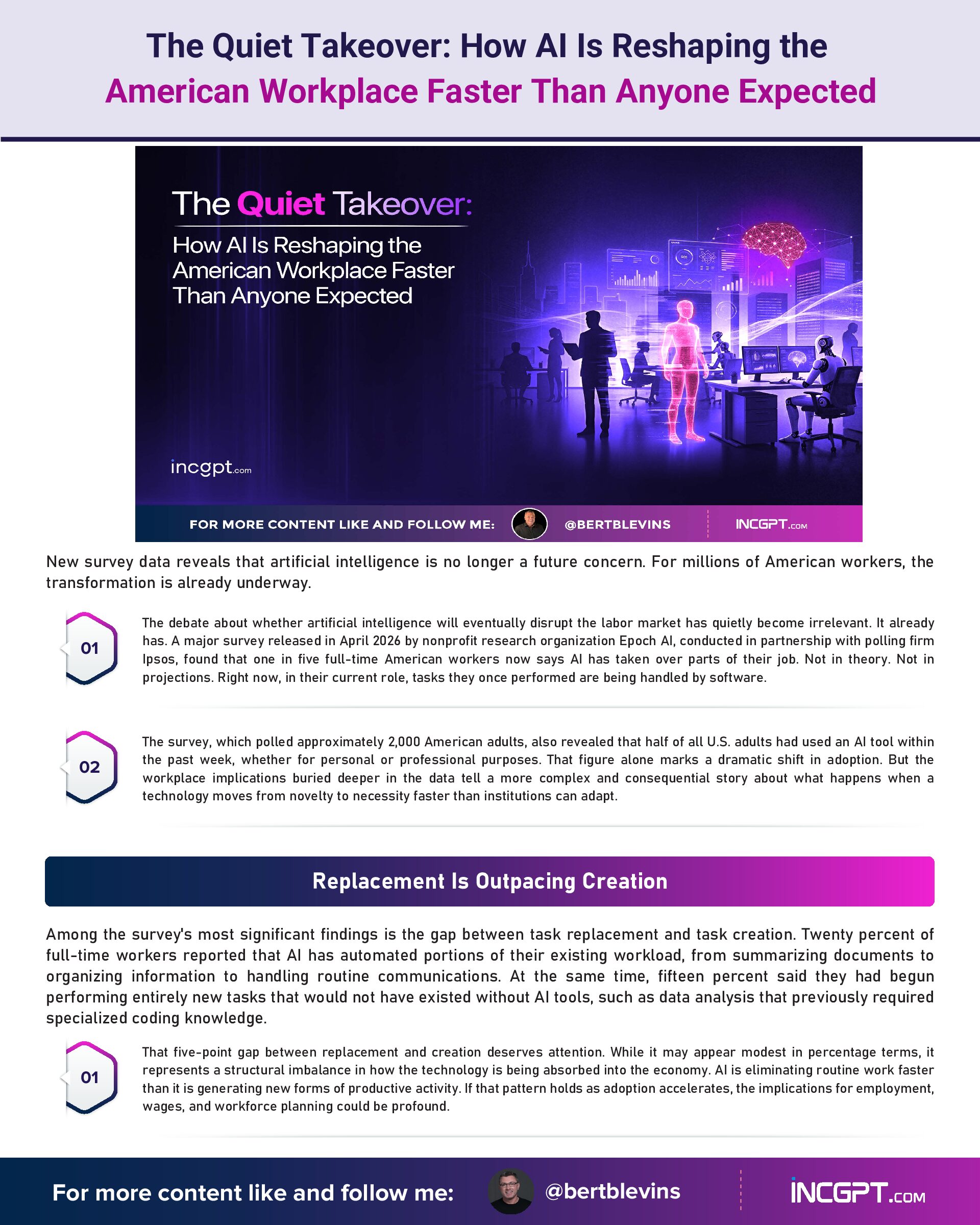
The Quiet Takeover: How AI Is Reshaping the American Workplace Faster Than Anyone Expected
New survey data reveals that artificial intelligence is no longer a future concern. For millions of American workers, the transformation is already underway.
The debate about whether artificial intelligence will eventually disrupt the labor market has quietly become irrelevant. It already has. A major survey released in April 2026 by nonprofit research organization Epoch AI, conducted in partnership with polling firm Ipsos, found that one in five full-time American workers now says AI has taken over parts of their job. Not in theory. Not in projections. Right now, in their current role, tasks they once performed are being handled by software.
The survey, which polled approximately 2,000 American adults, also revealed that half of all U.S. adults had used an AI tool within the past week, whether for personal or professional purposes. That figure alone marks a dramatic shift in adoption. But the workplace implications buried deeper in the data tell a more complex and consequential story about what happens when a technology moves from novelty to necessity faster than institutions can adapt.
Replacement Is Outpacing Creation
Among the survey’s most significant findings is the gap between task replacement and task creation. Twenty percent of full-time workers reported that AI has automated portions of their existing workload, from summarizing documents to organizing information to handling routine communications. At the same time, fifteen percent said they had begun performing entirely new tasks that would not have existed without AI tools, such as data analysis that previously required specialized coding knowledge.
That five-point gap between replacement and creation deserves attention. While it may appear modest in percentage terms, it represents a structural imbalance in how the technology is being absorbed into the economy. AI is eliminating routine work faster than it is generating new forms of productive activity. If that pattern holds as adoption accelerates, the implications for employment, wages, and workforce planning could be profound.
Policy experts have taken notice. One AI policy researcher described the finding as evidence that labor market restructuring is happening in real time, warning that the policy window to shape how AI transforms work is closing faster than most governments realize. Separate economic analysis from Goldman Sachs published around the same time estimated that AI-driven automation is already eliminating approximately 16,000 jobs per month in the United States when accounting for both direct displacement and indirect effects.
The Access Gap Is Shaping Adoption
The survey uncovered another dynamic that will likely influence how AI reshapes work in the coming years: the relationship between employer-provided access and professional usage. Among workers who received a paid AI subscription from their employer, 76 percent reported using the tools at least as much for work as for personal tasks. That figure dropped to 58 percent among those paying for their own subscriptions and fell further to roughly one-third among workers using free-tier AI services.
The pattern suggests that employer investment in AI tools directly correlates with how deeply those tools become embedded in daily work. Organizations that provide paid subscriptions are effectively accelerating the integration of AI into their operations, whether or not they have formal strategies for managing that transition. Meanwhile, roughly half of American adults who used AI for work in the past week relied entirely on personal subscriptions or free versions, meaning a substantial portion of workplace AI adoption is happening outside the view and control of employers.
Microsoft Copilot, bundled with the company’s suite of productivity and cloud services, emerged as the most widely used AI tool among employed Americans for work-related tasks. OpenAI’s ChatGPT and Google Gemini ranked second and third, respectively. The dominance of tools already integrated into existing workplace software ecosystems underscores how distribution and default access matter as much as raw capability in determining which AI systems gain traction.
The Rise of AI Agents
Perhaps the most forward-looking finding in the survey relates to AI agents, systems capable of performing independent tasks rather than simply responding to prompts. Eight percent of AI users reported engaging an AI agent within the past week, compared to 49 percent who used AI primarily for web search. While agent adoption remains relatively low, the speed of its emergence is notable. Autonomous AI agents that take actions on behalf of users, from scheduling meetings to managing workflows to conducting research, were not widely available to consumers two years ago.
The distinction between assistive AI and agentic AI matters enormously for the future of work. Traditional AI tools help workers complete tasks more efficiently. Agents can perform those tasks independently, raising fundamental questions about which roles will be augmented and which will be replaced entirely. If agent adoption follows the same trajectory as general AI tool usage, the next phase of workplace disruption could move beyond assistance into direct task execution at a pace that catches many organizations unprepared.
The Self-Assessment Paradox
Amid these shifts, a separate survey finding introduces an interesting tension. When asked whether they could perform their jobs at the same level without AI, 68 percent of workers said yes, describing AI as a convenience rather than a necessity. Another 28 percent said they could manage but would work more slowly. Only four percent reported that they would struggle significantly without AI tools.
On the surface, this suggests that AI dependency remains low. But the finding sits uncomfortably alongside another data point: roughly 19 percent of workers reported that their underlying skills have actively deteriorated since they began using AI regularly. Workers may be accurately assessing their current output while underestimating how much AI is compensating for a gradual erosion of the capabilities they once relied on. If that erosion compounds over time, the gap between perceived competence and actual ability could widen in ways that only become visible when access to AI tools is interrupted.
What Comes Next
The Epoch AI survey captures a labor market in transition, one where AI is neither the catastrophic job destroyer that pessimists fear nor the productivity miracle that optimists promise. The reality is messier and more nuanced. Tasks are being automated. New tasks are being created. Access is unevenly distributed. Adoption is outrunning policy. And workers are simultaneously benefiting from and being reshaped by tools they increasingly cannot imagine working without.
The organizations and governments that navigate this transition successfully will be those that look beyond the headline numbers and grapple with the structural questions underneath. Which tasks are being replaced and which workers are most affected? How should retraining programs be designed when the skills being displaced are changing every quarter? What happens when agent adoption reaches the same penetration as general AI tools? These are not future questions. They are current ones, and the data suggests the window for answering them thoughtfully is narrower than most decision-makers appreciate.