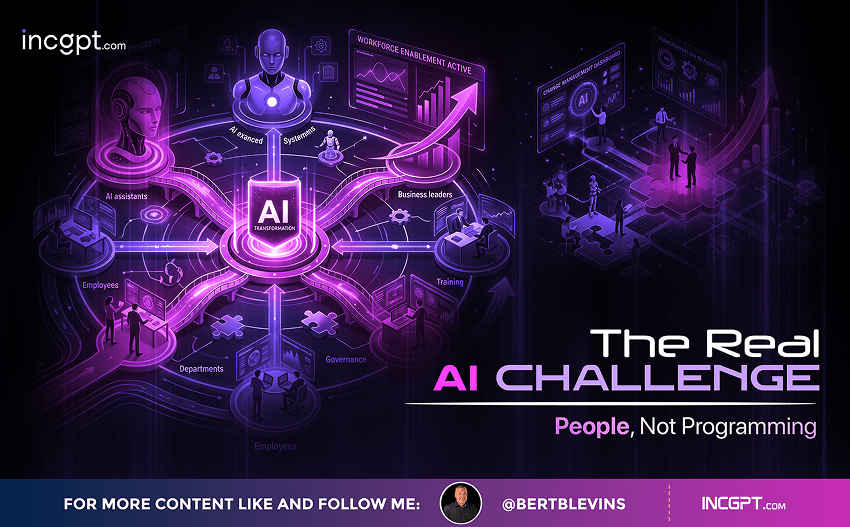
The Real AI Challenge: People, Not Programming
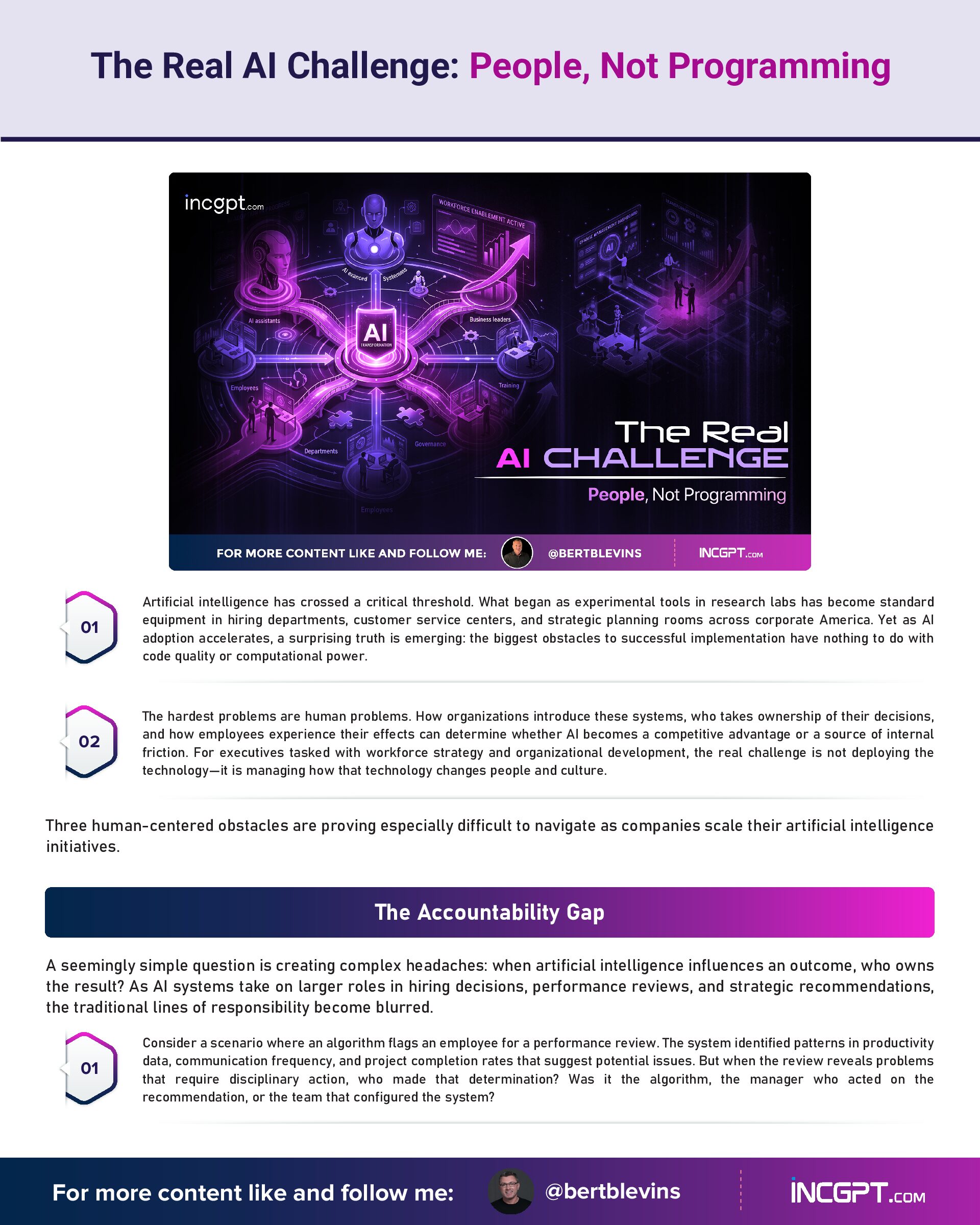
Artificial intelligence has crossed a critical threshold. What began as experimental tools in research labs has become standard equipment in hiring departments, customer service centers, and strategic planning rooms across corporate America. Yet as AI adoption accelerates, a surprising truth is emerging: the biggest obstacles to successful implementation have nothing to do with code quality or computational power.
The hardest problems are human problems. How organizations introduce these systems, who takes ownership of their decisions, and how employees experience their effects can determine whether AI becomes a competitive advantage or a source of internal friction. For executives tasked with workforce strategy and organizational development, the real challenge is not deploying the technology—it is managing how that technology changes people and culture.
Three human-centered obstacles are proving especially difficult to navigate as companies scale their artificial intelligence initiatives.
The Accountability Gap
A seemingly simple question is creating complex headaches: when artificial intelligence influences an outcome, who owns the result? As AI systems take on larger roles in hiring decisions, performance reviews, and strategic recommendations, the traditional lines of responsibility become blurred.
Consider a scenario where an algorithm flags an employee for a performance review. The system identified patterns in productivity data, communication frequency, and project completion rates that suggest potential issues. But when the review reveals problems that require disciplinary action, who made that determination? Was it the algorithm, the manager who acted on the recommendation, or the team that configured the system?
This ambiguity creates risk. When decision-making authority becomes diffuse, accountability follows. Organizations need clear frameworks that define where human judgment remains essential and how responsibility is maintained when automated systems provide input. Without these guidelines, AI can inadvertently create a culture where difficult decisions are blamed on the algorithm rather than owned by leadership.
The Trust and Fairness Problem
Employee perceptions of artificial intelligence can fundamentally alter their relationship with their organization. When people understand how AI is being used and feel confident about the logic behind decisions, these tools can deliver consistency and better outcomes. But when systems appear opaque or their reasoning seems questionable, workers and stakeholders may begin to doubt whether processes are fair and transparent.
This dynamic becomes especially sensitive in areas that directly affect careers and compensation. AI-driven hiring practices, promotion algorithms, and performance evaluation systems do not simply optimize HR processes—they shape how employees view their employer’s commitment to fairness. Poor implementation or inadequate communication about these tools can damage trust in ways that extend far beyond the technology itself.
The stakes extend beyond internal employee relations. Boards, partners, regulators, and other external stakeholders are paying increasing attention to how organizations use artificial intelligence in decision-making. Companies that cannot clearly explain their AI governance practices may find themselves facing scrutiny that affects their broader reputation and business relationships.
The Change Management Challenge
Artificial intelligence often accelerates operational change faster than organizations prepare their workforce to handle it. Tasks shift, roles evolve, and expectations for employee capabilities begin changing, sometimes before clear guidance is provided about how these transitions should work.
Employees may find themselves expected to collaborate with AI systems, adapt to new workflows, or interpret automated insights without sufficient training on how their responsibilities are evolving. This can create uncertainty rather than empowerment, especially when workers are unclear about which aspects of their jobs might be automated and which require human expertise.
The most successful AI implementations involve more than training people on new tools. They require leaders who can guide organizational change, communicate evolving expectations clearly, and ensure employees feel supported rather than threatened as work transforms around them.
Leadership as the Differentiator
These challenges point to a broader reality: artificial intelligence adoption is fundamentally a leadership issue, not a technology issue. The decisions executives make about governance, transparency, accountability, and workforce preparation determine how AI is experienced throughout the organization—by employees, customers, and stakeholders alike.
Early choices often establish patterns that persist as technology capabilities expand. Organizations that get the human elements right in their initial AI deployments create foundations for successful scaling. Those that focus primarily on technical deployment often find themselves managing trust issues and change resistance that could have been prevented with better planning.
Success with artificial intelligence increasingly depends not only on technical capability but also on leaders who can navigate complex tradeoffs between innovation, risk management, and human impact. This requires a different set of skills than traditional technology rollouts.
Building AI Leadership Capabilities
Addressing these challenges requires executives to develop new competencies. Leaders must learn to clarify accountability structures, establish governance frameworks, support workforce transitions, and communicate transparently about how artificial intelligence influences organizational decisions.
This is not a problem that can be solved with a single training session or policy document. It requires ongoing attention to how AI adoption affects company culture, employee relationships, and external stakeholder confidence. Organizations that treat this as an afterthought often find themselves managing problems that are much harder to fix after they have taken root.
As artificial intelligence continues to reshape the modern workplace, the most important question facing leaders is not what the technology can accomplish, but how they will implement it in ways that strengthen rather than undermine their organization’s human foundation. The companies that get this right will find AI to be a powerful accelerator of their existing strengths. Those that do not may discover that their most advanced tools have created their most difficult problems.