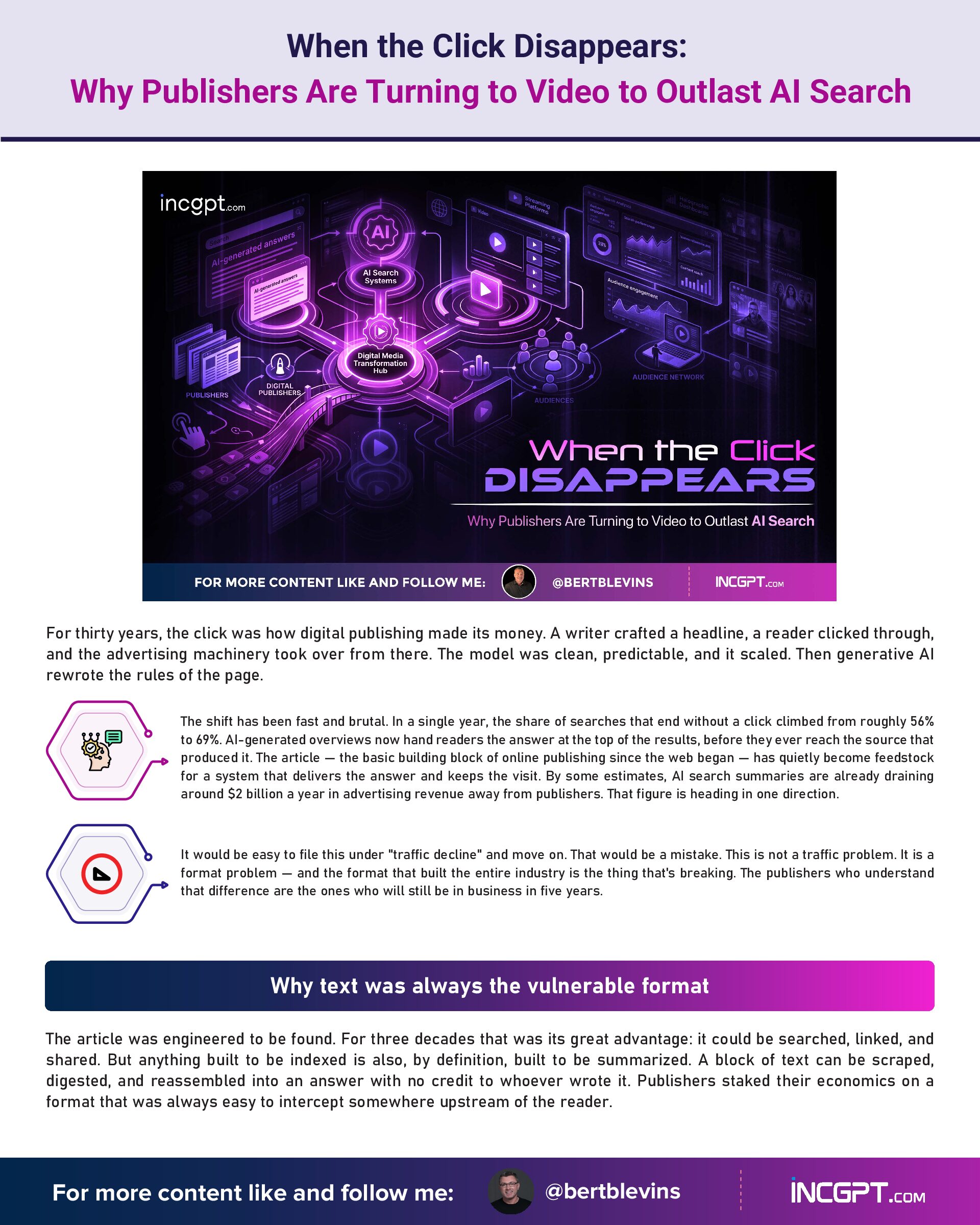
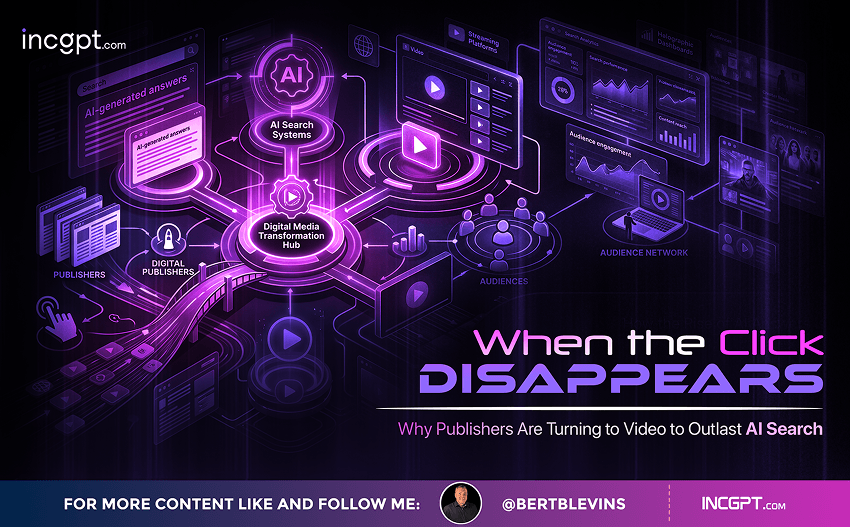
When the Click Disappears: Why Publishers Are Turning to Video to Outlast AI Search
For thirty years, the click was how digital publishing made its money. A writer crafted a headline, a reader clicked through, and the advertising machinery took over from there. The model was clean, predictable, and it scaled. Then generative AI rewrote the rules of the page.
The shift has been fast and brutal. In a single year, the share of searches that end without a click climbed from roughly 56% to 69%. AI-generated overviews now hand readers the answer at the top of the results, before they ever reach the source that produced it. The article — the basic building block of online publishing since the web began — has quietly become feedstock for a system that delivers the answer and keeps the visit. By some estimates, AI search summaries are already draining around $2 billion a year in advertising revenue away from publishers. That figure is heading in one direction.
It would be easy to file this under “traffic decline” and move on. That would be a mistake. This is not a traffic problem. It is a format problem — and the format that built the entire industry is the thing that’s breaking. The publishers who understand that difference are the ones who will still be in business in five years.
Why text was always the vulnerable format
The article was engineered to be found. For three decades that was its great advantage: it could be searched, linked, and shared. But anything built to be indexed is also, by definition, built to be summarized. A block of text can be scraped, digested, and reassembled into an answer with no credit to whoever wrote it. Publishers staked their economics on a format that was always easy to intercept somewhere upstream of the reader.
Video behaves differently. It is not immune to AI — nothing is — but as an experience, it resists the shortcut in a way text simply cannot. A machine can transcribe a clip or spit out a summary of it, yet the act of watching cannot be substituted by a description of what was watched. A story told on screen lands differently than the same story read on a page, and that difference doesn’t compress into a search snippet. With video, the experience is the product, and the product requires the viewing.
The advertising market has already placed its chips. Global video ad spend is projected to reach roughly $236 billion in 2026, making it the largest single format category in digital advertising. Money follows attention, and attention is flowing to video. Around nine in ten U.S. consumers say they’re willing to watch short vertical clips directly on a publisher’s site, and vertical video under a minute long drives about 2.5 times the engagement of conventional formats.
Publishers who have actually built a strong video experience are watching it show up in their numbers. The ones still treating video as a box to tick are leaving the money on the table. Time magazine, for instance, is reportedly pulling vertical-video advertising rates 25% to 40% above its standard display inventory — not because the journalism changed, but because the format did.
The next generation of video will sort the winners from the rest
Today’s best-performing formats are only the starting point. The video experiences coming next are immersive and adaptive — players that respond to both the content and the device, flipping between vertical and horizontal, expanding to fill the screen, and meeting viewers wherever they happen to be.
Designed around how people actually move through content, these formats achieve something a static article never could: they make staying feel better than leaving. A viewer who chooses to watch, stays through to the end, and clicks into whatever comes next is a completely different signal than a reader who bounces after twelve seconds. Advertisers understand this distinction intimately, and the price gap between passive ad space and genuinely immersive video environments is only going to grow as the technology matures.
This is not about chasing vertical video for its own sake, and it is not about imitating TikTok. It is about owning a premium video environment that belongs to the publisher’s brand rather than to someone else’s platform. Publishers investing in that experience now are building a durable asset. Everyone else is renting attention from an algorithm they don’t control.
The questions every publisher should be asking now
Over the past several years, publishers have diversified sensibly — into subscriptions, newsletters, live events, and first-party data. All of it matters. But none of it directly answers the core problem: AI now intercepts the reader before they ever arrive, and only video reliably pulls them back. Video isn’t new. What’s new is that it has become irreplaceable in a way text never was.
So the questions worth sitting with are pointed ones. Is your video experience actually built to capture this value, or is it bolted on as an afterthought? Is it immersive enough to keep someone on your site rather than bouncing to the next tab? Is it shaped for how your audience really consumes — on a phone, vertically, in short bursts of genuine attention? And is it producing the kind of inventory advertisers will pay a real premium to be part of?
How a publisher answers those questions will decide whether they lead the next chapter of digital media — or spend it trying to work out where their audience went.
Adapted from partner insights published by EX.CO via Digiday.