Back Button Hijacking Is Out: Inside Google's June Crackdown on a Decade-Old Publisher Trick
You have almost certainly run into it. You click a search result, skim the page, and tap the back button to return to where you came from. Instead, a different page loads. Maybe it is a curated recommendation feed from the same site. Maybe it is an ad. Maybe it is just another article from the publisher you were trying to leave. Whatever it is, it is not what you asked for.
That tactic has a name. It is called back button hijacking, and Google has officially decided it has seen enough.
What Back Button Hijacking Actually Is
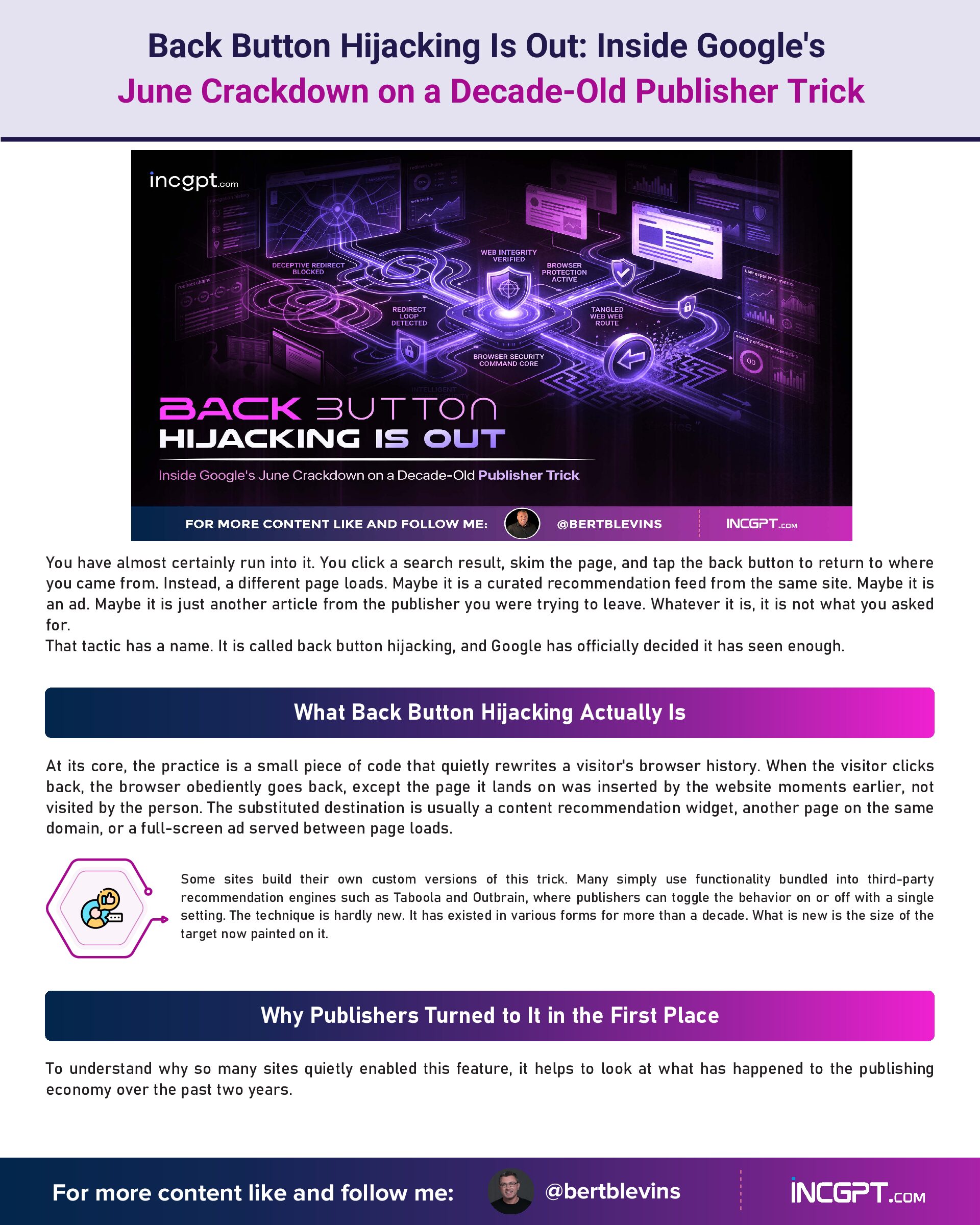
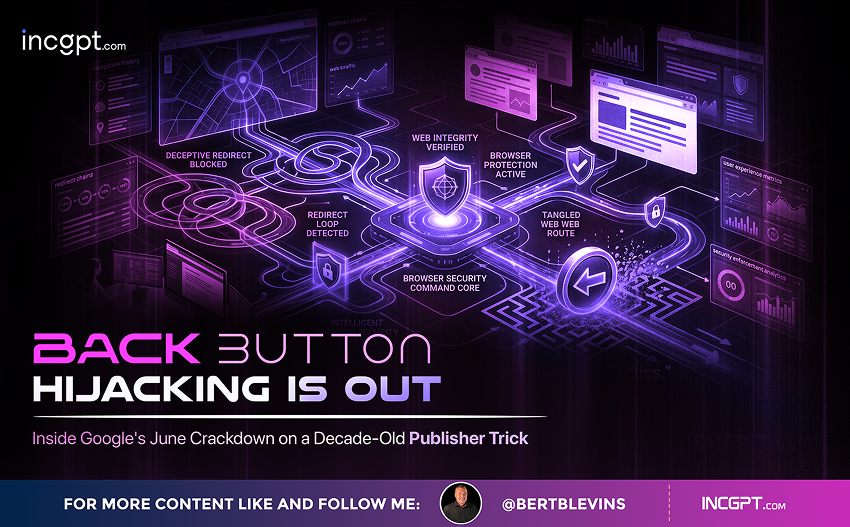
At its core, the practice is a small piece of code that quietly rewrites a visitor’s browser history. When the visitor clicks back, the browser obediently goes back, except the page it lands on was inserted by the website moments earlier, not visited by the person. The substituted destination is usually a content recommendation widget, another page on the same domain, or a full-screen ad served between page loads.
Some sites build their own custom versions of this trick. Many simply use functionality bundled into third-party recommendation engines such as Taboola and Outbrain, where publishers can toggle the behavior on or off with a single setting. The technique is hardly new. It has existed in various forms for more than a decade. What is new is the size of the target now painted on it.
Why Publishers Turned to It in the First Place
To understand why so many sites quietly enabled this feature, it helps to look at what has happened to the publishing economy over the past two years.
Search referral traffic, once a reliable river feeding most digital publishers, has slowed to a trickle in many corners of the web. Google’s repeated algorithm changes, the launch of AI Overviews that answer questions directly inside the search results page, and a string of core updates have left many publishers reporting that a third or more of their traditional search traffic has simply evaporated. When the front door of the building shrinks, operators try harder to keep the visitors who do walk in.
That is the logic behind back button hijacking. If a reader is about to leave, the site gets one more pageview, one more ad impression, or one more shot at clicking through a recommendation widget before that traffic disappears. For publishers staring at quarterly numbers, even a few extra percentage points per visitor can feel like the difference between survival and shrinkage.
Google's Verdict and the Timeline
On April 13, Google declared the practice off-limits, framing it as a violation of its spam policy and labeling it a malicious behavior. Sites that continue the tactic past June 15 risk demotion in search rankings or, in more severe cases, removal from search results altogether.
Google AdSense followed with its own announcement on May 8, confirming that vignette ads, the full-screen interstitials some publishers serve between page loads, will no longer be triggered when a user hits the back button after the same deadline.
Google’s stated reason is user experience. The company argues that interfering with the browser’s expected behavior breaks trust and frustrates visitors, both of which damage the broader web ecosystem it depends on. SEO consultants tend to agree. Industry voices have called the practice a textbook dark pattern, the kind of design choice that deceives users into actions they did not intend.
A widely shared analogy makes the point sharper than any spam policy can: if a guest walks into your restaurant and decides the menu is not for them, you do not lock the exit and charge them to leave. The back button has always been the visitor’s exit. Treating it as inventory is, in Google’s view, a line publishers should not cross.
What Ignoring the Warning Could Actually Cost
The math is unforgiving. Industry analysts estimate the additional revenue a site earns from back button hijacking is modest. Reportedly, at least one publisher reviewing its options concluded the feature was barely moving the needle and chose to disable it before the deadline rather than risk a worse outcome.
That worse outcome is the real question. A demotion in search ranking for a publisher already losing ground to AI summaries could be the blow that breaks a fragile business model. Full de-indexing, Google’s nuclear option, would effectively erase a site from the internet for the majority of users who still begin their day in a search box.
A small group of publishing executives have reportedly decided to keep their hijacking tactics in place anyway, treating June 15 as an experiment to see how aggressively Google enforces the new rule. That is a costly gamble. Google has indicated that sites penalized for back button hijacking can request reconsideration after fixing the issue, but the time spent in the penalty box is time off the leaderboard.
A Turning Point for Publisher Behavior
Back button hijacking is a symptom, not a cause. It is what happens when the economics of digital publishing get squeezed hard enough that practices once considered fringe migrate toward the mainstream. The tactic did not appear because publishers wanted to annoy readers. It appeared because the alternative felt like quiet decline.
Google’s June 15 deadline does not solve that underlying problem. The traffic shifts caused by AI Overviews, zero-click search, and the broader move toward agent-driven browsing are not going away. If anything, they are accelerating. But the crackdown does send a clear signal that growth tactics built on hijacking user intent are no longer a defensible response, even in a brutal market.
For publishers, the cleanest path forward is probably the boring one. Turn the feature off. Take the small revenue hit. Avoid an enforcement action that could cost far more than the tactic was ever bringing in. And start building the next phase of the business on something more durable than a stolen click on the back button.