Beyond the Prompt: How Obsidian Memory Vaults Are Quietly Rewriting AI-Assisted Development
Coding agents are powerful, but forgetful. A growing class of structured memory tools is giving them a place to remember — and changing how engineers ship software in the process.
Anyone who has spent a serious amount of time pair-programming with an AI agent knows the frustration. Every new task starts from zero. The agent has to be re-told what stack the project uses, where the API contracts live, which decorators the team has agreed on, and what naming conventions are non-negotiable. Repeat that ritual a few dozen times and the productivity gains start to leak away through pure context overhead. A new wave of developer tooling is trying to fix that problem at the root, and Obsidian, originally a humble note-taking app, has unexpectedly become one of the leading characters in the story.
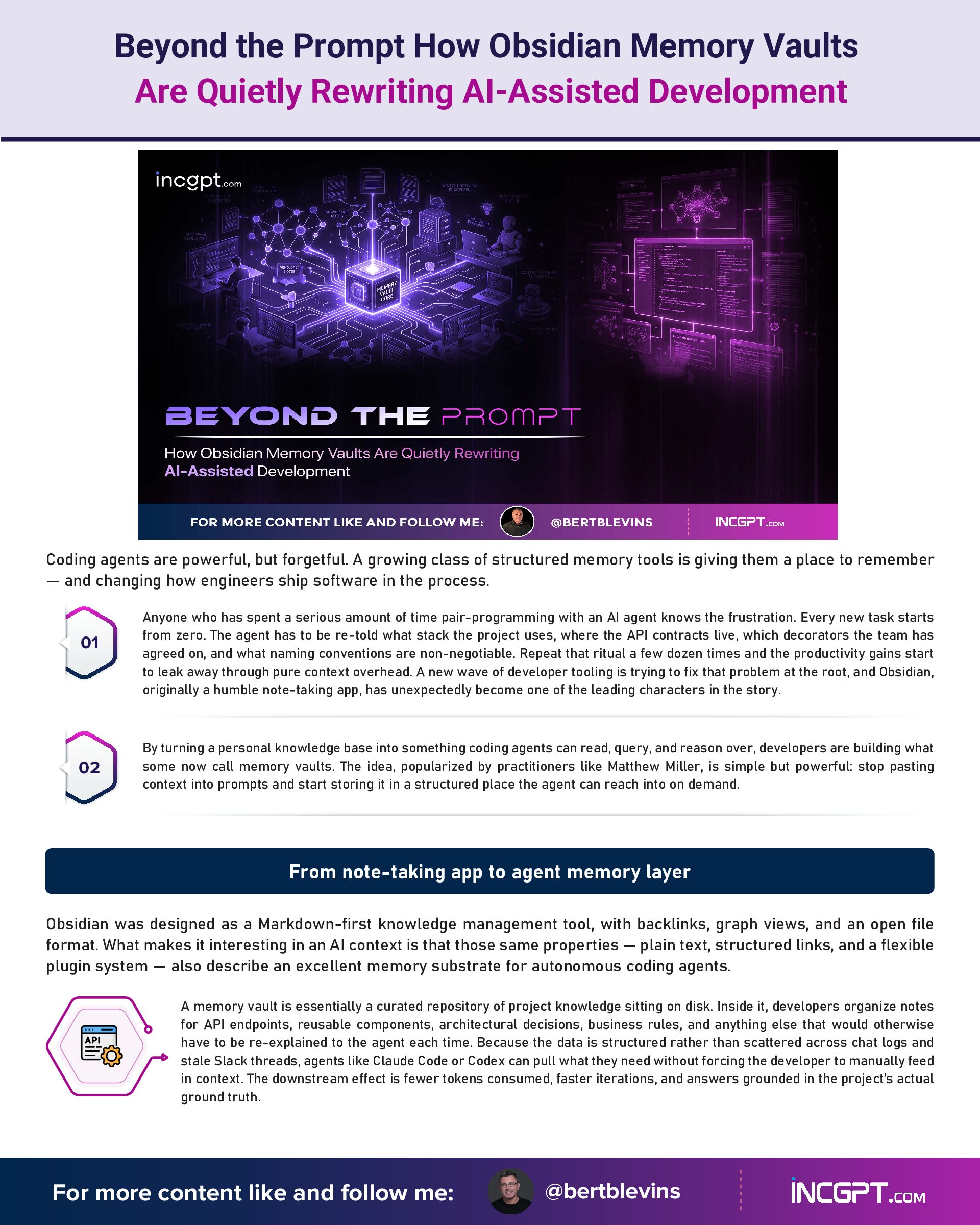
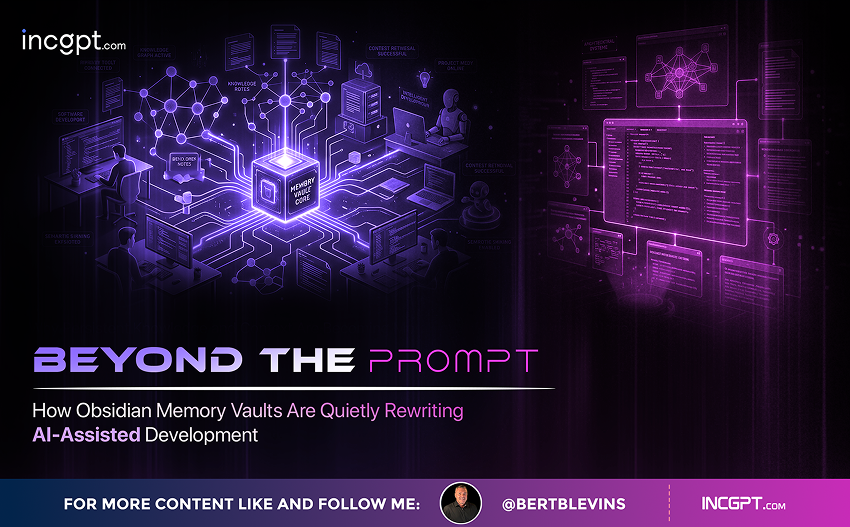
By turning a personal knowledge base into something coding agents can read, query, and reason over, developers are building what some now call memory vaults. The idea, popularized by practitioners like Matthew Miller, is simple but powerful: stop pasting context into prompts and start storing it in a structured place the agent can reach into on demand.
From note-taking app to agent memory layer
Obsidian was designed as a Markdown-first knowledge management tool, with backlinks, graph views, and an open file format. What makes it interesting in an AI context is that those same properties — plain text, structured links, and a flexible plugin system — also describe an excellent memory substrate for autonomous coding agents.
A memory vault is essentially a curated repository of project knowledge sitting on disk. Inside it, developers organize notes for API endpoints, reusable components, architectural decisions, business rules, and anything else that would otherwise have to be re-explained to the agent each time. Because the data is structured rather than scattered across chat logs and stale Slack threads, agents like Claude Code or Codex can pull what they need without forcing the developer to manually feed in context. The downstream effect is fewer tokens consumed, faster iterations, and answers grounded in the project’s actual ground truth.
Why structure beats more context
It might sound counterintuitive, but the fix for AI forgetfulness is rarely a bigger context window. The real fix is better organization of what gets fed into that window. A 200,000-token model that drowns in noise will still produce sloppy code. A smaller model fed the right twenty notes will not.
This is where Obsidian’s plugin ecosystem starts to earn its keep. The Data View plugin, in particular, lets developers query their notes the way they would query a database — filtering by tags, frontmatter properties, or folder paths. A coding agent can be pointed at the result of those queries and receive exactly the slice of project memory it needs for the task at hand. Need every endpoint that touches user authentication? One query. Need a list of every reusable decorator the team has agreed on? Another query. The agent stops guessing and starts referencing.
What developers actually store in a memory vault
In practice, memory vaults tend to fill up with the kind of knowledge that traditionally lives in scattered Markdown files, half-updated wikis, and the heads of senior engineers. API documentation is one of the heaviest use cases, with full request and response shapes captured in a way agents can pattern-match against when generating new endpoints. Reusable components are another sweet spot, since templates, decorators, and utility modules become genuinely reusable only when they are documented somewhere an agent can find them.
Beyond that, teams use vaults to encode project-specific knowledge that does not exist anywhere else: the reasoning behind a particular schema choice, the gotchas of a third-party integration, or the conventions a team has converged on after months of trial and error. By centralizing that knowledge, developers turn fragile institutional memory into something durable and query able.
The catch: Obsidian asks for effort upfront
Obsidian’s biggest strength — its flexibility — is also its biggest demand. The tool will happily do whatever you configure it to do, but it will not configure itself. Setting up a vault that integrates cleanly with a coding agent involves picking the right plugins, defining a folder structure, agreeing on tagging conventions, and wiring everything up so the agent can read it without confusion.
For solo developers and small teams with strong opinions, that ceremony pays off. For larger organizations, or for engineers who simply want a working memory system out of the box, the manual setup can feel like building a workshop before you can start carpentry. Synchronization across multiple agents and large project repositories adds another layer of complexity that not every team wants to manage in-house.
Bridge Memory and the rise of opinionated alternatives
That gap is exactly where alternatives like Bridge Memory are positioning themselves. Built into the Bridge pace development environment, Bridge Memory takes a more opinionated stance: instead of giving developers an empty workshop, it ships with a memory management system already wired up. A Memory Control Protocol (MCP) server handles synchronization and integration across coding agents, while Memory Graphs visualize the relationships between project components so engineers can reason about complex workflows at a glance.
The trade-off mirrors patterns elsewhere in the developer tooling space. Bridge Memory chooses a narrower, smoother path. Obsidian chooses a wider, rougher one. Neither is universally right. Bridge pace users get something that works on day one with minimal setup. Obsidian users get a system they can bend to fit a project of any shape, provided they are willing to invest the configuration time.
Choosing between a workshop and a kit
Picking between the two often comes down to where a developer wants to spend their attention. Engineers who treat their tooling as a craft, who tweak editor configurations for fun, and who run highly customized projects tend to gravitate toward Obsidian. Its plugin ecosystem and freeform structure reward that investment. Engineers who would rather spend that time on the actual product, especially those already living inside Bridge pace, will find Bridge Memory’s out-of-the-box behavior more practical.
It is also worth noting that the choice is not always permanent. Some teams start with a managed solution like Bridge Memory to get moving quickly, then graduate to a customized Obsidian setup once they understand the specific shape of their memory needs. Others go the other way, abandoning a hand-rolled vault in favor of something less brittle to maintain.
Why memory systems are no longer optional
The bigger story behind both tools is that structured memory has stopped being a nice-to-have. As of 2026, the complexity and pace of modern software work have outgrown the old workflow of dumping context into a chat window and hoping the model retains it. Scattered Markdown files, ad-hoc copy-pastes, and ever-longer system prompts simply do not scale to the kinds of projects coding agents are now expected to take on.
Structured memory systems address those limits by giving agents a single source of truth they can return to repeatedly. The benefits compound: less repetitive learning, more consistent output across a codebase, lower token spends on routine context management, and engineers freed up for the strategic work that AI cannot yet do alone. In other words, the memory layer is becoming as important as the model itself.
Where this is heading
Looking forward, memory systems for AI agents look likely to evolve along the same arc as version control did two decades ago — first an expert tool used by a few developers willing to set everything up by hand, then a managed product category that almost every team adopts as default. Obsidian and Bridge Memory represent two visible points on that arc today, but the broader category is still very much in motion, with new entrants experimenting with everything from graph databases to vector stores wrapped behind agent-friendly interfaces.
Whichever specific tool wins, the underlying lesson is already clear. Coding agents do not just need smarter models. They need better memory. Developers who invest in a structured memory layer now, whether through Obsidian’s flexibility or Bridge Memory’s simplicity, are setting themselves up for a substantially smoother decade of AI-assisted development.