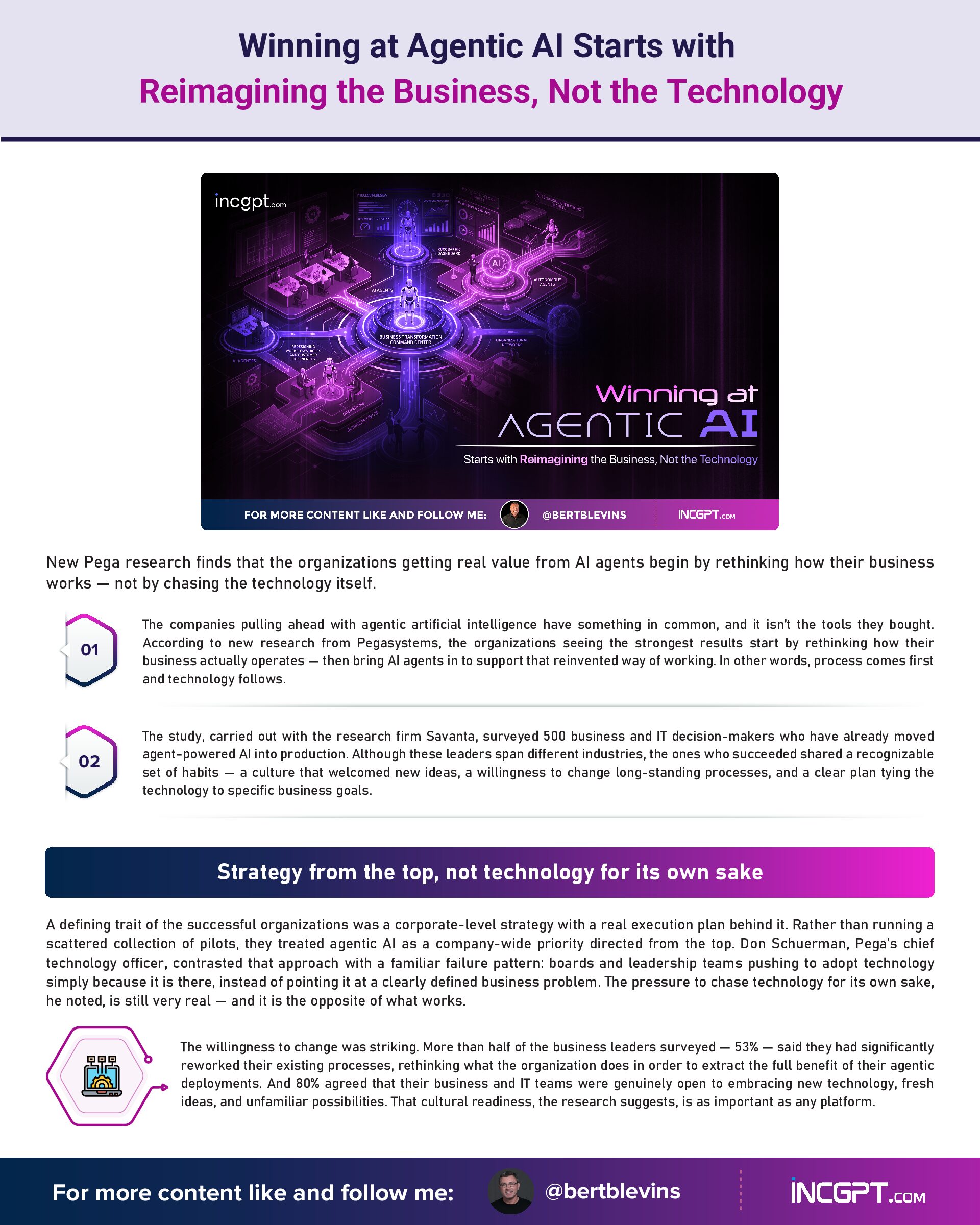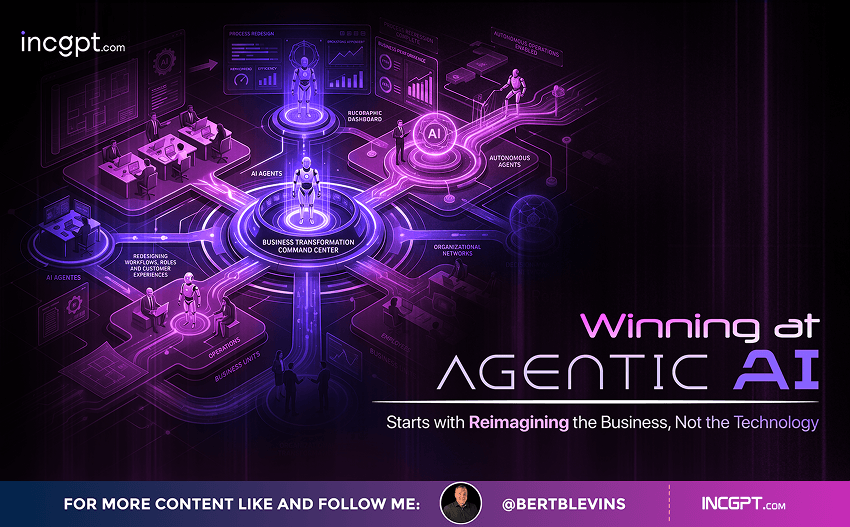
Winning at Agentic AI Starts with Reimagining the Business, Not the Technology
New Pega research finds that the organizations getting real value from AI agents begin by rethinking how their business works — not by chasing the technology itself.
The companies pulling ahead with agentic artificial intelligence have something in common, and it isn’t the tools they bought. According to new research from Pegasystems, the organizations seeing the strongest results start by rethinking how their business actually operates — then bring AI agents in to support that reinvented way of working. In other words, process comes first and technology follows.
The study, carried out with the research firm Savanta, surveyed 500 business and IT decision-makers who have already moved agent-powered AI into production. Although these leaders span different industries, the ones who succeeded shared a recognizable set of habits — a culture that welcomed new ideas, a willingness to change long-standing processes, and a clear plan tying the technology to specific business goals.
Strategy from the top, not technology for its own sake
A defining trait of the successful organizations was a corporate-level strategy with a real execution plan behind it. Rather than running a scattered collection of pilots, they treated agentic AI as a company-wide priority directed from the top. Don Schuerman, Pega’s chief technology officer, contrasted that approach with a familiar failure pattern: boards and leadership teams pushing to adopt technology simply because it is there, instead of pointing it at a clearly defined business problem. The pressure to chase technology for its own sake, he noted, is still very real — and it is the opposite of what works.
The willingness to change was striking. More than half of the business leaders surveyed — 53% — said they had significantly reworked their existing processes, rethinking what the organization does in order to extract the full benefit of their agentic deployments. And 80% agreed that their business and IT teams were genuinely open to embracing new technology, fresh ideas, and unfamiliar possibilities. That cultural readiness, the research suggests, is as important as any platform.
A focus on consistent, predictable outcomes
The organizations that succeeded were largely motivated by a desire for reliable, repeatable results rather than novelty. Nearly three-quarters — 71% — said that one of their top two objectives before deployment was to automate and simplify complex processes so they would run consistently and predictably across different systems and platforms. The goal was less about flashy capability and more about dependable execution.
That focus appears to be paying off. A majority — 58% — reported they had already seen more predictable outcomes, reduced complexity, and improved customer experiences as a direct result of their agentic work.
Clear metrics and a defined plan
The research drew a sharp line between the successful implementers and the rest: the winners measured what they were doing. An overwhelming 95% had a specific corporate-level strategy and an execution plan, and 65% had comprehensive success metrics agreed on in advance, tied to business outcomes and reviewed regularly to track how the rollout was progressing.
Expectations were ambitious but grounded. Some 61% began their agentic projects anticipating a significant improvement in customer experience once the technology was fully integrated, while 58% started out expecting meaningful, measurable value — a combination of higher customer satisfaction and lower costs.
The barriers that still get in the way
The study also surfaced the obstacles standing between organizations and a positive outcome. More than three-quarters — 77% — cited a lack of sufficient resources as a leading barrier. A similar share, 75%, pointed to something more fundamental: a lack of knowledge and understanding of what agentic AI can actually do for the business. In other words, the technology is often available before the organizational understanding needed to use it well.
Schuerman framed the moment as a tipping point. Adoption inside organizations is climbing quickly, he observed, but maturity has not caught up. The real value, in his view, comes from rethinking how people work and aligning company culture around what AI now makes possible — and it is precisely those changes that separate the promise of the technology from genuinely transformational results.
The winners in the agentic era, Schuerman argued, won’t be the companies that deploy agents everywhere they can. They’ll be the ones that reinvent themselves and discover new ways to give their clients and customers exactly what they want.
The takeaway from the research is consistent throughout: agentic AI rewards organizations that lead with strategy, culture, and process reinvention — and treat the agents themselves as the means to that end, not the goal.
Source: Pegasystems / Savanta study of 500 business and IT decision-makers, as reported by Computer Weekly.