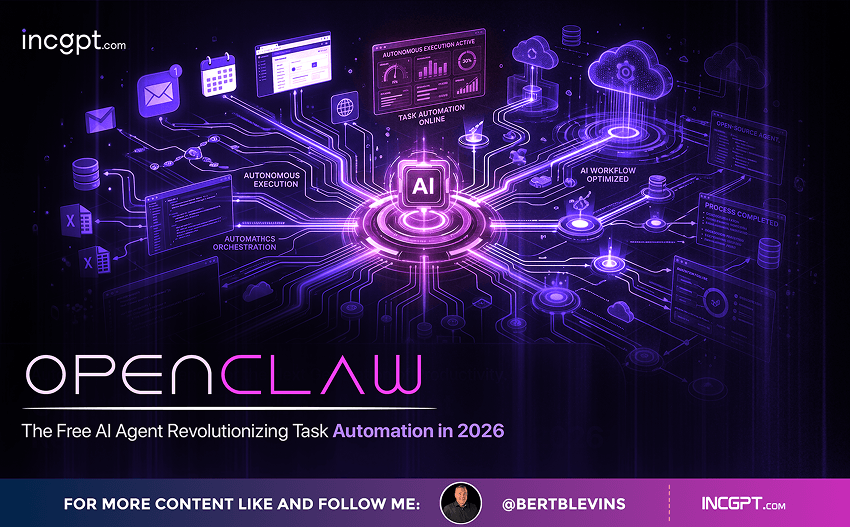
OpenClaw: The Free AI Agent Revolutionizing Task Automation in 2026
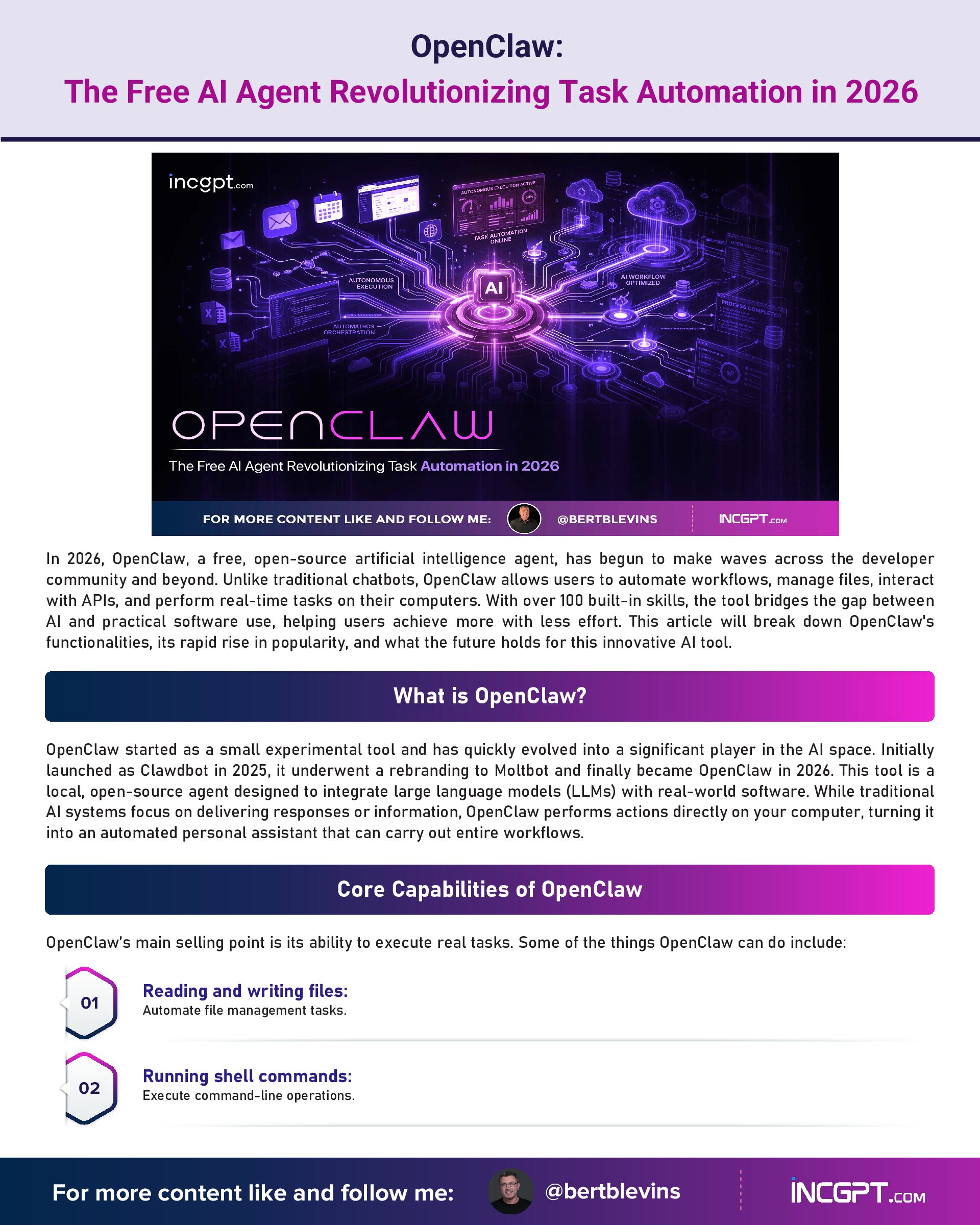
In 2026, OpenClaw, a free, open-source artificial intelligence agent, has begun to make waves across the developer community and beyond. Unlike traditional chatbots, OpenClaw allows users to automate workflows, manage files, interact with APIs, and perform real-time tasks on their computers. With over 100 built-in skills, the tool bridges the gap between AI and practical software use, helping users achieve more with less effort. This article will break down OpenClaw’s functionalities, its rapid rise in popularity, and what the future holds for this innovative AI tool.
What is OpenClaw?
OpenClaw started as a small experimental tool and has quickly evolved into a significant player in the AI space. Initially launched as Clawdbot in 2025, it underwent a rebranding to Moltbot and finally became OpenClaw in 2026. This tool is a local, open-source agent designed to integrate large language models (LLMs) with real-world software. While traditional AI systems focus on delivering responses or information, OpenClaw performs actions directly on your computer, turning it into an automated personal assistant that can carry out entire workflows.
Core Capabilities of OpenClaw
OpenClaw’s main selling point is its ability to execute real tasks. Some of the things OpenClaw can do include:
- Reading and writing files: Automate file management tasks.
- Running shell commands: Execute command-line operations.
- Browsing websites: Navigate and interact with websites.
- Sending emails: Automate communication tasks.
- Controlling APIs: Interface with various services and tools.
- Task automation across apps: Manage workflows between different software applications.
For instance, a user might ask OpenClaw to “clean my inbox, summarize important emails, and schedule meetings,” and the tool will carry out these steps autonomously. This contrasts with traditional chatbots, which would only provide instructions on how to perform these tasks.
The Evolution of OpenClaw
The journey of OpenClaw from its humble beginnings to viral sensation is nothing short of remarkable:
- 2025: The project began as Clawdbot, developed by Peter Steinberger as a proof of concept.
- Early 2026: The name was changed to Moltbot due to trademark concerns.
- January 2026: OpenClaw was officially launched as a fully functional, open-source agent.
- February 2026: OpenClaw surpassed 100,000 stars on GitHub, signifying its growing popularity within the developer community.
Following the viral success of OpenClaw, Steinberger announced that he would join OpenAI to work on next-generation AI agents, while OpenClaw would continue as an open-source project.
How OpenClaw Works
OpenClaw functions by acting as an intermediary between large language models (LLMs) and your computer’s software environment. Here’s how the process works step-by-step:
1. User input: You type a command into the OpenClaw interface.
2. Command interpretation: The LLM interprets the instruction, deciding what actions are needed.
3. Execution of tasks: OpenClaw uses its pre-built skills, such as interacting with APIs, running shell commands, or browsing the web, to complete the requested tasks.
4. Feedback: The results are sent back to you, and OpenClaw continues to work until the task is complete.
Because OpenClaw has system-level access, it can perform actions directly on your machine or interact with external services, making it a powerful tool for automation and task management.
OpenClaw vs. ChatGPT: A Comparison
While ChatGPT and other AI models have gained immense popularity for their conversational abilities, OpenClaw takes a different approach. Here are some key differences between OpenClaw and traditional chatbots like ChatGPT:
Feature
ChatGPT
OpenClaw
Executes commands
No
Yes
Access to files
No
Yes
Runs workflows
No
Yes
Multi-step reasoning
Limited
Built-in
Works across apps
Mostly no
Yes
The Power of OpenClaw’s Skills System
OpenClaw’s functionality is largely powered by its skills system, a plugin architecture that allows the agent to interact with various tools and services. Some of the core skill categories include:
- Web browsers (Chrome, Firefox, etc.)
- Messaging applications (WhatsApp, Telegram, Slack, Discord)
- File systems (Windows Explorer, macOS Finder)
- Productivity software (Microsoft Office, Google Docs)
- Automation platforms (Zapier, IFTTT)
OpenClaw comes preloaded with over 100 skills, and developers can add their own custom scripts to further expand its capabilities. This flexibility allows OpenClaw to adapt to a wide range of use cases, from personal task automation to complex workflows in a professional setting.
Real-World Usage and Applications
OpenClaw’s potential isn’t just theoretical; it’s already being used in real-world scenarios. Developers are creating multi-agent workflows, where one agent plans a task, and other agents execute specialized jobs. Some common uses include:
- Automating coding workflows: OpenClaw can manage repositories, run tests, and generate code snippets.
- Streamlining research tasks: Multiple agents collaborate to gather data, analyze it, and present results.
- Managing personal tasks: Users automate daily activities like scheduling, file management, and email processing.
Additionally, Moltbook, a platform where agents interact with each other, is gaining traction. In this platform, agents collaborate without human intervention, sharing knowledge and solving problems collectively.
Why OpenClaw Went Viral
OpenClaw’s rapid rise in popularity can be attributed to several factors:
1. Free and open-source: Anyone can download and modify the software, making it accessible to a wide audience.
2. Action-oriented AI: Unlike other models that just generate text, OpenClaw performs real tasks and workflows.
3. Integration with popular apps: OpenClaw works seamlessly with widely used applications like WhatsApp, Slack, and Discord, making it easy to incorporate into existing workflows.
4. Aligns with the agentic trend: Developers are increasingly looking for AI tools that can replace standalone applications. OpenClaw fits this demand by offering a more autonomous experience.
The Risks of OpenClaw and Autonomous Agents
While OpenClaw offers impressive capabilities, it’s not without risks:
- Security vulnerabilities: Running OpenClaw without proper safeguards could expose sensitive files and data.
- Malicious extensions: Some third-party skills could contain malware that targets sensitive data like credentials or cryptocurrency wallets.
- Unintended behavior: There have been incidents where OpenClaw agents performed unintended actions, like accidentally deleting email inboxes during automated cleanups.
These risks highlight the need for caution when deploying autonomous agents, especially in sensitive or professional environments. Proper precautions, such as running OpenClaw in a secure, sandboxed environment, can mitigate some of these dangers.
The Future of AI Agents: OpenClaw’s Role
Despite the risks, many researchers and developers believe that OpenClaw is a glimpse into the future of personal computing. In the coming years, AI agents like OpenClaw could replace the need for individual applications, offering a more streamlined, automated approach to managing digital tasks. Instead of switching between different apps, users could rely on agents to handle everything from communication to file management.
Industry experts predict that OpenClaw and similar tools could eventually redefine how we interact with our computers, moving beyond simple interfaces to fully autonomous digital assistants capable of managing complex workflows.
Conclusion: OpenClaw’s Impact and Potential
OpenClaw is more than just a chatbot. It is a programmable digital worker that brings AI into the realm of real-world action. With its impressive set of features, it’s no surprise that the tool has gone viral in 2026. While there are still risks to consider, the potential for OpenClaw and similar agents to transform how we manage tasks on our computers is enormous.
In the coming years, OpenClaw may very well become a standard tool for developers, professionals, and everyday users, making this year a milestone in the journey toward autonomous, AI-driven computing. Whether or not it becomes the ultimate personal agent remains to be seen, but one thing is clear: OpenClaw is at the forefront of a new wave of AI innovation.