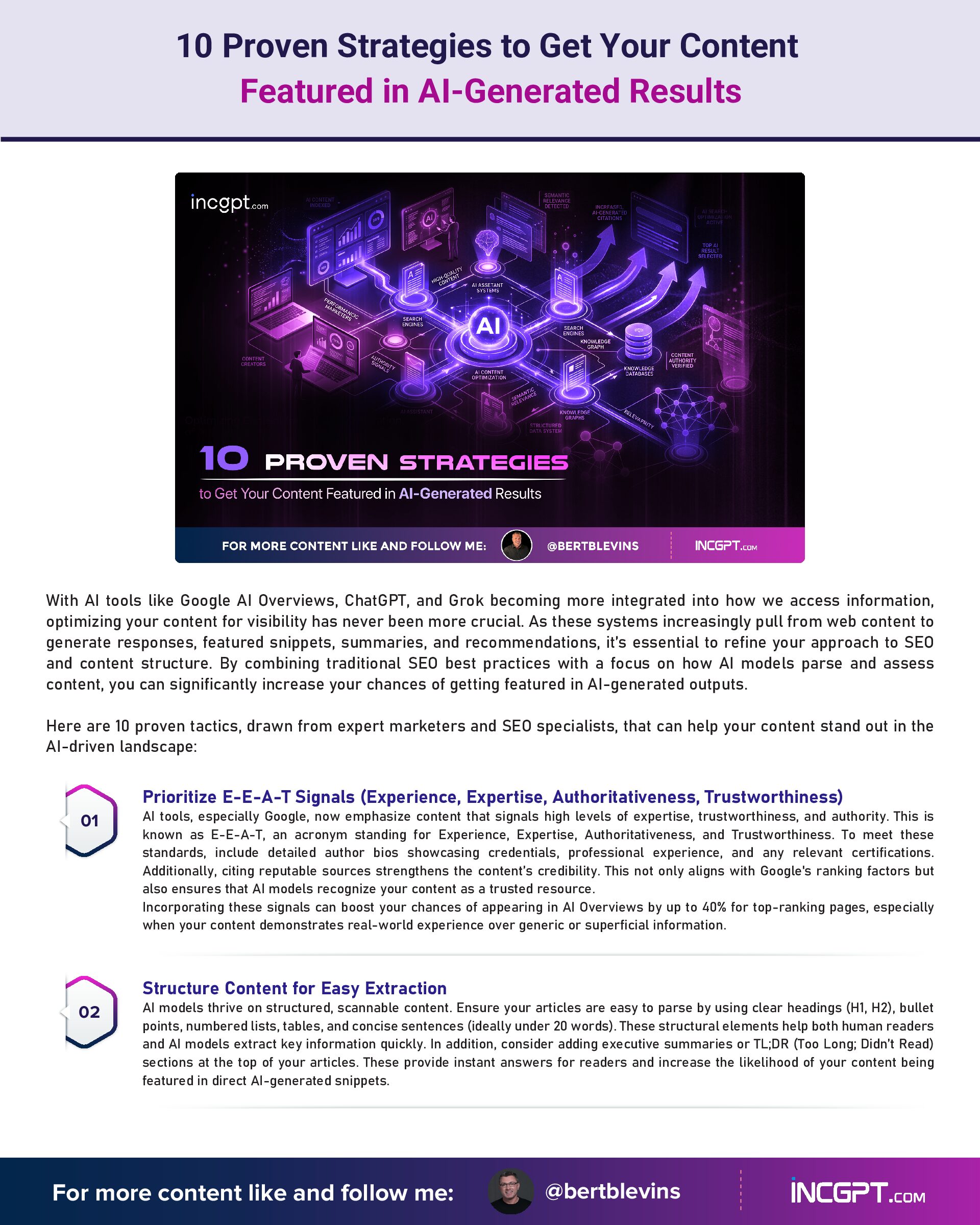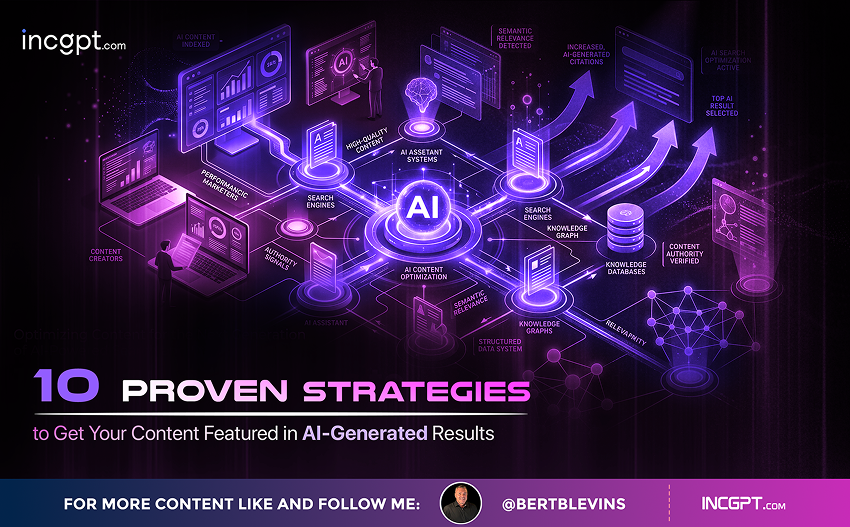
10 Proven Strategies to Get Your Content Featured in AI-Generated Results
With AI tools like Google AI Overviews, ChatGPT, and Grok becoming more integrated into how we access information, optimizing your content for visibility has never been more crucial. As these systems increasingly pull from web content to generate responses, featured snippets, summaries, and recommendations, it’s essential to refine your approach to SEO and content structure. By combining traditional SEO best practices with a focus on how AI models parse and assess content, you can significantly increase your chances of getting featured in AI-generated outputs.
Here are 10 proven tactics, drawn from expert marketers and SEO specialists, that can help your content stand out in the AI-driven landscape:
1. Prioritize E-E-A-T Signals (Experience, Expertise, Authoritativeness, Trustworthiness)
AI tools, especially Google, now emphasize content that signals high levels of expertise, trustworthiness, and authority. This is known as E-E-A-T, an acronym standing for Experience, Expertise, Authoritativeness, and Trustworthiness. To meet these standards, include detailed author bios showcasing credentials, professional experience, and any relevant certifications. Additionally, citing reputable sources strengthens the content’s credibility. This not only aligns with Google’s ranking factors but also ensures that AI models recognize your content as a trusted resource.
Incorporating these signals can boost your chances of appearing in AI Overviews by up to 40% for top-ranking pages, especially when your content demonstrates real-world experience over generic or superficial information.
2. Structure Content for Easy Extraction
AI models thrive on structured, scannable content. Ensure your articles are easy to parse by using clear headings (H1, H2), bullet points, numbered lists, tables, and concise sentences (ideally under 20 words). These structural elements help both human readers and AI models extract key information quickly. In addition, consider adding executive summaries or TL;DR (Too Long; Didn’t Read) sections at the top of your articles. These provide instant answers for readers and increase the likelihood of your content being featured in direct AI-generated snippets.
3. Implement Schema Markup and Structured Data
Schema markup and structured data help AI understand the context and relationships within your content. Adding schema elements like FAQ, HowTo, or Article tags to your HTML allows search engines and AI systems to recognize the topic, structure, and relevance of your content more easily. This can make your pages eligible for rich results such as featured snippets, knowledge panels, and other enhanced search features.
For example, if your article answers specific questions or offers a step-by-step guide, including HowTo schema will signal to AI that your content is particularly valuable for those seeking clear, actionable instructions.
4. Target Conversational, Long-Tail Queries
AI models often pull from content that directly answers conversational, long-tail queries (e.g., “How to optimize content for AI search in 2025?”). These queries tend to be more specific and naturally aligned with how people interact with AI-powered search tools. To optimize for these types of queries, place direct answers near the top of your page in a conversational tone. Structuring your content around these kinds of questions ensures your content is more likely to be included in zero-click summaries, which directly appear in AI-driven search results.
5. Create Unique, In-Depth, Non-Commodity Content
To stand out in AI outputs, your content must offer unique insights and depth. Go beyond surface-level content by incorporating original data, case studies, benchmarks, and visual elements like charts or infographics. AI tends to prioritize content that is “helpful and satisfying” – content that answers specific user questions in a comprehensive, engaging way.
Avoid publishing generic or commodity material that doesn’t provide new value. Fresh insights or real-world examples are more likely to be picked up by AI models, ensuring your content is not only seen but cited in valuable ways.
6. Build Backlinks and Brand Mentions from Authoritative Sources
Earning backlinks from high-authority websites and getting featured in reputable roundups, news outlets, or online discussions (e.g., Reddit, podcasts) helps build your content’s credibility. These actions signal to AI that your content is relevant and trusted within your field. Even without direct links, consistent brand mentions across authoritative sources help train AI models to recognize your brand as an expert.
Additionally, appearing in discussions and debates on external platforms signals authority, which enhances your content’s chances of being featured in AI-powered summaries and responses.
7. Incorporate Data, Statistics, and Visuals
AI systems prefer content that incorporates solid data, statistics, and visual aids. This could include citing industry-standard statistics, using research-backed claims, or integrating relevant infographics, charts, and videos. Using the DRIVE framework—Data, Review, Insights, Visuals, Energy—can make your content more engaging and credible.
Including data-driven insights and well-designed visuals improves your chances of having AI quote your content accurately and prominently in their outputs. Always ensure the data is sourced and up-to-date to enhance the authority of your content.
8. Keep Content Fresh and Updated Regularly
AI tools favor fresh, timely content, especially on fast-evolving topics. To maintain visibility, regularly update your articles with the latest data, case studies, and trends. Refreshing older posts by adding new timestamps, conducting audits, or adding fresh insights signals to AI that your content is relevant and up-to-date.
Consistent publishing also helps build topical authority over time. Aim to publish or update your top-performing pages regularly (e.g., weekly or monthly) to keep AI models recognizing your site as a reliable, current resource.
9. Repurpose Content Across Platforms for Broader Reach
Expanding your content reach across multiple platforms can amplify its signals to AI crawlers. Repurpose your pillar content (e.g., in-depth blog posts) into shorter formats like videos, carousels, and threads for platforms like YouTube, TikTok, and LinkedIn. Cross-link all content pieces to create an interconnected ecosystem that boosts your content’s visibility across AI systems.
By making your content accessible on various platforms, you not only increase its reach but also create a broader web of signals that AI uses to assess your content’s authority and relevance.
10. Monitor and Iterate with AI Visibility Tools
Lastly, track your content’s performance in AI Overviews using tools like Google Search Console or third-party platforms like Ahrefs. Monitor which of your pages are featured in AI-generated responses, snippets, or overviews. Then, iterate on your strategy by testing different formats and refining content based on engagement metrics.
Analyze competitors’ content to see what is getting cited in AI outputs and adjust your strategy accordingly. This iterative process allows you to refine your content over time and steadily climb rankings.
Conclusion
The future of content marketing is deeply intertwined with AI, and optimizing your content for AI visibility requires a strategic, multifaceted approach. By implementing these 10 tactics, you not only improve your chances of being featured in AI outputs but also build lasting authority and credibility in your field. Start by integrating 2-3 of these strategies on your top-performing pages for quick wins, and refine your efforts based on measurable performance metrics.
In this rapidly evolving landscape, the key to success lies in blending high-quality content creation with AI-savvy optimization techniques. Stay ahead of the curve, and watch your content rise to the top of AI-driven search results.