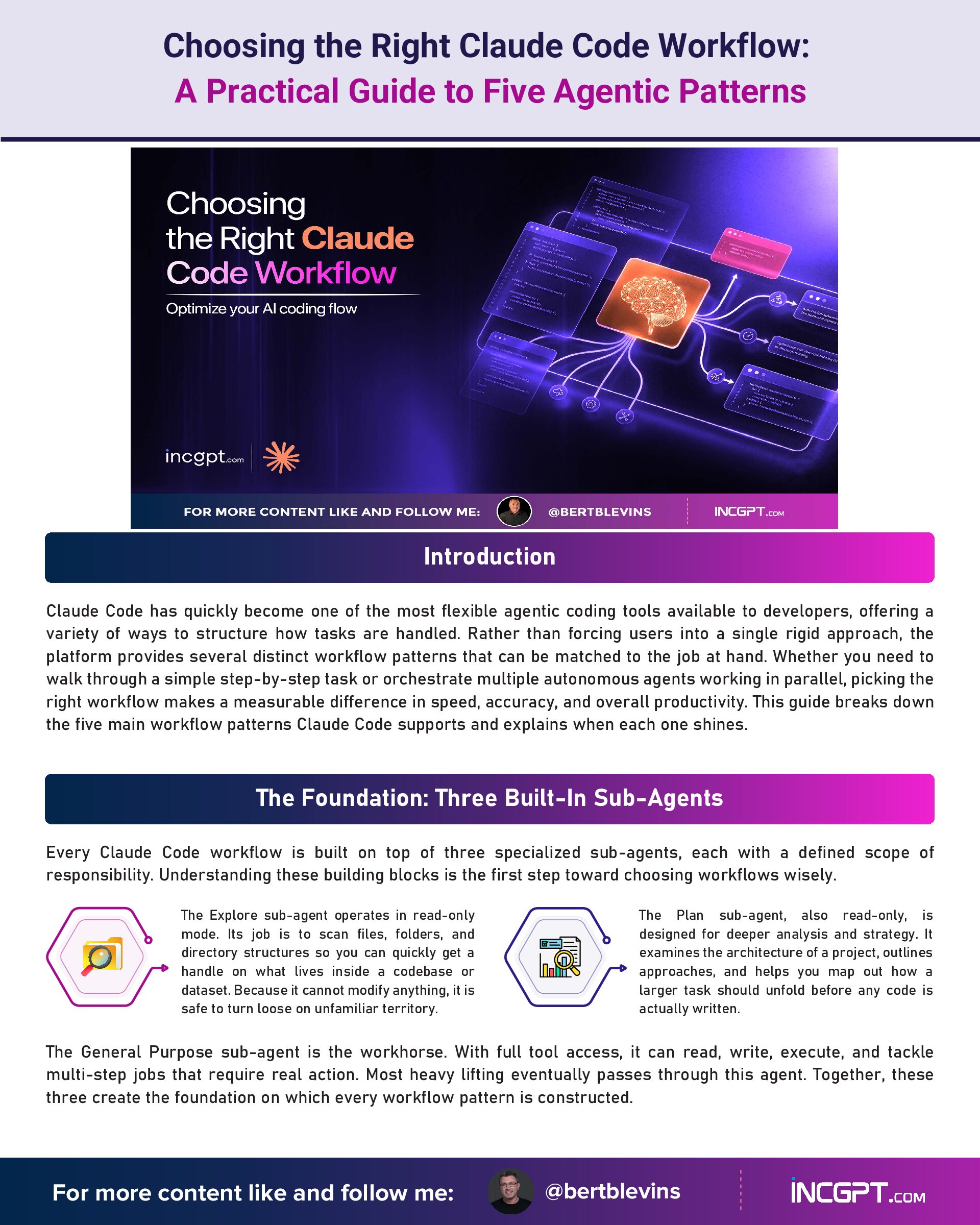
Choosing the Right Claude Code Workflow: A Practical Guide to Five Agentic Patterns
Introduction
Claude Code has quickly become one of the most flexible agentic coding tools available to developers, offering a variety of ways to structure how tasks are handled. Rather than forcing users into a single rigid approach, the platform provides several distinct workflow patterns that can be matched to the job at hand. Whether you need to walk through a simple step-by-step task or orchestrate multiple autonomous agents working in parallel, picking the right workflow makes a measurable difference in speed, accuracy, and overall productivity. This guide breaks down the five main workflow patterns Claude Code supports and explains when each one shines.
The Foundation: Three Built-In Sub-Agents
Every Claude Code workflow is built on top of three specialized sub-agents, each with a defined scope of responsibility. Understanding these building blocks is the first step toward choosing workflows wisely.
The Explore sub-agent operates in read-only mode. Its job is to scan files, folders, and directory structures so you can quickly get a handle on what lives inside a codebase or dataset. Because it cannot modify anything, it is safe to turn loose on unfamiliar territory.
The Plan sub-agent, also read-only, is designed for deeper analysis and strategy. It examines the architecture of a project, outlines approaches, and helps you map out how a larger task should unfold before any code is actually written.
The General Purpose sub-agent is the workhorse. With full tool access, it can read, write, execute, and tackle multi-step jobs that require real action. Most heavy lifting eventually passes through this agent. Together, these three create the foundation on which every workflow pattern is constructed.
The Five Core Workflow Patterns
1. Sequential Flow
Sequential Flow is the simplest pattern. Tasks move through a single session one step at a time, preserving a shared context from start to finish. This is ideal when each step genuinely depends on what came before. The main limitation is the size of the context window: as conversations grow long, earlier details risk being pushed out, a problem often called context rot. Commands like /clear and /compact help by resetting or summarizing the context when it starts to overflow. Use this pattern for straightforward, linear jobs where continuity matters more than scale.
2. Operator Pattern
The Operator Pattern takes the opposite approach. Instead of stacking everything into one session, you run several Claude sessions side by side, each in its own terminal window. Because the sessions are fully isolated, there is no risk of one project’s details leaking into another. This is the go-to choice when you have multiple unrelated jobs running at the same time, such as maintaining several repositories or juggling independent features. Each session keeps a clean slate and its own context window.
3. Split and Merge
Split and Merge sits between the first two patterns. Within a single session, a large task is broken into smaller components and handed out to sub-agents, which work on them in parallel. Once each piece is finished, the results flow back to the main session and are combined into a final product. This pattern excels when a problem has clearly separable parts, but it does require up-front planning. Sub-agents cannot talk to one another directly, so the initial split has to be clean enough that the pieces do not step on each other.
4. Agent Teams
Agent Teams push collaboration further. Multiple agents work from a shared task list and can exchange findings as they go, adjusting their approach based on what their peers discover. This makes the pattern well suited to interdependent problems where flexibility matters. The trade-offs are real, though: Agent Teams is still an experimental feature that must be enabled manually, and it burns through tokens quickly. If you are working within a tight token budget, save this pattern for problems that truly need its coordination power.
5. Headless Mode
Headless Mode removes the user from the loop entirely. Tasks run autonomously and deliver their results when finished, with no prompts or check-ins along the way. This is ideal for batch jobs, scheduled operations, report generation, or any repetitive work with clearly defined success criteria. The catch is trust: you have to be confident the task is well-scoped and verifiable after the fact, because you will not be watching it unfold.
Advanced Features That Extend Every Workflow
Beyond the core patterns, Claude Code ships with several features that sharpen execution and reduce manual oversight.
Custom Sub-Agents let you design specialized helpers tuned to recurring tasks in your domain. Rather than relying solely on the three built-in roles, you can package your own logic and prompts into reusable agents.
Builder-Validator Chains pair every piece of work with a dedicated review step. One agent produces output, a second agent checks it, and only verified results pass through. This pattern catches errors early and is especially valuable in high-stakes coding environments.
Scheduling Tools Integration connects Claude Code to external schedulers so that workflows can fire on a timer, without manual kickoff. Combined with Headless Mode, this enables true set-and-forget automation.
Limitations to Keep in Mind
No workflow is perfect, and each pattern carries trade-offs worth considering before you commit. Sequential Flow is bounded by the context window, which constrains how much you can pack into one session before quality degrades. Agent Teams, while powerful, are expensive in terms of token consumption and may not fit every budget. Headless Mode demands a level of trust in the model’s autonomy that not every task warrants, and it often requires verification steps downstream to confirm the work is correct. Recognizing these limits early helps you avoid choosing a pattern that cannot deliver in your situation.
Making the Most of Claude Code
Claude Code’s workflow system is less about finding a single best approach and more about matching the pattern to the problem. Simple tasks belong in Sequential Flow. Independent parallel work is a natural fit for the Operator Pattern. Divisible problems slot into Split and Merge, collaborative ones benefit from Agent Teams, and fully automated jobs are the domain of Headless Mode. Layer in custom agents, validator chains, and scheduling, and you have a toolkit that scales from quick one-off scripts to full automation pipelines. The secret is simply picking the right tool for the job.