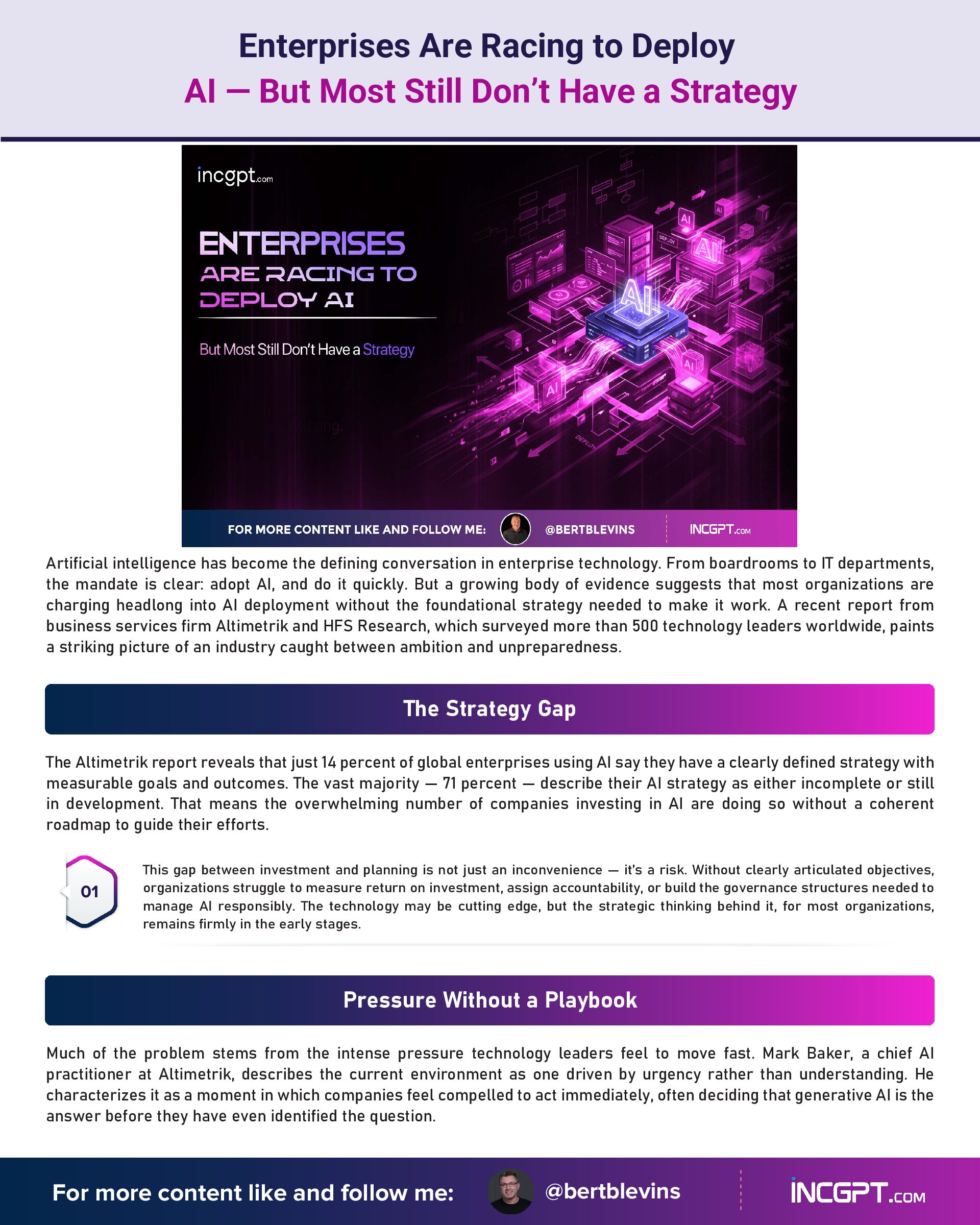
Enterprises Are Racing to Deploy AI — But Most Still Don’t Have a Strategy
Artificial intelligence has become the defining conversation in enterprise technology. From boardrooms to IT departments, the mandate is clear: adopt AI, and do it quickly. But a growing body of evidence suggests that most organizations are charging headlong into AI deployment without the foundational strategy needed to make it work. A recent report from business services firm Altimetrik and HFS Research, which surveyed more than 500 technology leaders worldwide, paints a striking picture of an industry caught between ambition and unpreparedness.
The Strategy Gap
The Altimetrik report reveals that just 14 percent of global enterprises using AI say they have a clearly defined strategy with measurable goals and outcomes. The vast majority — 71 percent — describe their AI strategy as either incomplete or still in development. That means the overwhelming number of companies investing in AI are doing so without a coherent roadmap to guide their efforts.
This gap between investment and planning is not just an inconvenience — it’s a risk. Without clearly articulated objectives, organizations struggle to measure return on investment, assign accountability, or build the governance structures needed to manage AI responsibly. The technology may be cutting edge, but the strategic thinking behind it, for most organizations, remains firmly in the early stages.
Pressure Without a Playbook
Much of the problem stems from the intense pressure technology leaders feel to move fast. Mark Baker, a chief AI practitioner at Altimetrik, describes the current environment as one driven by urgency rather than understanding. He characterizes it as a moment in which companies feel compelled to act immediately, often deciding that generative AI is the answer before they have even identified the question.
That pressure falls disproportionately on CIOs, CTOs, and other senior technology leaders, who the report identifies as bearing primary accountability for AI within their organizations. Many of these leaders are deploying AI tools before they have established governance frameworks, trained their employees, or determined who will be held responsible when something goes wrong. The result, according to Baker, is a climate of anxiety — a sense of panic driven by the speed at which AI is evolving and the fear of falling behind competitors.
Cost Cutting Is Not a Strategy
When asked about their primary motivation for adopting AI, most technology leaders cited reducing operating costs. But Baker argues that this framing is fundamentally flawed. He emphasizes that cost reduction is an outcome, not a strategy. The real work of generating return on investment, he says, follows the same logic it always has: identifying a specific problem, developing a targeted solution, and then measuring the savings that result.
Companies that skip this foundational step and jump straight to deploying AI in search of savings risk wasting resources on pilots that lack direction. The technology itself is not a shortcut to efficiency — it requires the same careful problem definition and planning that any successful enterprise initiative demands.
The Deterministic-to-Probabilistic Shift
Part of the challenge lies in the nature of the technology itself. For decades, enterprise systems were built on deterministic foundations — software that followed predefined rules and operated within tightly controlled boundaries. Organizations developed clear lines of accountability for when these systems failed, because the systems themselves were predictable.
Generative AI operates differently. These models are probabilistic, meaning their outputs can vary and are not always predictable. Adapting governance and accountability frameworks designed for rule-based systems to this new paradigm is a significant undertaking, and it requires deeper involvement from technology leaders in the planning, building, and testing of AI tools before they are deployed. Baker argues that when the people involved in conceiving an AI project truly understand what the technology is being asked to do, accountability and ownership emerge naturally and become part of standard operating procedures.
A Training Deficit
Another critical gap highlighted by the report is the lack of employee education around AI. Nearly 80 percent of respondents said their employees receive fewer than 10 hours of AI training per year. That minimal investment in upskilling is contributing to a widespread lack of confidence: 43 percent of those surveyed admitted to experiencing self-doubt or feeling behind when asked to use AI in their work.
Education is not a peripheral concern — it is central to successful AI adoption. Organizations that invest in helping their people understand the technology, its capabilities, and its limitations are far better positioned to experiment productively. Separate research from KPMG supports this view, finding that companies with mature AI deployments — those that have invested in people, behaviors, and trust — are seeing significantly higher returns from their AI initiatives.
Workforce Implications
The survey also sheds light on how organizations expect AI to reshape their workforces. Just over half of respondents said they anticipate that roles within their companies will shift or be reduced as a result of AI in the coming years. However, most of those leaders expect the transition to happen through natural attrition rather than through a deliberate, proactive workforce strategy. This passive approach may leave organizations unprepared for the magnitude of change AI is likely to bring, and it underscores the broader pattern of reacting to AI’s impact rather than planning for it.
A Path Forward
Despite the challenges, the path forward is not mysterious. Baker encourages CIOs and technology leaders to slow down, take ownership of their AI strategies, and focus on understanding the specific problems they aim to solve before launching into pilots. The fundamentals of good technology governance have not changed: ask the right questions, test against your goals, and build in accountability from the start.
The current moment, for all its urgency, is not one that rewards haste. Organizations that pause to build a genuine strategy — one grounded in clear objectives, employee readiness, and robust governance — will be far better positioned to realize the transformative potential of AI. Those that continue to deploy first and plan later risk compounding their challenges and falling further behind the organizations that took the time to get it right.
Baker’s advice is straightforward: take a breath, do the foundational work of understanding the moment, and answer the hard questions before the technology answers them for you.