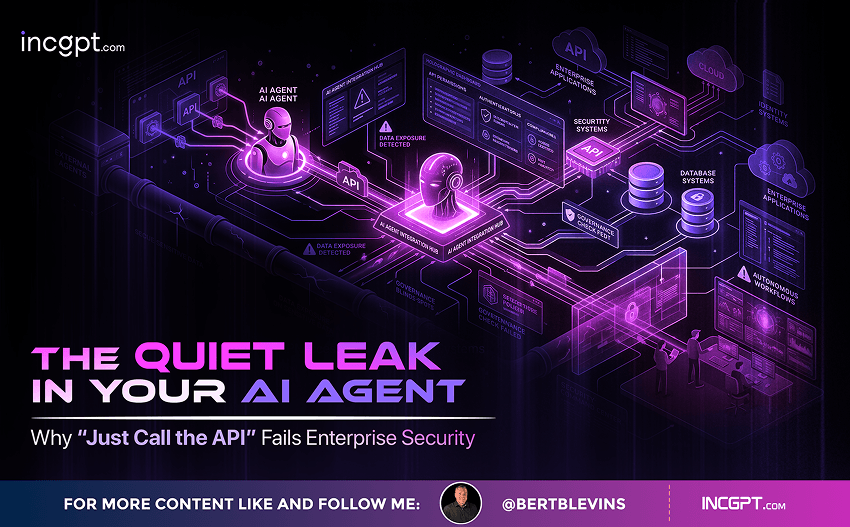
The Quiet Leak in Your AI Agent: Why “Just Call the API” Fails Enterprise Security
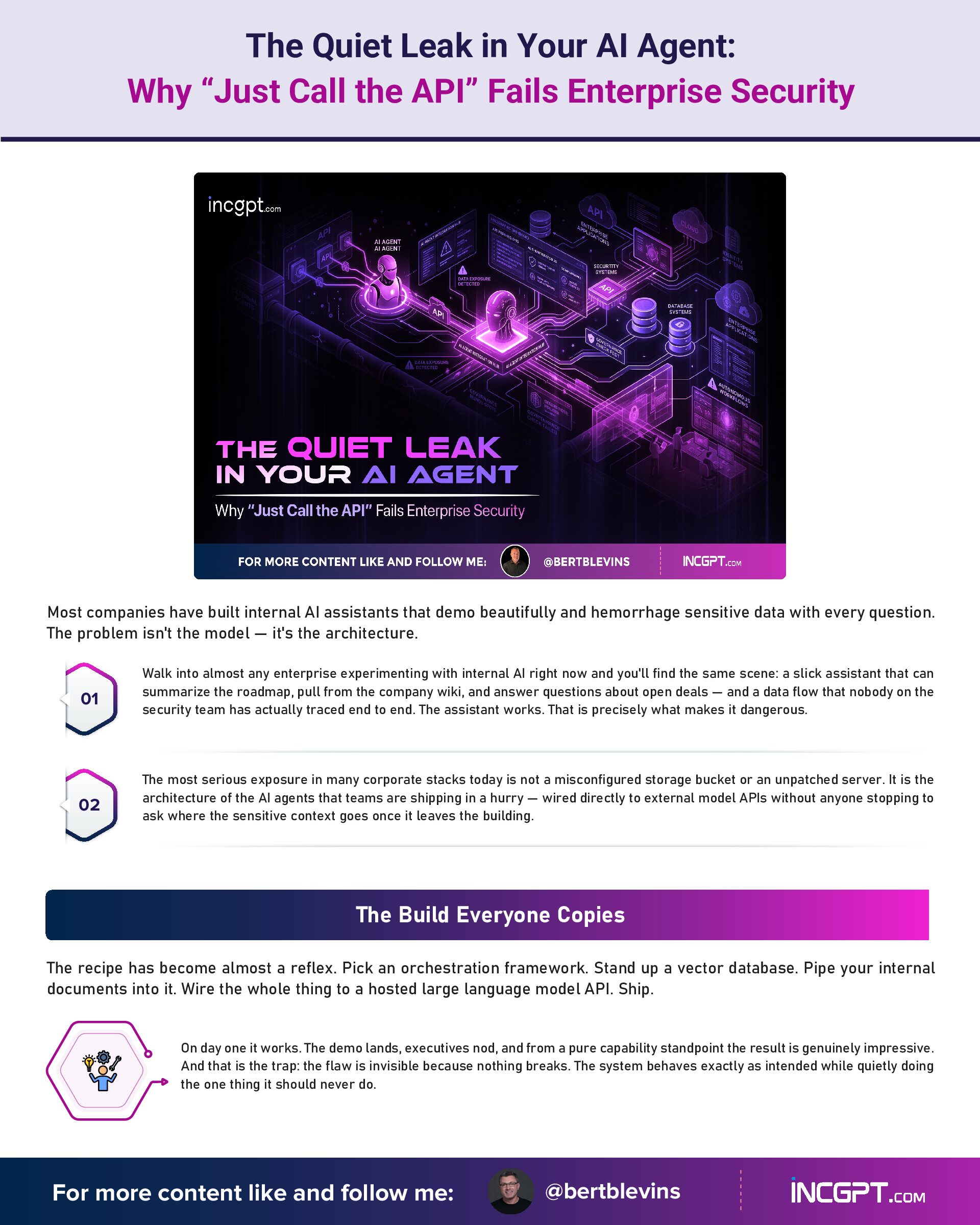
Most companies have built internal AI assistants that demo beautifully and hemorrhage sensitive data with every question. The problem isn’t the model — it’s the architecture.
Walk into almost any enterprise experimenting with internal AI right now and you’ll find the same scene: a slick assistant that can summarize the roadmap, pull from the company wiki, and answer questions about open deals — and a data flow that nobody on the security team has actually traced end to end. The assistant works. That is precisely what makes it dangerous.
The most serious exposure in many corporate stacks today is not a misconfigured storage bucket or an unpatched server. It is the architecture of the AI agents that teams are shipping in a hurry — wired directly to external model APIs without anyone stopping to ask where the sensitive context goes once it leaves the building.
The Build Everyone Copies
The recipe has become almost a reflex. Pick an orchestration framework. Stand up a vector database. Pipe your internal documents into it. Wire the whole thing to a hosted large language model API. Ship.
On day one it works. The demo lands, executives nod, and from a pure capability standpoint the result is genuinely impressive. And that is the trap: the flaw is invisible because nothing breaks. The system behaves exactly as intended while quietly doing the one thing it should never do.
Follow the Data, Not the Demo
To see the problem, trace a single question through a retrieval-augmented generation (RAG) pipeline instead of watching the chat window. An employee asks something proprietary — say, how the company is positioning against a competitor this quarter. Here is what actually happens next:
- A semantic search runs against your vector store and retrieves the most relevant chunks from your internal documents — strategy decks, pricing models, deal notes.
- The orchestration layer stitches the original question together with that proprietary context into a single compiled prompt.
- That combined payload — the question plus slices of your most sensitive internal material — is sent over the network to a third-party inference endpoint.
Sit with that last step. Your retrieval layer has just hand-assembled a tidy, structured package of your crown-jewel data and mailed it outside your security perimeter. The better your RAG works, the more sensitive the context it bundles up and ships out. The quality of the system is directly proportional to the value of what’s leaking.
“But We Signed an Enterprise Agreement”
This is the reflexive defense, and it confuses a contract with an architecture. A vendor agreement is a promise about behavior; it does nothing to change where your data physically travels. Five realities the paperwork doesn’t touch:
- A no-training clause is a policy, not a boundary. It governs what the provider does with your data, not whether your data leaves your control. It still crosses networks and infrastructure you don't operate.
- Encryption in transit is the floor. TLS is a baseline expectation, not a security design. Protecting the pipe says nothing about what happens at the other end of it.
- You're trusting a black box at inference time. Logging, caching, load balancing, incident response — the entire internal handling of your payload is invisible to you.
- Compliance frameworks don't honor vendor paperwork. SOC 2, ISO 27001, HIPAA, and GDPR have no carve-out for “but we have an agreement.” Data leaving the perimeter is an event you must account for, especially in healthcare, finance, and legal.
- Leaked IP cannot be recalled. Trade secrets, unreleased roadmaps, and deal materials that escape are gone. No service-level credit puts them back in the box.
The Threat Surface No One Is Modeling
Most teams have diligently threat-modeled the classics — injection, broken authentication, leaked secrets — and never once modeled the AI pipeline itself. The overlooked surfaces are exactly where the next wave of incidents will come from:
- Poisoned retrieval. If an attacker can plant content in any document that lands in your vector store — a tampered wiki page, a manipulated support ticket — they can hijack the agent's behavior through the context it retrieves. This is prompt injection delivered through your own data.
- The orchestration server as a jackpot. Compromise that one server and every compiled prompt becomes a pre-packaged bundle of your most relevant internal data, neatly assembled by your own pipeline and ready to walk out the door.
- Their incidents become your incidents. Providers have bugs and breaches like everyone else. When your proprietary data lives inside their inference pipeline, their worst day automatically becomes yours.
- Timing as a side channel. Variable round-trip latency to an external endpoint can leak patterns of system activity — a subtle but real concern in high-security environments.
The Fix Is a principle, not a Product
There is one rule that resolves all of this: the agent and the data it operates on must live inside the same isolated perimeter. Rather than stretching your security boundary across the public internet on every query, you collapse it inward.
In practice, that means a self-hosted flow where orchestration, the vector store, and model inference all run on infrastructure you own and control, with zero external calls for sensitive operations. The employee’s question goes in, retrieval and inference happen entirely within your network, and the answer comes back — without a single byte of proprietary context ever crossing a boundary you don’t govern. The threat model shrinks dramatically because the data simply never leaves.
Two Honest Roads to Get There
Self-hosting is the destination; there are two realistic ways to reach it, and the right one depends on your engineering bandwidth.
- The bespoke build. An open-weight model running on your own GPU infrastructure, a self-managed vector database, your own orchestration and authentication. This is the gold standard of control. It also costs real senior-engineering time and ongoing MLOps maintenance. Modern self-hosted models can deliver sub-second inference with full query-level audit logging and zero external egress — if you have the team and the runway to operate them.
- The unified self-hosted platform. A single deployable unit that bundles orchestration, retrieval, and inference and runs on your own infrastructure. You trade some customization granularity for a far shorter path to a compliant, isolated stack. For mid-market organizations or teams without a dedicated MLOps function, that trade is often the correct one.
Whichever road you take, hold any platform to the same vendor-neutral test: Does inference stay internal? Does the vector store egress nothing externally? Is there a complete, query able audit log? Does the deployment model fit your environment? The first three are non-negotiable for sensitive data.
The Audit to Run This Week
Before your next architecture review, map your AI data flows against this short checklist:
1. Trace every external inference call and document the full payload — not just the query, but the entire assembled prompt, including retrieved context.
2. Classify what you are indexing. Vectorizing public documentation and vectorizing internal strategy are different risk profiles by orders of magnitude.
3. Read the whole data-handling section of your vendor contract, not just the no-training headline. Understand inference, logging, and incident response.
4. Bring compliance into the conversation before the architecture review, not after the system is live.
5. Add the orchestration layer, vector store, and inference path to your threat model. Most security teams have not done this yet.
The Bottom Line
Two things are true at the same time. External model APIs are genuinely powerful, and the standard way of wiring them into enterprise data is genuinely unsafe for anything sensitive. Holding both ideas at once is the whole point.
The enterprises that move through the next few years without an AI-driven data incident will be the ones that gave their AI data flows the same rigor they apply to every other system that touches their secrets. The capability is here. The default architecture is not enough. Build accordingly.