Human Imagination Remains Unique
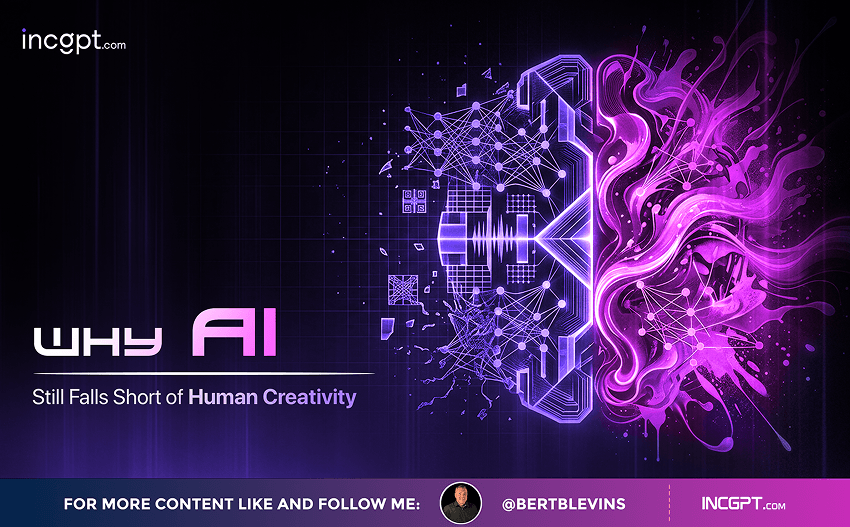
A new study suggests that artificial intelligence may be powerful at generating images, but it still struggles to match the originality of human creativity. While AI can produce impressive visuals, its creative ability appears to depend heavily on human guidance rather than independent imagination.
Researchers from the University of Barcelona explored this question by examining whether AI could create truly original visual ideas on its own. Their findings showed that, despite recent advances in generative technology, AI is still far from reproducing the natural creative processes of the human mind.
How the Researchers Tested Creativity
How the Researchers Tested Creativity
To measure creativity, the researchers used a method called the Test of Creative Imagery Abilities. This test presents abstract shapes and asks participants to imagine something from them, describe their idea, and then draw it. The purpose is not simply to judge the final product, but to understand how imagination works from the moment an idea begins.
The study involved two groups of people: visual artists and non-artists. At the same time, a Stable Diffusion image-generation model was asked to complete the same task under two different conditions. In the first condition, the AI was given a human-generated idea as part of its prompt. In the second, it received only a very basic instruction, with no creative input from a person.
Artists Led, AI Trailed Behind
The results revealed a clear pattern. Visual artists performed best across all measures of creativity. Non-artists followed behind them, while the AI guided by human ideas performed at about the same level as ordinary people without artistic training. The self-guided AI, however, ranked last and showed the weakest creative performance.
This outcome highlights an important point: AI improved only when a human provided the central idea. Without that support, the system struggled to generate imaginative results. In other words, the creativity did not come from the machine itself, but from the person shaping its direction.
Why Human Input Makes the Difference
The study helps explain why AI often appears more creative than it really is. In many earlier experiments, AI systems were tested using word-based tasks, where they could rely on language patterns and huge amounts of training data. In those situations, they often seemed highly inventive.
But abstract visual tasks are different. A random shape does not carry an obvious meaning. Humans can connect such shapes to memories, emotions, experiences, or unusual associations. AI, by contrast, has difficulty turning something vague into something genuinely original unless a human first gives it a concept to build on.
Can AI Judge Creativity Accurately?
The researchers also investigated whether AI could evaluate creativity in images. For this, GPT-4o was asked to score the generated images in categories such as originality, aesthetics, vividness, liking, and curiosity.
The results showed that AI was not especially reliable as a judge of creativity. Without examples of how humans rated the images, it struggled to separate human-made work from AI-made work. It tended to give similar scores across categories that human reviewers clearly distinguished. Even when reference examples were added, AI still showed less consistency than human evaluators.
This suggests that AI not only has limits in producing creativity, but also in recognizing it, especially when it comes to deeper qualities like originality and curiosity.
What This Means for Creative Work
These findings have practical importance for artists, designers, educators, and marketers who are increasingly using AI tools. The study suggests that AI should not be viewed as an independent creative partner, at least not yet. Instead, it functions more effectively as a tool that develops or executes ideas already provided by humans.
That does not make AI useless in creative industries. On the contrary, it can still be highly valuable for speeding up workflows, visualizing concepts, and expanding possibilities. However, the real spark still comes from people. Human imagination remains the foundation, while AI serves mainly as an assistant rather than a creator in its own right.
Conclusion
The study makes one thing clear: artificial intelligence can support creativity, but it cannot yet replace the human mind behind it. When left alone, AI struggles to produce original and meaningful ideas. When guided by people, it becomes much more capable. For now, true creativity remains a distinctly human strength.