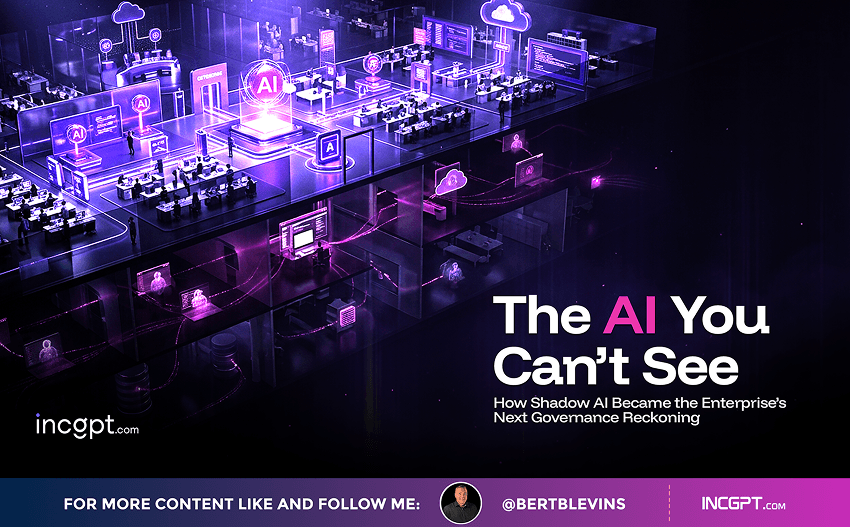
The AI You Can't See: How Shadow AI Became the Enterprise's Next Governance Reckoning
Every organization is busy talking about how to adopt artificial intelligence. Far fewer are asking a more uncomfortable question: how much AI is already running inside the business that no one in charge can actually see? That blind spot has a name now, and it is spreading fast. Shadow AI is the unsanctioned, unmonitored use of generative tools, copilots, and automation platforms by employees who simply went ahead and adopted them on their own. It is quietly becoming one of the defining risks of the AI era.
If this feels familiar, that is because it is. For the better part of two decades, IT departments wrestled with shadow IT, the steady stream of cloud services and SaaS apps that employees signed up for without bothering to wait for procurement or approval. Shadow AI is the same instinct, only faster, cheaper, and far harder to contain. Workers are reaching for whatever tool helps them move quicker, and central IT is often the last to find out.
Why AI Walks Straight Past the Gatekeepers
The reason shadow AI proliferates so easily comes down to friction, or rather the lack of it. Traditional enterprise software demanded servers, licenses, integration work, and a procurement cycle that gave IT a natural checkpoint. Modern AI tools demand almost none of that. An employee can open a browser, paste in company data, and put a generative model to work in seconds, with no infrastructure to provision and no purchase order to sign.
None of this means employees are acting in bad faith. In most cases the opposite is true. People are experimenting with AI precisely because it works, automating tedious manual tasks, freeing up time for higher-value work, and helping teams make sharper decisions. Experimentation should be encouraged. The trouble is that it is happening in the dark, well ahead of any framework designed to keep it safe.
From a Procurement Headache to a Visibility Crisis
As AI quietly threads itself into the day-to-day work of marketing, finance, operations, and every other function, the nature of the problem shifts. This is no longer just about employees buying tools without sign-off. It is about leaders losing sight of how their own organization actually runs.
Ask many companies a few basic questions and the answers run dry quickly. Which AI tools are employees relying on? What data is being fed into them? Where does that information end up once it leaves the building? When those questions cannot be answered, the business is exposed on three fronts at once: operational risk from processes no one is monitoring, compliance risk from data handled outside policy, and reputational risk when something inevitably goes wrong in public view.
The Vendor Sprawl Trap
Compounding all of this is vendor sprawl, one of the thorniest side effects of unmanaged AI. Many organizations have belatedly realized that AI is already woven through their operations, and their instinct is to respond by buying more of it. They layer fresh AI tools on top of an already fragmented technology estate, hoping to simplify, and end up doing the reverse.
Every department procures its own platform. Employees build custom automations. Existing suppliers quietly bolt AI features onto products customers already use. The result is a tangled ecosystem of overlapping tools, automated workflows, and providers, made messier still when outsourcing partners, public cloud platforms, and SaaS vendors each own a different slice of the picture and accountability is split among them all.
Who Is Responsible When the AI Gets It Wrong?
Layer AI onto that fragmented foundation and a dangerous set of blind spots appears. Picture an automated workflow that breaks, produces a flawed result, or quietly violates a compliance requirement. Now try to assign responsibility. Is it the AI model provider? The vendor whose software the model sits inside? The automation platform that strung the steps together? The employee who deployed it? The source of the data that fed it?
Without strong governance over AI activity and the way services connect to one another, those questions have no clean answers. And that points to the deeper truth underneath the whole phenomenon: AI transformation is fundamentally an operating-model challenge, not a technology one. Too many leaders are approaching it backward, fixated on deploying the technology while ignoring how it is actually used across the business. Real resilience does not come from owning the most AI tools. It comes from building governance, clear ownership, and operational durability into AI activity from the very first day.
IT's New Job: Integrator, Not Bouncer
Meeting this moment requires a genuine change of mindset, and it lands first on IT. The old posture of gatekeeper no longer holds. Teams across the business are going to use AI with or without a blessing from IT, and any attempt to simply ban it will only drive more activity further into the shadows, recreating the exact dynamic that made shadow IT so hard to manage.
Instead, IT and IT service management functions need to evolve toward service integration, governance, and operational oversight. In practice, that means taking ownership of a set of responsibilities that barely existed a few years ago:
- Creating real transparency into how AI is being used across the organization
- Setting clear, responsible AI usage guidelines that teams can actually follow
- Managing the risk introduced by the growing roster of AI suppliers
- Integrating AI cleanly into established operational workflows
- Defining accountability for decisions that AI systems make or influence
- Enabling innovation rather than smothering it, with governance as the guardrail
The goal across all of these is end-to-end visibility into AI usage spanning teams, suppliers, automation tools, and third-party services. Without that line of sight, hairline cracks will keep appearing in an organization’s operational resilience until one of them gives way.
Regulation Is Coming, and Most Companies Aren't Ready
If the operational case for getting a grip on shadow AI is not persuasive enough, the regulatory one soon will be. Lawmakers are turning their full attention to artificial intelligence. With frameworks such as the EU AI Act taking effect, alongside fresh interpretations of existing data protection law, businesses will increasingly be expected to demonstrate exactly how their AI tools are monitored, governed, and used.
The timing is awkward. Most organizations have adopted AI long before giving any serious thought to AI governance. By the time regulators are fully enforcing the rules, many companies will find themselves badly behind, scrambling to document and control systems that took root while no one was watching. The consequences of that gap are not hypothetical. Employees may unwittingly expose sensitive information through public AI services. Teams may push AI-generated content into customer-facing channels without checking it for accuracy or quality. Consequential internal decisions may be handed to automated workflows that offer no visibility and no audit trail.
Four Moves to Stay Ahead of a Shadow AI Crisis
The encouraging news is that the window has not closed. Organizations can still get in front of shadow AI, but only if they act deliberately rather than hoping the problem manages itself. Four steps form a practical starting point.
1. Map how AI is actually being used. Build a clear picture of which AI tools are in play across the organization, who is using them, and to what end, including the informal, department-led experiments happening well outside IT’s view.
2. Define what responsible use looks like. Establish straightforward guidelines covering AI use, data practices, supplier risk, and accountability. The aim is not a maze of restrictive approvals but practical guardrails that teams can realistically work within.
3. Treat AI as an operational service. As AI embeds itself into business-critical workflows, it deserves the same discipline as any other critical service: clear ownership of AI activity, structured supplier management, and enforced security and compliance.
4. Make governance a company-wide effort. AI governance cannot sit with IT alone. Procurement, security, HR, operations, legal, and executive leadership all need a seat at the table and a share of the responsibility.
The Real Lesson: Don't Fear AI, See It Clearly
None of this is an argument for fearing artificial intelligence or trying to stamp out the experimentation that makes it valuable. The point is far simpler and more urgent. Most organizations are already losing visibility and control over a technology that is quietly becoming central to how they operate, and many of them do not yet realize it. Recognizing that blind spot is where the work begins. The companies that confront shadow AI now, with transparency and governance rather than denial, will be the ones still standing on solid ground when both the failures and the regulators arrive.