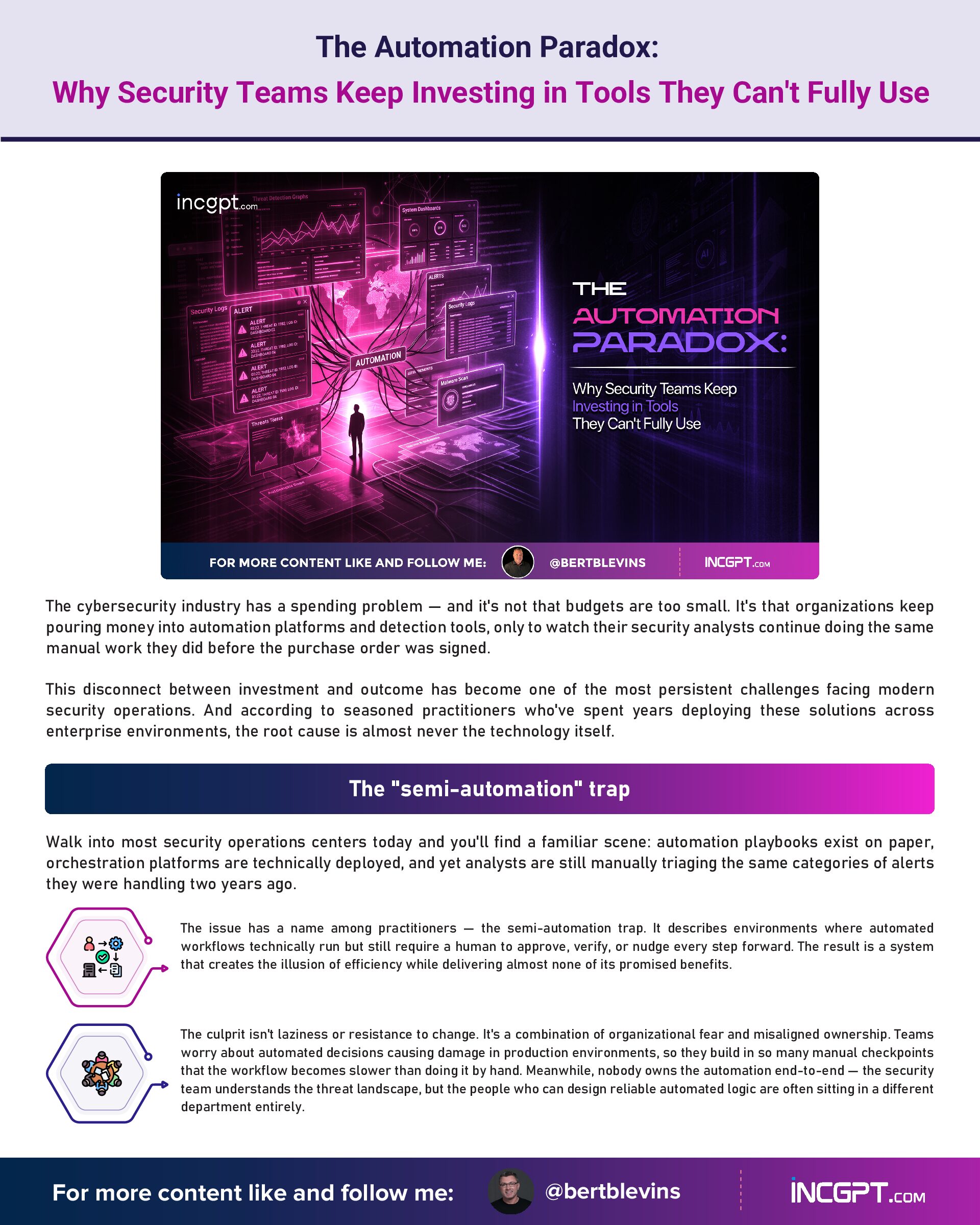
The Automation Paradox: Why Security Teams Keep Investing in Tools They Can't Fully Use
The cybersecurity industry has a spending problem — and it’s not that budgets are too small. It’s that organizations keep pouring money into automation platforms and detection tools, only to watch their security analysts continue doing the same manual work they did before the purchase order was signed.
This disconnect between investment and outcome has become one of the most persistent challenges facing modern security operations. And according to seasoned practitioners who’ve spent years deploying these solutions across enterprise environments, the root cause is almost never the technology itself.
The "semi-automation" trap
Walk into most security operations centers today and you’ll find a familiar scene: automation playbooks exist on paper, orchestration platforms are technically deployed, and yet analysts are still manually triaging the same categories of alerts they were handling two years ago.
The issue has a name among practitioners — the semi-automation trap. It describes environments where automated workflows technically run but still require a human to approve, verify, or nudge every step forward. The result is a system that creates the illusion of efficiency while delivering almost none of its promised benefits.
The culprit isn’t laziness or resistance to change. It’s a combination of organizational fear and misaligned ownership. Teams worry about automated decisions causing damage in production environments, so they build in so many manual checkpoints that the workflow becomes slower than doing it by hand. Meanwhile, nobody owns the automation end-to-end — the security team understands the threat landscape, but the people who can design reliable automated logic are often sitting in a different department entirely.
What's actually working
Despite these challenges, organizations that get automation right are seeing tangible returns in three specific areas.
First, alert volume management. When enrichment, deduplication, and correlation are genuinely automated — not just theoretically automated — the number of alerts that require human attention drops dramatically. This isn’t about suppressing signals; it’s about ensuring that when an analyst does look at something, it’s worth their time.
Second, investigation speed. Well-constructed workflows can gather context, pull related evidence, and make preliminary assessments in minutes rather than the hours it typically takes a human to do the same work across multiple consoles and dashboards.
Third, compliance and governance. The tedious work of collecting evidence for audits, running control checks, and documenting risk decisions is a natural fit for automation — and removing it from human hands frees up skilled analysts for work that actually requires judgment.
The boardroom translation problem
Even when security teams achieve meaningful operational improvements, many struggle to communicate those wins in terms that resonate with executive leadership. The instinct is to lead with technical metrics — alerts closed, vulnerabilities patched, mean time to detect — but these numbers rarely land with a board that’s trying to evaluate risk in the context of revenue, brand reputation, and regulatory exposure.
The most effective security leaders have learned to frame every initiative around a simple narrative structure: what business function does this protect, which regulatory or financial risk does it address, and what would the consequence be if we chose to do nothing? Executives don’t need to understand the mechanics of an exploit chain. They need to understand impact, options, and confidence levels so they can make informed resource allocation decisions.
Building operations that learn from failure
Beyond automation and communication, the most resilient security programs share another trait: they treat every incident as a feedback mechanism. Post-incident reviews don’t just produce reports that sit in shared drives — they generate specific updates to playbooks, detection rules, and automated workflows.
This creates a compounding effect over time. Each incident, whether successfully contained or not, makes the operation slightly sharper. The teams that embrace this cycle — running tabletop exercises, stress-testing their runbooks, and building recovery capabilities into their workflows from day one — are the ones that consistently outperform their peers when real crises hit.
The leadership gap that still exists
While the cybersecurity workforce has grown significantly over the past decade, the composition of that workforce at senior levels still doesn’t reflect the talent pipeline. Women continue to gain ground in managerial and technical leadership positions, and visibility for women-led cybersecurity initiatives has increased meaningfully. But representation at the C-suite and board level remains disproportionately low, and retention continues to be a challenge across the industry.
For professionals navigating this landscape — particularly those from underrepresented backgrounds — career growth often depends less on technical credentials and more on intentionally building networks of mentors, sponsors, and peers who can advocate in rooms where decisions get made. The most successful leaders in the field consistently credit these relationships as the difference between career progression and career stagnation.
The bottom line
The cybersecurity industry doesn’t have a technology shortage. It has an implementation and alignment problem. The tools exist. The frameworks exist. What’s missing in most organizations is the disciplined focus required to connect automated capabilities to real operational outcomes, communicate those outcomes in business language, and build feedback loops that make the entire system smarter over time.
Until security teams solve for people and process with the same intensity they bring to evaluating vendor feature lists, the gap between cybersecurity investment and cybersecurity outcomes will continue to widen.