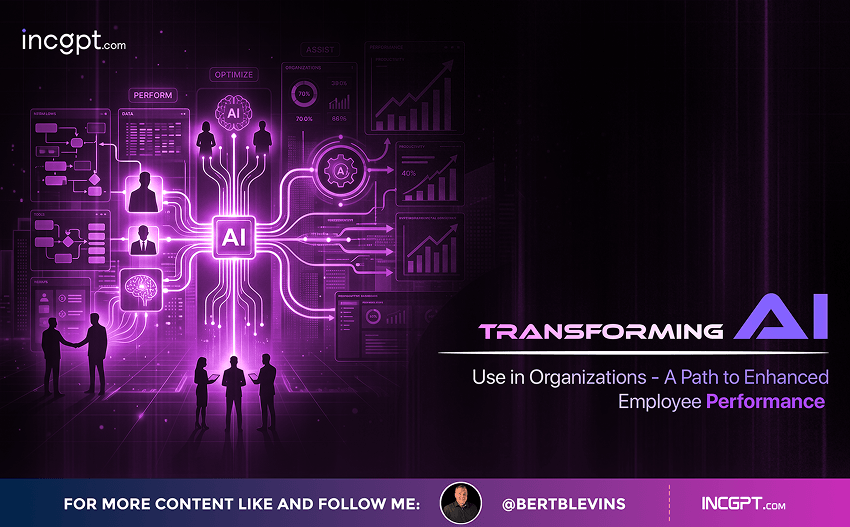
Transforming AI Use in Organizations: A Path to Enhanced Employee Performance
As Artificial Intelligence (AI) continues to infiltrate workplaces across industries, organizations are quick to adopt AI tools for their employees. However, despite the widespread usage, many organizations struggle to assess the real impact of these tools. Are employees using AI to its full potential? How can AI improve the quality, speed, and ambition of their work? These questions remain largely unanswered, and most companies fall back on tracking activity metrics such as the number of prompts or hours logged, which don’t necessarily capture the sophistication or true value of AI usage. In this article, we explore the key behaviors that separate advanced AI users from the rest and provide actionable insights on how to foster better AI usage across all employee levels.
1. The Challenge of Measuring AI Impact in the Workplace
AI adoption is spreading rapidly, with a variety of tools being implemented across industries. However, assessing the effectiveness of these tools and measuring their impact on employee performance is far from straightforward. Without clear frameworks to track qualitative outcomes, organizations often rely on quantitative measures such as tool usage frequency, number of prompts, or self-assessed skills. These metrics are insufficient as they only measure activity and not the sophistication of AI usage.
2. What Makes AI Usage Sophisticated?
In order to distinguish between basic AI use and sophisticated human-AI collaboration, KPMG partnered with researchers at the University of Texas Austin to study over 1.4 million AI interactions from 2,500 employees across an eight-month period. The goal was to define what “effective” or “sophisticated” AI use looks like and identify key indicators of success. What was found was a series of low-cost, observable behaviors that set advanced users apart from others. These behaviors were tied to how employees approached AI prompts, engaged with the AI, and applied it across their work.
3. Key Behaviors of the Most Sophisticated AI Users
From the data analysis, four common behaviors emerged among the most sophisticated AI users in the organization:
A. Ambitious Engagement with AI
Sophisticated users go beyond basic tool usage by engaging deeply with the AI. They have long, involved interactions with the AI, involving iterative back-and-forth exchanges. They make deliberate choices about the models and tools they use, depending on the task at hand. These users tend to prompt the AI with more detailed, complex requests, which reflect a higher level of engagement and sophistication.
B. Treating AI as a Reasoning Partner
Rather than passively accepting the AI’s outputs, advanced users actively engage the AI as a reasoning partner. They ask questions that guide the model’s thinking, using techniques like defining roles, giving examples of desired outputs, and refining responses. These users understand that the value of AI lies not in one-off questions but in a continuous, collaborative process where the AI assists with reasoning and exploring ideas.
C. Delegating Complex Tasks with Clear Objectives
Sophisticated users delegate complex, multi-step tasks to AI with well-defined objectives. They set clear constraints, define the structure of the responses they want, and articulate their goals. They understand that AI is best used for handling intricate tasks with specific requirements, allowing them to free up their time for more critical decision-making activities.
D. AI as a Cognitive Tool Across Multiple Use Cases
The most advanced users understand that AI is not just a tool for productivity but a general cognitive assistant. These users apply AI across a wide range of tasks, from ideation and technical guidance to knowledge work and problem-solving. They switch between models intentionally, depending on the use case, and are comfortable interacting with the AI in a conversational tone, demonstrating fluency and confidence.
4. Understanding the Role of Seniority in AI Success
A surprising finding from the study was that senior employees, rather than junior-level workers, were often the most sophisticated users of AI. This contradicts the common belief that younger employees are naturally more comfortable with technology and AI tools. The research showed that senior employees, with their experience and context-specific knowledge, were more likely to leverage AI in complex, high-level tasks such as ideation and technical analysis.
5. How AI Adoption Differs Across Employee Levels
While 90% of employees used AI regularly, only 5% exhibited advanced AI behaviors, highlighting that successful AI adoption is not an automatic process. The study revealed that employees in more senior roles, such as managers and above, were more likely to use AI across a broader set of tasks and to engage in deliberate AI strategies. In contrast, junior-level employees were more likely to use AI for simple tasks or personal purposes.
6. The Path Forward: How Leaders Can Foster AI Mastery
The findings from this study offer practical insights for leaders looking to accelerate AI adoption and sophistication within their organizations. Here are some strategies leaders can use:
A. Develop AI-First Best Practices
To drive meaningful AI outcomes, leaders must encourage specific behaviors that promote sophisticated AI use. Companies should define what “good” AI use looks like and make it a central part of the organizational culture. This can be done through the creation of playbooks, practical guides, and peer networks where employees share their strategies for advanced AI use.
B. Rethink Upskilling and Training
Leaders must rethink how they approach AI-related training and upskilling. Instead of focusing solely on tool adoption, the focus should shift toward teaching employees how to use AI effectively in their roles. Scenario-based training, hands-on workshops, and case studies should be used to help employees develop the skills necessary to engage in complex tasks with AI.
C. Set Clear Expectations for Growth
Leaders should make it clear what high-quality, AI-enabled work looks like in different departments and roles. By setting specific expectations, such as using AI for risk assessment in Audit or enhancing research capabilities in Advisory, leaders can guide employees on how to integrate AI into their core tasks. These expectations should be tailored to different functions, ensuring that AI adoption aligns with the specific goals and challenges of each department.
Conclusion
Embracing the Future of AI in the Workplace
The use of AI in the workplace is evolving quickly, and organizations that want to stay ahead must foster a culture of continuous learning and improvement. Leaders must go beyond tracking usage and focus on developing sophisticated AI behaviors that enhance employee performance and decision-making. By creating clear expectations, providing the right training, and reinforcing AI best practices, organizations can harness the full potential of AI tools to drive productivity, innovation, and success in the workplace.
As AI becomes increasingly integral to daily work, the organizations that excel will be those that not only adopt AI but also teach their employees how to use it effectively, with a focus on critical thinking, collaboration, and long-term mastery.