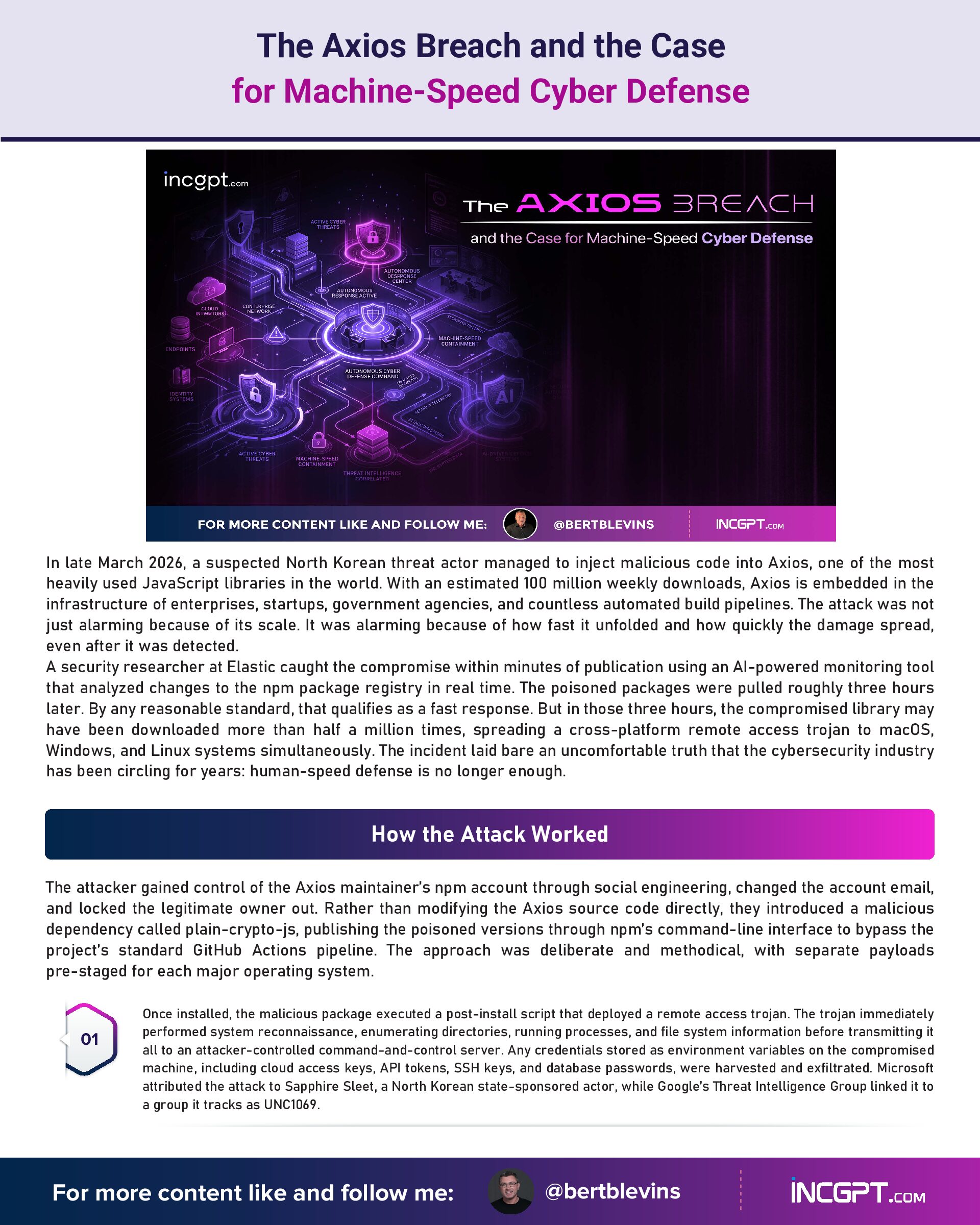
The Axios Breach and the Case for Machine-Speed Cyber Defense
In late March 2026, a suspected North Korean threat actor managed to inject malicious code into Axios, one of the most heavily used JavaScript libraries in the world. With an estimated 100 million weekly downloads, Axios is embedded in the infrastructure of enterprises, startups, government agencies, and countless automated build pipelines. The attack was not just alarming because of its scale. It was alarming because of how fast it unfolded and how quickly the damage spread, even after it was detected.
A security researcher at Elastic caught the compromise within minutes of publication using an AI-powered monitoring tool that analyzed changes to the npm package registry in real time. The poisoned packages were pulled roughly three hours later. By any reasonable standard, that qualifies as a fast response. But in those three hours, the compromised library may have been downloaded more than half a million times, spreading a cross-platform remote access trojan to macOS, Windows, and Linux systems simultaneously. The incident laid bare an uncomfortable truth that the cybersecurity industry has been circling for years: human-speed defense is no longer enough.
How the Attack Worked
The attacker gained control of the Axios maintainer’s npm account through social engineering, changed the account email, and locked the legitimate owner out. Rather than modifying the Axios source code directly, they introduced a malicious dependency called plain-crypto-js, publishing the poisoned versions through npm’s command-line interface to bypass the project’s standard GitHub Actions pipeline. The approach was deliberate and methodical, with separate payloads pre-staged for each major operating system.
Once installed, the malicious package executed a post-install script that deployed a remote access trojan. The trojan immediately performed system reconnaissance, enumerating directories, running processes, and file system information before transmitting it all to an attacker-controlled command-and-control server. Any credentials stored as environment variables on the compromised machine, including cloud access keys, API tokens, SSH keys, and database passwords, were harvested and exfiltrated. Microsoft attributed the attack to Sapphire Sleet, a North Korean state-sponsored actor, while Google’s Threat Intelligence Group linked it to a group it tracks as UNC1069.
Why Government Systems Are Especially Vulnerable
Government agencies rely on the same open-source JavaScript frameworks as the private sector. A poisoned npm package does not distinguish between a startup’s development server and a federal agency’s internal application. When a supply chain attack targets a library as widely used as Axios, it can provide adversaries with access to sensitive government systems before anyone realizes the supply chain has been compromised. The cross-platform nature of this particular attack made the threat even broader, reaching every major operating system in use across the public sector.
The implications extend beyond a single incident. AI has fundamentally lowered the barrier to executing sophisticated cyber operations. Groups that lacked nation-state-level capabilities five years ago can now deploy automated reconnaissance, craft convincing social engineering campaigns, and develop evasive malware with relative ease. The threat landscape has expanded from a handful of elite adversaries to a much larger pool of actors operating with comparable sophistication, all moving at machine speed.
The Argument for AI-Driven Defense
The Axios compromise demonstrated both the promise and the limitations of AI in cybersecurity. On the defensive side, it was an AI-powered tool that caught the attack in the first place. The researcher’s monitoring system used large language models to classify code changes at the moment of publication, comparing diffs against known patterns of malicious behavior in real time. Without that capability, the compromise might have gone undetected for significantly longer, with far greater consequences.
But the incident also revealed the uncomfortable arithmetic of modern cyber defense. Even with AI-powered detection catching the threat within minutes, the three-hour window before removal was enough for the attack to reach hundreds of thousands of systems. Adversaries are now using AI for automated reconnaissance, code obfuscation, and simultaneous deployment across multiple attack vectors. If defensive teams are not deploying AI at comparable speed and scale, they are structurally disadvantaged. This does not mean that AI is a silver bullet. The autonomous security operations center that runs itself without human oversight remains a fantasy. AI is better understood as the minimum entry fee for staying level with modern attackers. Organizations still need human judgment, business context, and mission-specific knowledge to make strategic decisions. What AI provides is the ability to handle the volume and velocity of threats that have grown far beyond what any human team can manage manually.
Rethinking the Security Operations Center
Traditional security operations centers are built on a pyramid model. A large base of analysts handles alert triage, feeding a smaller tier of senior analysts who conduct investigations, with a handful of specialists at the top making strategic decisions. This structure worked when the volume of threats was manageable and the speed of attacks allowed for human-paced response. Neither condition holds true any longer.
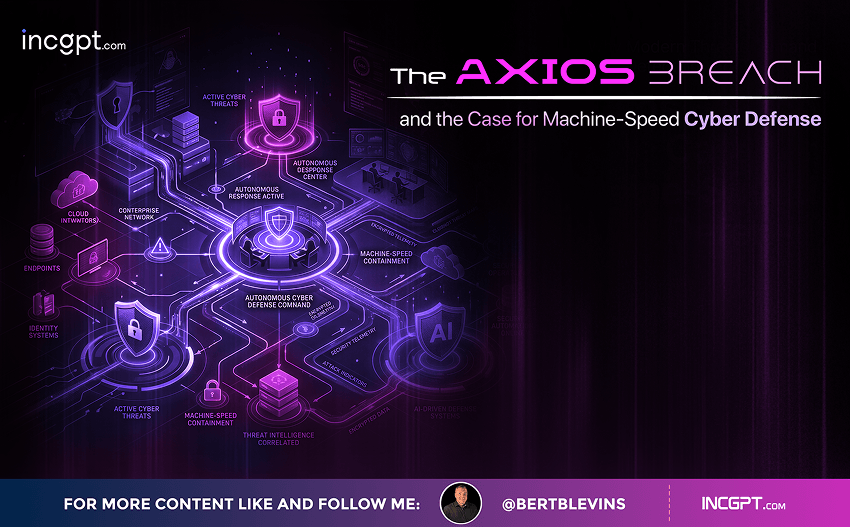
The emerging model inverts the pyramid into a diamond shape. AI agents take over the high-volume base layer, handling alert correlation, investigation enrichment, initial containment, and routine triage. Human analysts move up to become threat engineers, focusing on validating AI-generated findings, managing and improving the automated agents, and applying the strategic judgment that machines cannot replicate. The result is a security operation that can match the speed of modern threats while preserving the critical human elements that automated systems lack.
This transformation is sometimes described as the shift toward an agentic SOC, where AI-driven workflows automatically triage, investigate, and contain suspicious activity on behalf of analysts rather than simply generating alerts for humans to process. The approach does not remove humans from the equation. It elevates them, delivering pre-investigated, correlated findings instead of a flood of disconnected notifications.
Lessons from the Axios Incident
The Axios attack underscored several realities that organizations across both the public and private sectors need to internalize. First, software supply chains are critical infrastructure. Package registries like npm serve as the foundation for millions of applications, and a single compromised maintainer account can turn a trusted library into a weapon. The existing trust models governing open-source distribution are not equipped to handle threats of this magnitude and speed.
Second, detection speed matters enormously but is not sufficient on its own. Even a response measured in minutes can leave a window of exposure that attackers exploit at scale. The goal must be to compress every stage of the response cycle, from detection through containment to remediation, to the absolute minimum.
Third, the era of fighting AI-powered attacks with human-speed processes is ending. Organizations that do not integrate AI into their defensive operations will find themselves permanently behind adversaries who have already done so. The attackers are not waiting for the security industry to catch up, and every day of delay widens the gap.
Moving Forward
The Axios compromise was not an isolated event. It was one of multiple major supply chain attacks in early 2026, part of a broader trend of adversaries targeting the software distribution channels that modern organizations depend on. The organizations that will defend successfully against these threats are the ones building security operations capable of moving at the same speed as their adversaries.
That means investing in AI-powered monitoring and detection, restructuring security teams around human-machine collaboration, and accepting that the traditional model of manual alert triage is no longer viable. The technology exists. The threat demands it. The question is whether organizations will adopt it before the next compromise arrives.