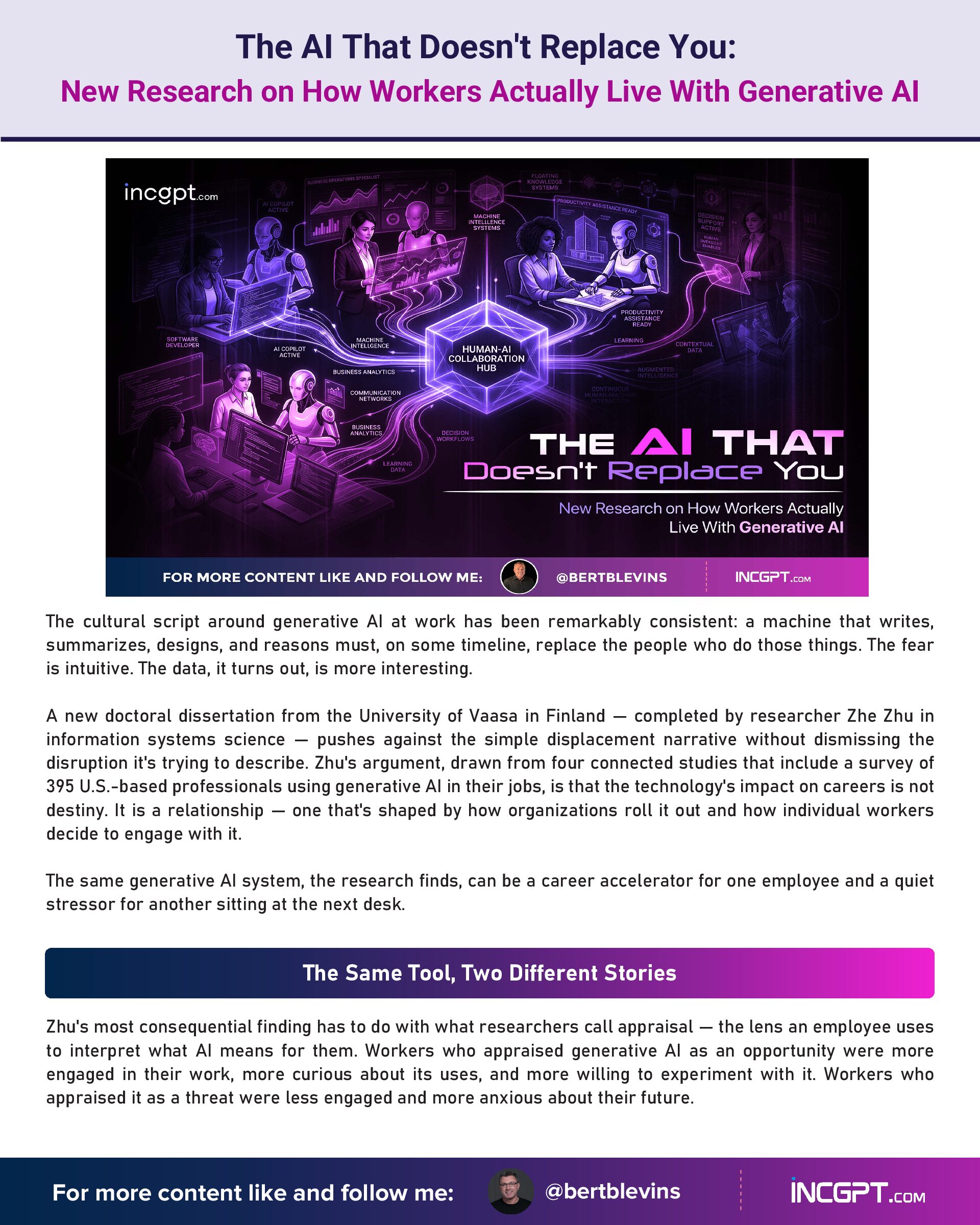
The AI That Doesn't Replace You: New Research on How Workers Actually Live With Generative AI
The cultural script around generative AI at work has been remarkably consistent: a machine that writes, summarizes, designs, and reasons must, on some timeline, replace the people who do those things. The fear is intuitive. The data, it turns out, is more interesting.
A new doctoral dissertation from the University of Vaasa in Finland — completed by researcher Zhe Zhu in information systems science — pushes against the simple displacement narrative without dismissing the disruption it’s trying to describe. Zhu’s argument, drawn from four connected studies that include a survey of 395 U.S.-based professionals using generative AI in their jobs, is that the technology’s impact on careers is not destiny. It is a relationship — one that’s shaped by how organizations roll it out and how individual workers decide to engage with it.
The same generative AI system, the research finds, can be a career accelerator for one employee and a quiet stressor for another sitting at the next desk.
The Same Tool, Two Different Stories
Zhu’s most consequential finding has to do with what researchers call appraisal — the lens an employee uses to interpret what AI means for them. Workers who appraised generative AI as an opportunity were more engaged in their work, more curious about its uses, and more willing to experiment with it. Workers who appraised it as a threat were less engaged and more anxious about their future.
The unexpected piece is what triggers each appraisal. Threat perception was not automatically caused by working with AI. It was caused, primarily, by other stressors in the environment — most notably job insecurity. An employee already worried about their footing read AI as a sign of trouble. An employee who felt supported read the same technology as a source of help. The system was identical. The reaction wasn’t.
Perceived ease of use mattered too. The harder the AI tool felt to use, the more emotionally charged it became, in both directions. Friction amplifies whatever appraisal a worker is already inclined toward.
Trust, but Not Too Much
If there is a single thread running through Zhu’s work, it’s about calibration. Employees need enough trust in AI to use it meaningfully. They need enough skepticism to keep questioning what it produces. Tip too far either way and the relationship breaks.
Too much trust is a familiar failure mode. Generative AI still produces fluent-sounding errors, biased reasoning, and confident nonsense. Employees who defer too readily accept those outputs and bake them into work that downstream colleagues then rely on. Too little trust is the opposite problem — workers who refuse to engage with the technology miss capability gains their peers are quietly capturing.
The healthiest position turns out to be informed collaboration. Treat the AI as a useful junior colleague whose work you sign off on, not as an oracle whose answers you accept on faith.
Why Adaptability Is the Career Asset That Actually Matters
In the part of the dissertation focused on career sustainability, Zhu studied 361 expatriate professionals to test whether AI collaboration changed long-term career outcomes. It did — but indirectly, through what the research calls career adaptability. Four traits make up that adaptability: concern for the future, a sense of control over one’s path, curiosity about options, and confidence in solving problems.
Working with generative AI was linked to gains across all four. Workers who engaged with the technology became more willing to think ahead about their careers, more proactive about shaping them, more curious about alternatives, and more confident in their own problem-solving capacity. Adaptability, in turn, predicted career sustainability.
This is a structural argument worth pausing on. Generative AI isn’t just changing the tasks workers do today. It’s changing the resources workers have for navigating an economy where the next change is already being scheduled. The career advantage doesn’t come from any particular skill. It comes from the disposition to keep developing them.
What Employers Actually Have to Do
Zhu’s findings have direct implications for how organizations roll out AI — and most are still getting it wrong. Buying advanced tools is the easy part. The harder part is aligning the technology with real workflows, building governance and ethical safeguards, explaining the system’s limits honestly, and giving employees room to learn with it rather than feeling evaluated against it.
The dissertation proposes an eight-step framework for that move from experimentation to integration. The specifics matter less than the principle behind them: rollout is a management and design problem, not a procurement one. Organizations that treat it as procurement are the ones whose employees most often read AI as a threat.
“Workers are not simply being replaced by AI, but by those who have learned to use it to work more effectively,” Zhu observes, echoing a line popularized by Nvidia CEO Jensen Huang. The framing reframes the threat. The displacement isn’t AI taking your job. It’s a colleague — at your company or somewhere else — using AI better than you.
The Honest Middle Ground
None of this is a promise that no jobs will be lost. Zhu is direct that some will, and that entire industries will reorganize around AI infrastructure, data centers, and digital services in ways that haven’t fully arrived yet. The dissertation calls this a new industrial revolution and means it.
But the case it builds is that the workers most likely to come out ahead aren’t the ones with the deepest technical skills or the loudest skepticism. They’re the ones who treat generative AI the way every previous generation of professionals treated whatever new technology arrived in their field: as something to be learned critically, used carefully, and integrated into a working life that remains, fundamentally, their own.
Informed collaboration is the durable position. Not blind trust. Not total resistance. The middle ground that requires the most effort — and pays the highest dividend.